Skip to Content Facebook Feature Image

Chinese exporters at Canton Fair pair products with services to win global buyers

China

China

China

Chinese exporters at Canton Fair pair products with services to win global buyers

2026-10-17 17:33 Last Updated At:10-18 13:26

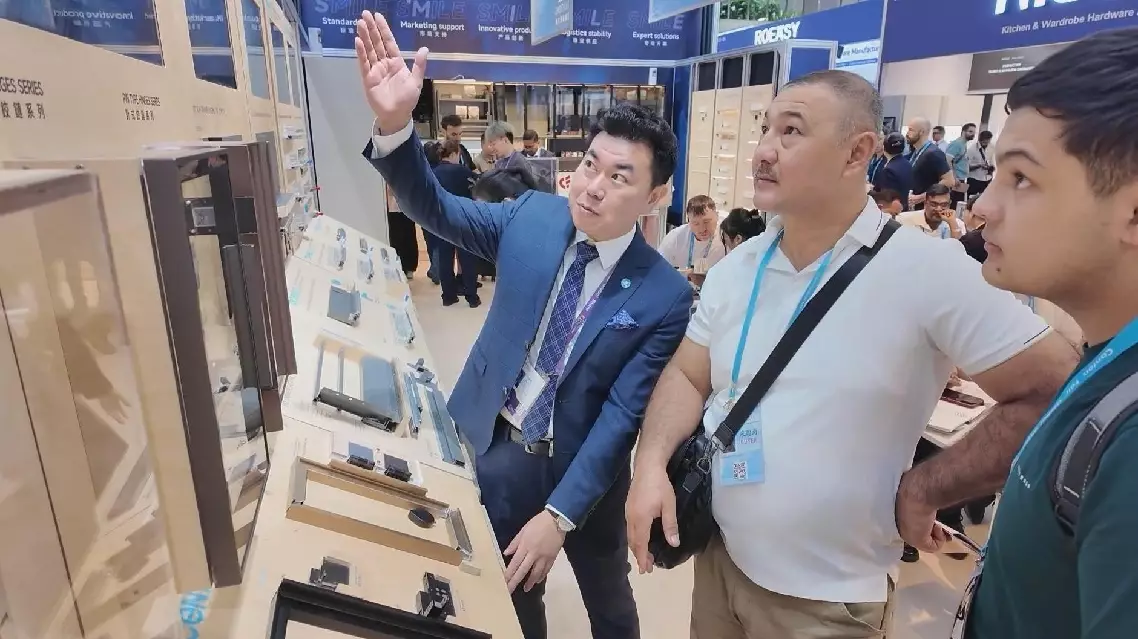
Chinese manufacturers are pairing their products with value-added services at the ongoing 140th Canton Fair in Guangzhou, south China's Guangdong Province, drawing strong interest from global buyers and injecting new vitality into the country's foreign trade.

The fair opened on Thursday with 32,000 companies exhibiting across its three phases, and runs through November 4. This year's edition is presenting the "product-plus-service" model with extraordinary innovation, as manufacturers combine physical goods with services, technical support and lifecycle solutions rather than competing on base price or hardware alone.

In the smart equipment zone, exhibitor He Qing showcased an integrated food processing system that handles front-end deep-processing tasks such as washing and cutting ingredients. Fusing equipment manufacturing with services from food preparation to delivery, the machine won immediate favor with overseas buyers upon its debut.

"Our machine effectively drives the catering industry within the tertiary sector. Once service providers adopt this technology, their production efficiency doubles while labor costs drop significantly. The equipment primarily targets Europe, Russia, and the United States, and we have already received intent orders worth around 5 million U.S. dollars," said He.

Across the fairgrounds, many exhibitors are following suit, building on their manufacturing foundations to capture global market opportunities and attracting buyers from around the world to try out their offerings and negotiate deals.

Exhibitor Zheng Bikui noted a strategic shift in their export approach, moving from standalone parts to complete systems.

"In the past, the components we sold accounted for just 3 percent to 5 percent of a product's overall value. By innovating and reorganizing these components, we now export integrated modules that account for 30 percent to 50 percent of the product's overall value," said Zheng.

As policy frameworks continue to improve from the central to the local levels, Chinese foreign trade enterprises are accelerating the rollout of the "product-plus-service" integration model, while the steady upgrading of the country's advanced manufacturing sector continues to power export growth.

According to the General Administration of Customs, China's exports of independent brands grew by 27 percent in the first three quarters of the year, accounting for 25 percent of total exports, an increase of 2 percentage points from the same period last year.
Chinese exporters at Canton Fair pair products with services to win global buyers

Chinese exporters at Canton Fair pair products with services to win global buyers
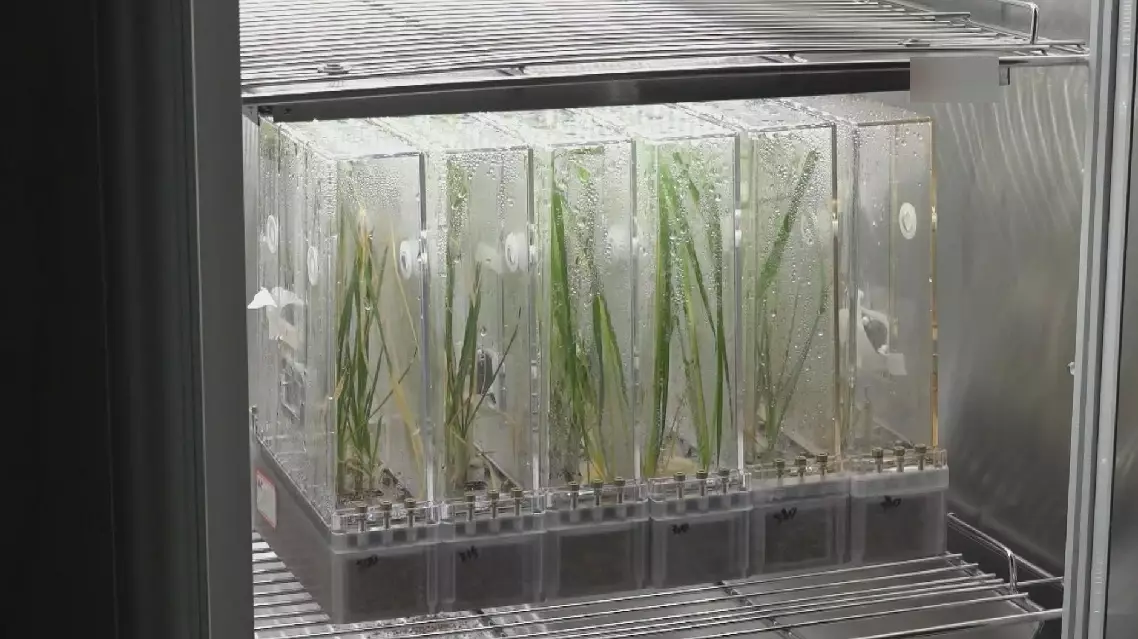
China's first-ever multi-generational space rice research has taken a new step toward humans' ability to fully grow food in orbit, with the Shenzhou-23 crew completing another round of sample collection, sowing, and storage aboard the Tiangong space station.

The research project aims to study the molecular mechanisms behind rice's multi-generational genetic stability and environmental adaptability in microgravity. Over the past week, the three astronauts collected a new batch of samples, which will be returned to Earth for scientists to analyze at the phenotypic and molecular levels, helping reveal how long-term microgravity affects rice genetic stability.

China's space rice research began in 2022, when the Shenzhou-14 crew conducted the world's first full life-cycle rice cultivation experiment in space. During that mission, six rice seeds were grown aboard Tiangong for 120 days, producing 59 first-generation space-grown seeds that the crew returned to Earth.

On May 24 this year, the Shenzhou-23 spacecraft carried a new batch of rice seeds into orbit. The seeds fall into two groups: ordinary seeds that have never left Earth, and third-generation descendants bred on the ground from the 59 space-grown seeds harvested in 2022. Both are Chinese japonica varieties known for their adaptability and three- to four-month growing cycle.

After more than four months in orbit, the Shenzhou-23 crew has reached the first harvest and begun second-generation cultivation using two propagation methods. The aim is to compare how space-flown and Earth-grown rice adapt to space, and to explore how different propagation methods affect second-generation space rice.

The second-generation space rice is expected to mature during the Shenzhou-24 mission, scheduled for later this year.

While the 2022 experiment covered a full life cycle "from ground seed to space seed," this year's research advances to "from ground seed to space seed to space seed" -- a repeating cycle that researchers hope could provide important theoretical support for in-situ crop production beyond Earth -- the ability to grow food in space without relying on resupply from Earth. Such a capability is considered essential for humanity's future exploration of deep space.

China's multi-generational space rice research advances toward growing food in orbit

China's multi-generational space rice research advances toward growing food in orbit

Recommended Articles