The pair of new Chinese giant pandas, Ping Ping and Fu Shuang, who made their public debut on Friday, are adapting quite well to their new environment at Zoo Atlanta in Georgia, United States, according to a Chinese giant panda expert.
Before meeting the public, the panda pair spent more than a month in quarantine, adjusting to the new bamboo, new caretakers and new environment. They arrived in the southern U.S. city on a chartered flight on Sept. 27, marking the return of Chinese giant pandas after nearly two years. The last pair of giant pandas and their offspring returned to China from Zoo Atlanta in October 2024.
Chen Xin, a Chinese expert on giant pandas, said now the two beloved bears can understand some of the gestures by the U.S. keepers.
"When we keepers conduct training sessions in China, we primarily use Chinese, though we sometimes incorporate English. The trainings include verbal commands and physical cues. Now, the pandas can also understand some of the moves by the U.S. keepers," said Chen.
While getting to know his new home, Ping Ping made a choice that amused his caretakers.
"When Ping Ping first entered the renovated enclosure at the Atlanta Zoo, he immediately headed straight for the cave where Yang Yang used to love to hang out. It's fascinating to see how animals choose their spots," said Chen.
Yang Yang is a male giant panda that lived at the Atlanta Zoo from 1999 to 2024.
When Ping Ping and Fu Shuang arrived in their new environment, the two giant pandas were still a bit insecure while eating and would occasionally look around. Now, they have gradually adapted to their new habitat.
"At first, they might have been a little hesitant to eat, observing their surroundings. But today, we see that as soon as the two pandas entered the outdoor enclosure, they immediately seemed to settle into their territory and started eating their favorite food apples right away. They seemed very comfortable and relaxed. They've now become familiar with the facilities and equipment and will soon be able to go to some of them to drink water and eat," said Chen.
The two pandas are expected to stay at the zoo for 10 years.

Chinese pandas adapt well to new Zoo Atlanta home
Power shortages continue to plague residents in Syria's northeastern province of Hasakah, where even the most ordinary electric light has become an unaffordable cost.
After more than a decade of war, many power plants, substations, as well as transmission and distribution facilities in Syria have been damaged, while aging equipment and insufficient fuel supplies have continued to hamper the recovery of the electricity system.
Since the beginning of 2026, power supply across Syria has improved somewhat, but recovery has been uneven across regions.
In Hasakah, the public grid has long failed to supply electricity normally, so many residents chose to rely on private generators. But with the rising of diesel prices, the cost of private electricity generation has also climbed.
"We used to rely on a generator, and it cost us only 3 U.S. dollars a month. It was still within our means. Now it's gone up to 45 U.S. dollars, and we simply can't afford it. As for the electricity supplied by the government, we haven't had any for three whole years. The power company recently repaired part of the grid, but the transformer here was stolen, so we're still completely without power," said local resident Sumaya.
Data released by Syria's energy sector in September showed that nationwide power generation had risen from about 915 megawatts to around 3,500 megawatts, but Hasakah Province currently receives only about 50 megawatts, far below the demand of roughly 500 megawatts.
Some better-off families in Hasakah have installed solar power systems, which cost about 800 U.S. dollars to 1,000 U.S. dollars per unit. But such a price remains out of reach for Sumaya's family, as nearly all of their meager savings have been used for her husband's medical treatment.
"My sister and I both dropped out of school. Now we work from 06:00 to 18:00 every day. When we get home, there's no electricity, so we have only this small flashlight for light. This has been our life since the power went out completely. The darkness of the long nights has become part of our lives. I have two wishes: first, my father recovers after his surgery. And second, our home can have electricity, so that every room can at least be lit for a while at night," Aya, a member of Sumaya's family.
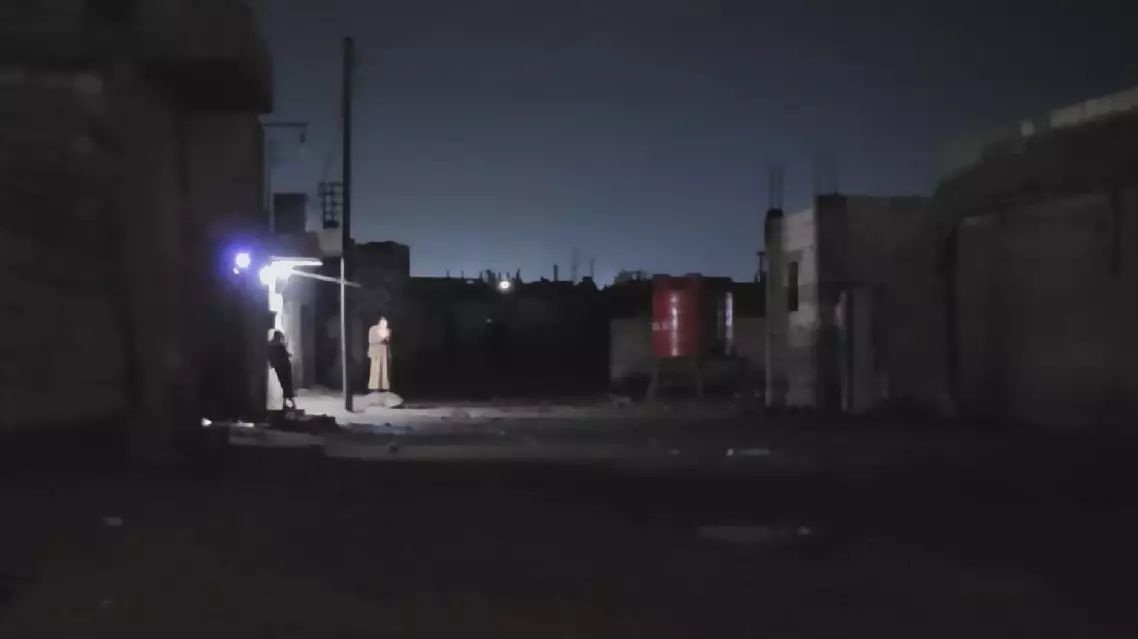
Power shortages continue to plague Syria's Hasakah Province