Rain and snow since Saturday have led to expressway closures and restrictions in northern and northwestern China, and transport authorities have launched emergency responses and cleared roads to keep traffic moving.
It began snowing in the mountainous areas of northern Beijing early on Saturday. In the afternoon, persistent rain fell in districts including Chaoyang, Daxing and Tongzhou. In the evening, snow also fell in Yanqing, Mentougou and Huairou districts.
In response, transport authorities launched an emergency response, clearing ice and snow from highways, monitoring and coordinating road conditions, ensuring bus capacity and controlling road safety to ensure the public's travel safety.
"This time we have equipped a total of more than 340 pieces of machinery and equipment, including snowplows, spreader trucks and manual snow throwers. We have divided the work area into ten grids, so that once the command center gives the order, all personnel, vehicles and equipment can go into operation immediately," said Yang Linna, head of the command and dispatch department of the Mentougou District sanitation center.
"Around the core snowfall areas in the western and northern mountains, we pre-stationed emergency support forces at 161 key locations, achieving full coverage without blind spots across high-risk road sections. Meanwhile, reserve train set units and buses have been placed on standby, with service frequency increased on routes leading to suburbs, scenic sites, commercial hubs, and transport hubs," said Zhou Yongjie, head of the safety supervision and emergency management division at the Beijing Municipal Transport Commission.
Cold air brought a wave of snow, rain, and falling temperatures to Tianjin in north China, with heavy snowfall hitting northern districts. The meteorological observatory in Jizhou District upgraded its blizzard warning from blue to yellow early on Sunday, while Baodi District issued a blue blizzard warning. Expressways passing through Tianjin were also affected to varying degrees.
Traffic control authorities reminded drivers to exercise caution, as roads can freeze quickly.
Starting Saturday afternoon, widespread snow and rain hit cities of Datong, Shuozhou, Xinzhou, and Yangquan in north China's Shanxi Province, causing snow accumulation and road icing on expressways and increasing travel risks. Traffic police intensified patrols and imposed temporary traffic controls on affected sections, while highway maintenance crews began spreading salt to help clear snow.
Police advised drivers to check road conditions before traveling, slow down, and maintain safe following distances.
Snowfall also began Saturday evening in Jiayuguan, Zhangye, Jinchang, and Wuwei in northwest China's Gansu Province.
On the Yongchang section of the Lianyungang-Horgos Expressway, continued snowfall has reduced visibility and affected safe passage for vehicles. Local expressway traffic police quickly activated an emergency plan for severe weather, patrolling nonstop and using police cars to set the pace and escort vehicles through safely.
In Jiayuguan, road maintenance crews used snowplows in staggered formations to clear continuously while spreading snow-melting agents. Meteorological authorities in Gansu forecast that this round of snowfall will continue through Sunday night.
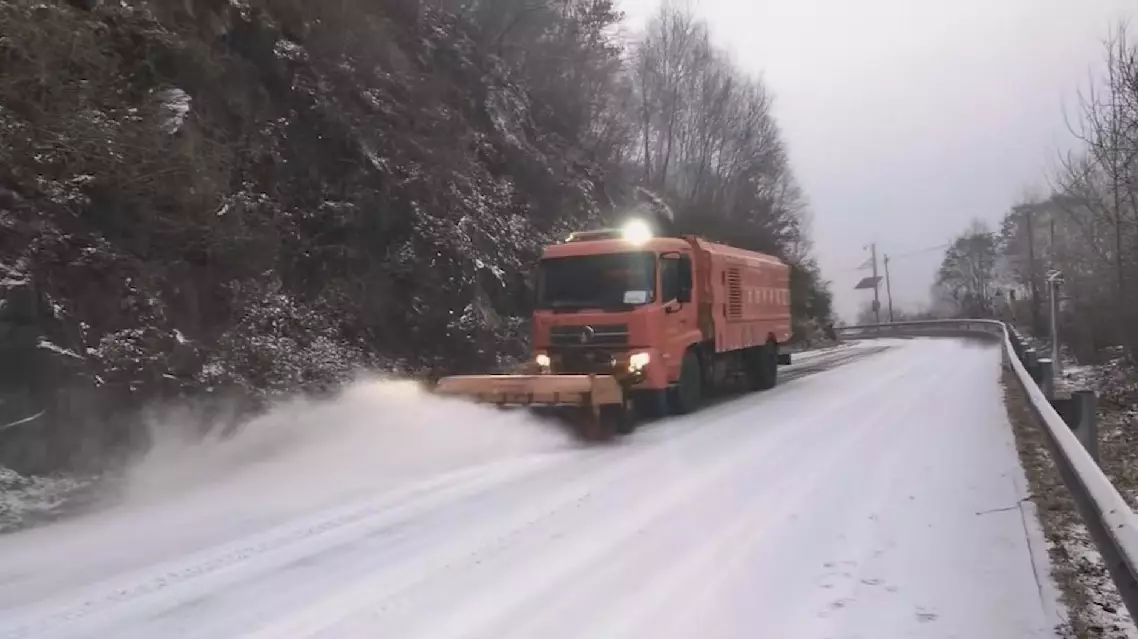
Snow, rain trigger road emergency responses in northern, northwestern China