Skip to Content Facebook Feature Image

Trailblazing film producers Christine Vachon and Pamela Koffler make Governors Awards history

ENT

Trailblazing film producers Christine Vachon and Pamela Koffler make Governors Awards history
ENT

ENT

Trailblazing film producers Christine Vachon and Pamela Koffler make Governors Awards history

2026-11-14 21:02 Last Updated At:21:11

Killer Films co-founders Christine Vachon and Pamela Koffler are making history Sunday at the Governors Awards. The two women, who have spent their careers bringing bold, independent cinema into the world — from “Boys Don’t Cry” to “Safe” — are being honored with the Irving G. Thalberg Memorial Award.

That honorary Oscar has been given to some of the biggest names in Hollywood, from Walt Disney to Steven Spielberg. But Vachon and Koffler are the first female producing team and the first independent producers to receive it.

More Images
Pamela Koffler, left, and Christine Vachon pose for a portrait on Monday, Nov. 9, 2026, in New York. (Photo by Matt Licari/Invision/AP)

Pamela Koffler, left, and Christine Vachon pose for a portrait on Monday, Nov. 9, 2026, in New York. (Photo by Matt Licari/Invision/AP)

Pamela Koffler, left, and Christine Vachon pose for a portrait on Monday, Nov. 9, 2026, in New York. (Photo by Matt Licari/Invision/AP)

Pamela Koffler, left, and Christine Vachon pose for a portrait on Monday, Nov. 9, 2026, in New York. (Photo by Matt Licari/Invision/AP)

Pamela Koffler, left, and Christine Vachon pose for a portrait on Monday, Nov. 9, 2026, in New York. (Photo by Matt Licari/Invision/AP)

Pamela Koffler, left, and Christine Vachon pose for a portrait on Monday, Nov. 9, 2026, in New York. (Photo by Matt Licari/Invision/AP)

Pamela Koffler, left, and Christine Vachon pose for a portrait on Monday, Nov. 9, 2026, in New York. (Photo by Matt Licari/Invision/AP)

Pamela Koffler, left, and Christine Vachon pose for a portrait on Monday, Nov. 9, 2026, in New York. (Photo by Matt Licari/Invision/AP)

Pamela Koffler, left, and Christine Vachon pose for a portrait on Monday, Nov. 9, 2026, in New York. (Photo by Matt Licari/Invision/AP)

Pamela Koffler, left, and Christine Vachon pose for a portrait on Monday, Nov. 9, 2026, in New York. (Photo by Matt Licari/Invision/AP)

“It really feels so bound up in our longevity in New York City and in the independent film community in New York,” Koffler said in an interview with The Associated Press. “We do all know each other and, over the years, those of us who are still doing it really feel like an extended community that has supported each other, because opportunities are a little bit fewer, the movies are a little bit tougher, and it really feels like an acknowledgment of this space that we’re the ones who are being honored.”

Vachon chimed in: “A producer said to me … ‘I know it’s not my award, but it feels like it does belong to all of us.’”

It was a vibrant moment in independent cinema in New York when Vachon met Koffler in the early 1990s.

Vachon had already made a name for herself with her own films, and as the producer of Todd Haynes’ first feature “Poison” — someone who, despite all odds, was getting quality queer-themed films made. Koffler was bouncing around on indie film sets doing dozens of different jobs when Vachon asked if she wanted to supervise postproduction on “Postcards From America.” Koffler didn’t know what that entailed, but it hardly mattered: It was a great time to just dive in and figure things out.

“We met at the right time where it was like we could take these risks,” Vachon said. “We had some luck, because a lot of it is luck. But we also had really good taste.”

It was also the beginning of a beautiful partnership: In the past 30 years, Koffler and Vachon have produced over 100 films, and some television too, with their company Killer Films: “Hedwig and the Angry Inch,” “One Hour Photo,” “Velvet Goldmine,” “Far from Heaven,” “I’m Not There,” “Carol” and “Past Lives,” for which they received their first best picture nomination. It is a body of work that speaks for itself, with provocative and imaginative art house films, landmarks of New Queer Cinema and many, many cult classics finding second lives and fandoms.

“We were so inventing a wheel in a way that we didn’t even really know how crazy and ambitious it was to do it,” Koffler said.

They didn’t set out to make an “all-female company,” Vachon said, but they were grateful to be their own bosses. Indie film in New York in the 1990s was very male, not to mention the time of Miramax and Harvey Weinstein. And it was the kind of environment where Vachon, instead of telling New Line that she couldn’t come to a Todd Solondz set one day because her 1-year-old was very sick, said that she had to tend to another movie that was falling apart.

With Koffler, however, Vachon didn’t have to lie about family responsibilities. When Koffler was in the same boat with a newborn and stressing about missing an early screening of “One Hour Photo,” Vachon said, gently, “Just bring the baby.”

“It was a hundred percent our company,” Vachon said. “Our company, our rules.”

Koffler and Vachon have loved seeing some of their films get rediscovered over the years, especially the ones that weren’t greeted with much fanfare when they came out. Recently they have noticed people talking about Mary Harron’s Valerie Solanas film “I Shot Andy Warhol” and Tim Blake Nelson’s war drama “The Grey Zone.”

“It’s fun, but it’s also not why we do it,” Vachon said. “Because if it was why we did it, we’d be really dumb because it doesn’t happen that often.”

Even “Hedwig and the Angry Inch,” Vachon said, is “so iconic now, but people forget it didn’t make any money.”

“Hedwig,” she pointed out, is part of Mike De Luca’s filmmaking legacy. De Luca, who has recently been in the headlines for his work and recent departure from Warner Bros. under their new ownership, “really pushed to make it happen and make it happen on our terms,” Vachon said. “We really got to make the movie that John Cameron Mitchell wanted to make.”

They have been in the industry long enough to have seen sky-is-falling crises come and go every few years, but they are “eternal optimists,” Koffler said.

“We still get great material. We are managing to get things made,” Koffler, 60, said. “Would we like the budgets to be bigger? Yeah.”

Vachon, 63, chimed in: “Would you like our fees to be bigger? Yeah, I mean, we’d like to retire eventually.”

Sometimes they amuse one another by quoting lines from their projects, like “He’s got me all tied up with that greasy contract” (from “I Shot Andy Warhol”). But in this case, “You gotta live on what you earn, Mildred” (from “Mildred Pierce”) seems most apt.

And they are still hard at work, excited by new scripts and filmmakers and challenges. They have a new Haynes movie coming up, the romantic drama “De Noche” starring Pedro Pascal and Danny Ramirez that they rescued from ruin after Joaquin Phoenix abruptly dropped out days before filming was set to start. And there are always other projects in the works.

In fact, when the film academy's president Lynette Howell Taylor, also a producer, was trying to get Vachon and Koffler on the phone to tell them about the Thalberg Award, they assumed that she was calling with her producer's cap on to tell them that one of their movies was falling apart. (It later did.)

“The thing is it’s so hard to get these movies made and we’re lucky we’ve done it over a hundred times,” Vachon said. “I always do make this joke that every time I show up, I’m like, ‘Oh right, I forgot, I hate this.’ But, that said, there is something, there is this sort of magic of it all coming together that never really gets old. I mean, I think if it did, we would have stopped a long time ago.”
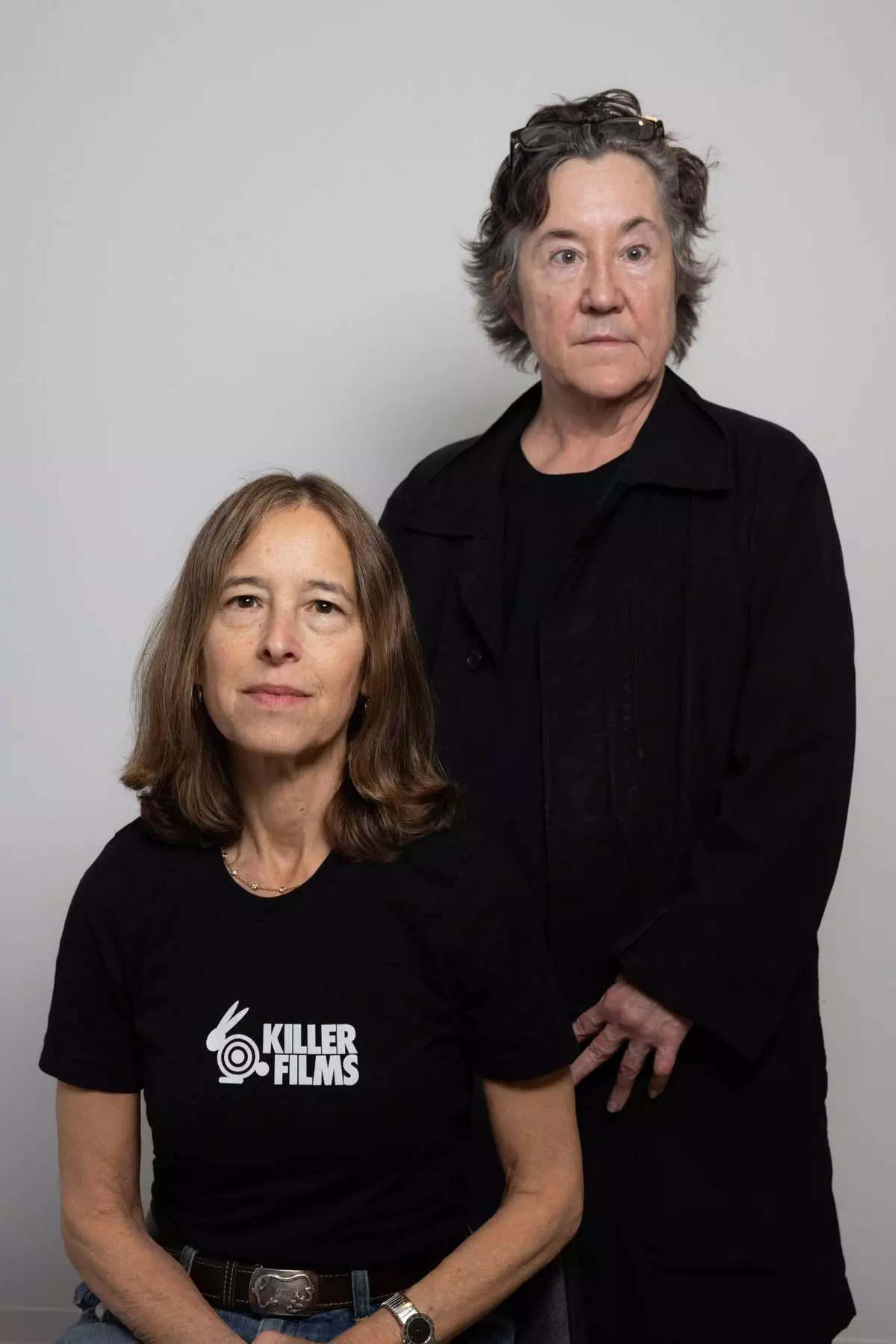
Pamela Koffler, left, and Christine Vachon pose for a portrait on Monday, Nov. 9, 2026, in New York. (Photo by Matt Licari/Invision/AP)
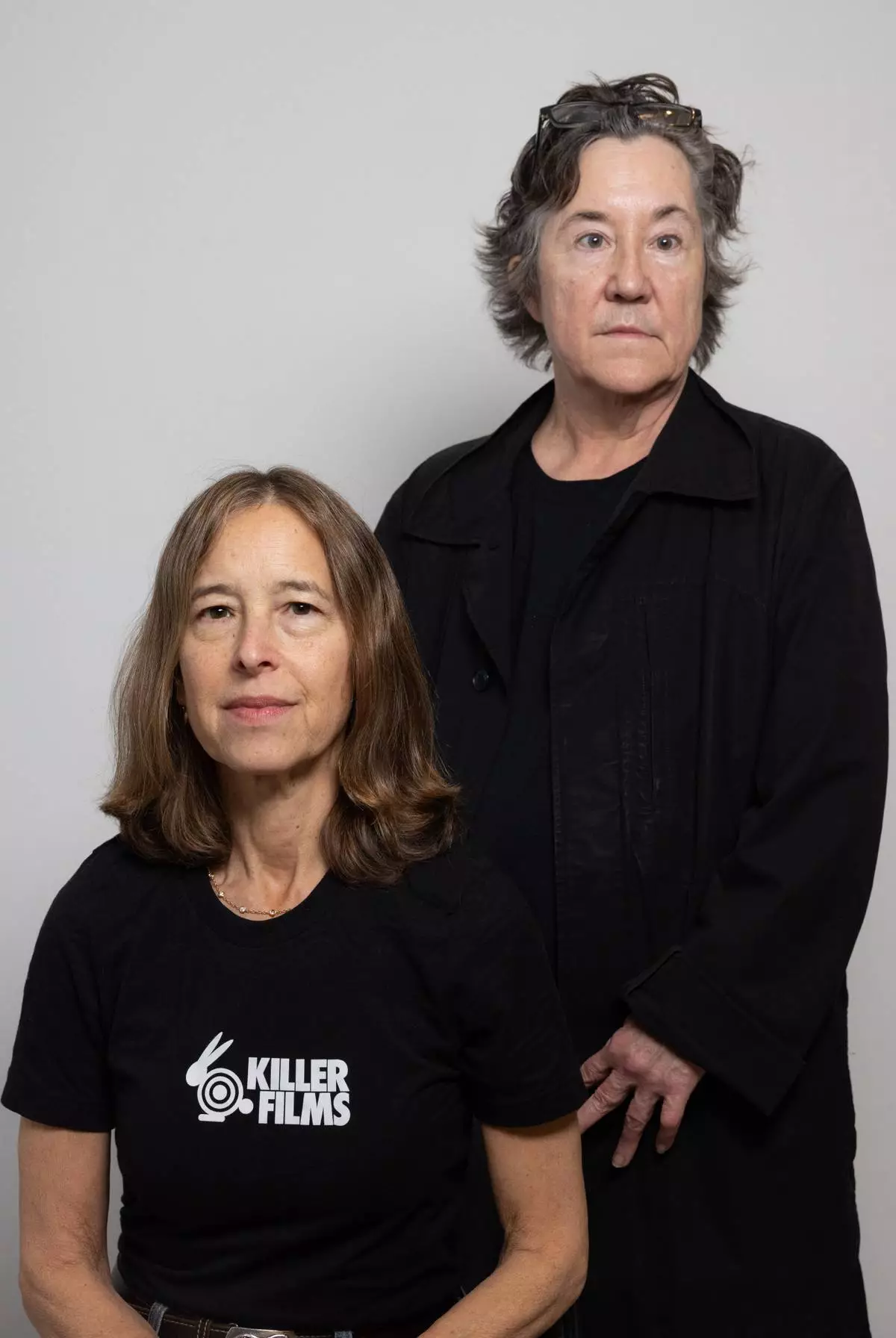
Pamela Koffler, left, and Christine Vachon pose for a portrait on Monday, Nov. 9, 2026, in New York. (Photo by Matt Licari/Invision/AP)

Pamela Koffler, left, and Christine Vachon pose for a portrait on Monday, Nov. 9, 2026, in New York. (Photo by Matt Licari/Invision/AP)

Pamela Koffler, left, and Christine Vachon pose for a portrait on Monday, Nov. 9, 2026, in New York. (Photo by Matt Licari/Invision/AP)

Pamela Koffler, left, and Christine Vachon pose for a portrait on Monday, Nov. 9, 2026, in New York. (Photo by Matt Licari/Invision/AP)

Pamela Koffler, left, and Christine Vachon pose for a portrait on Monday, Nov. 9, 2026, in New York. (Photo by Matt Licari/Invision/AP)
Pamela Koffler, left, and Christine Vachon pose for a portrait on Monday, Nov. 9, 2026, in New York. (Photo by Matt Licari/Invision/AP)
Pamela Koffler, left, and Christine Vachon pose for a portrait on Monday, Nov. 9, 2026, in New York. (Photo by Matt Licari/Invision/AP)
Pamela Koffler, left, and Christine Vachon pose for a portrait on Monday, Nov. 9, 2026, in New York. (Photo by Matt Licari/Invision/AP)
Pamela Koffler, left, and Christine Vachon pose for a portrait on Monday, Nov. 9, 2026, in New York. (Photo by Matt Licari/Invision/AP)
CAPE CANAVERAL, Fla. (AP) — NASA’s Voyager 1 is about to become humanity’s first object to reach one light-day from Earth as it pushes ever deeper into interstellar space.

That’s a mind-blowing distance of more than 16 billion miles (26 billion kilometers) for the spacecraft launched 49 years ago.

When Voyager 1 reaches that remarkable milestone on Wednesday, its radio signals will take precisely 24 hours traveling at the speed of light to reach Earth — in other words, one light-day. NASA is looking at another 18,000 years before the spacecraft achieves a full light-year and more than double that before it comes near another star.

Project manager Suzanne Dodd sees Voyager 1 as Earth's ambassador hurtling between stars while providing a “sense of wonder” on the home front.

“It's a national treasure,” she told The Associated Press. “Really extraordinary.”

To celebrate this moment, NASA is urging people from all corners to grab their phone or a flashlight to create a wave of golden light after sunset Tuesday, using Morse code to spell the letters V-G-R, Voyager's call sign, into the night sky.

Despite sporadic problems typical of old age, Voyager 1 and its twin Voyager 2 continue to send back science and engineering data as they zoom toward different points in space at 38,000 mph (61,000 kph). Although launched two weeks before its sibling in 1977, Voyager 2 won't reach the one light-day mark until 2035.

Voyager 1 swept past Jupiter and Saturn to scientists' delight in 1979 and 1980, respectively, before exiting the solar system. It reached what NASA defines as interstellar space — the expansive region between star systems — in 2012. Voyager 2 visited those two planets plus Uranus and Neptune, also sending back stunning photos, before entering interstellar space in 2018.

Almost every day, the Voyagers beam back details about their never-before-explored environment: the strength and direction of the magnetic field as well as tidbits about the surrounding pressure, dust and galactic cosmic rays. They're a bit like weather satellites, according to Dodd, who's worked with the Voyagers since 1984.

The skeleton flight control team at NASA's Jet Propulsion Laboratory in Pasadena, California, sends commands about once a week. The operation ramps up when spacecraft problems arise, with help sometimes coming from a couple of retirees who once worked on the project.

In September, controllers completed the latest power-conserving effort for the plutonium-powered spacecraft, then in October briefly lost contact with it. They're still trying to figure out why communication was disrupted.

All this expertise and love have kept Voyager 1 chugging along like “the little engine that could,” according to Dodd, while racking up entries in Guinness World Records. Besides venturing farther than any other human-made object, Voyager 1 in 1990 snapped the most distant picture of Earth: the iconic “Pale Blue Dot” as seen from beyond Neptune.

“On that blue dot, that's where everyone you know and everyone you ever heard of and every human being who ever lived, lived out their lives. It's a very small stage in a great cosmic arena,” Cornell University astronomer Carl Sagan, part of the imaging team, said as he introduced the picture to the world in 1990.

While the majority of people alive today were not yet born when the Voyagers launched, “all of us — everyone on Earth — have been touched by these missions,” the Planetary Society's Bill Nye said in a statement. The society was co-founded in 1980 by Sagan, who died in 1996.

The Golden Record also resulted from Sagan's effort.

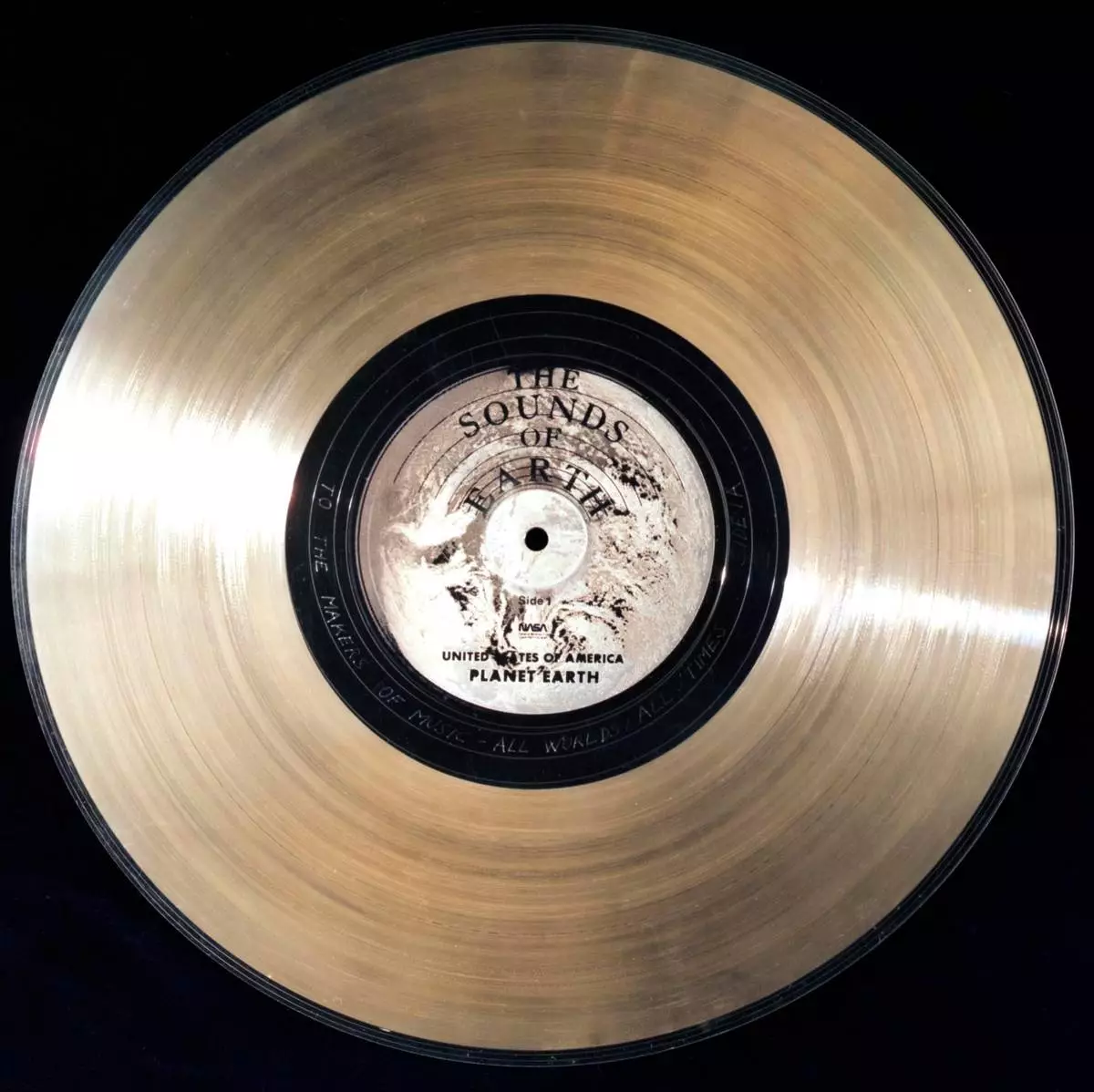
Each Voyager carries a 12-inch (30-centimeter) gold-plated phonographic record containing greetings in 55 languages as well as images and diagrams. Sagan included the voice of his son Nick, then 6: “Hello from the children on Planet Earth.” He added a stylus and instructions for any finders-keepers out there.

“It’s a time capsule of life on Earth from 1977,” Dodd said. “I hope something, someone, finds it maybe 1,000 years from now.”

The Associated Press’ health and science coverage receives financial support from the AP Fund for Journalism and private foundations. AP is solely responsible for all content. Find AP’s standards for working with philanthropies, a list of supporters and funded coverage areas at AP.org.

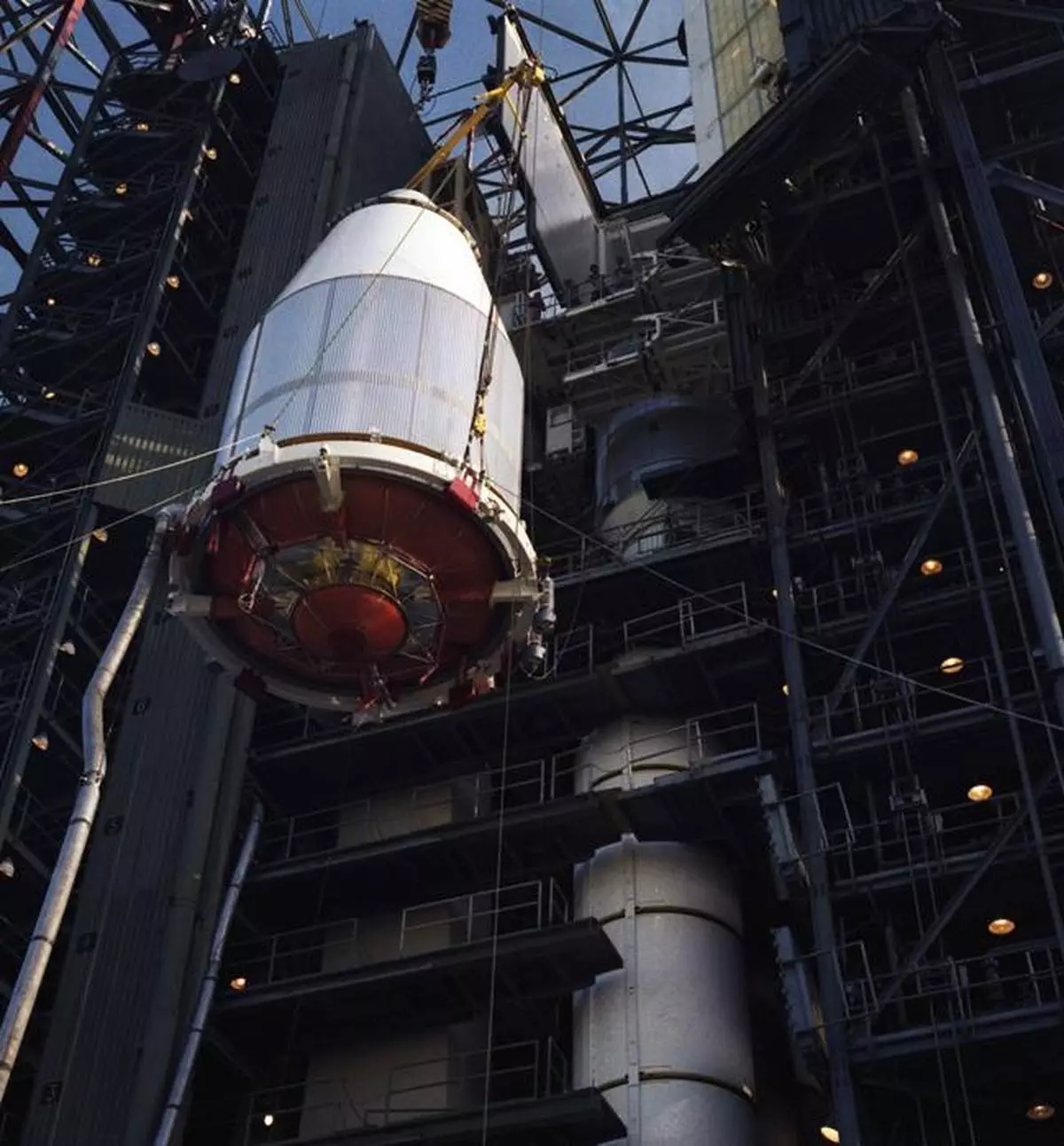
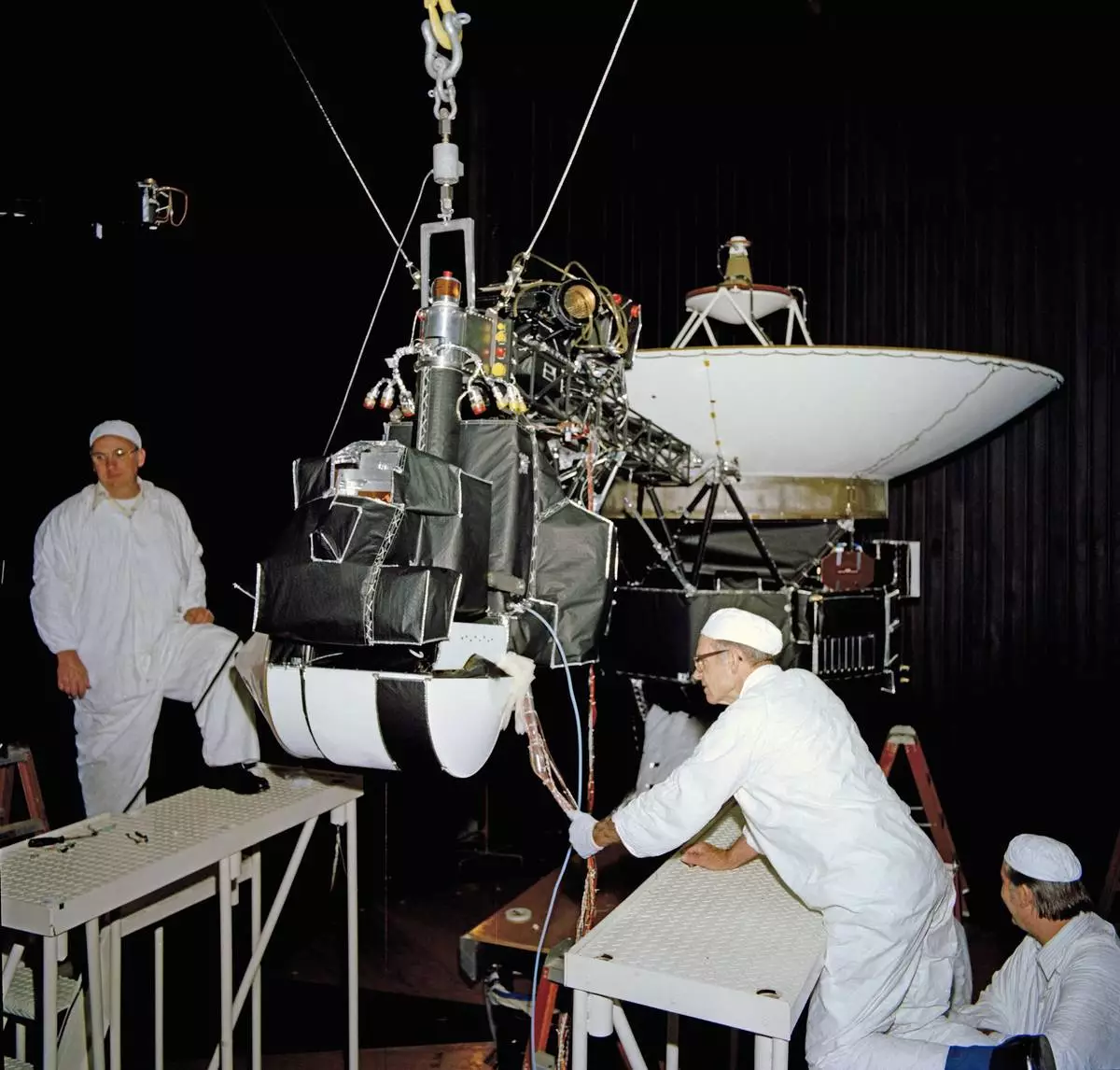
In this image provided by NASA/JPL-Caltech/KSC, The Voyager 2 spacecraft, encapsulated within its payload fairing, is seen in August 1977, as it was being hoisted upward for attachment to its launch vehicle at NASA's Kennedy Space Center in Cape Canaveral, Florida. (NASA/JPL-Caltech/KSC via AP)

In this image provided by NASA/JPL-Caltech/KSC, The Voyager 2 spacecraft, encapsulated within its payload fairing, is seen in August 1977, as it was being hoisted upward for attachment to its launch vehicle at NASA's Kennedy Space Center in Cape Canaveral, Florida. (NASA/JPL-Caltech/KSC via AP)

This undated handout image provided by NASA shows the Voyager Golden Record Album. (NASA/JPL-Caltech via AP)

This undated handout image provided by NASA shows the Voyager Golden Record Album. (NASA/JPL-Caltech via AP)

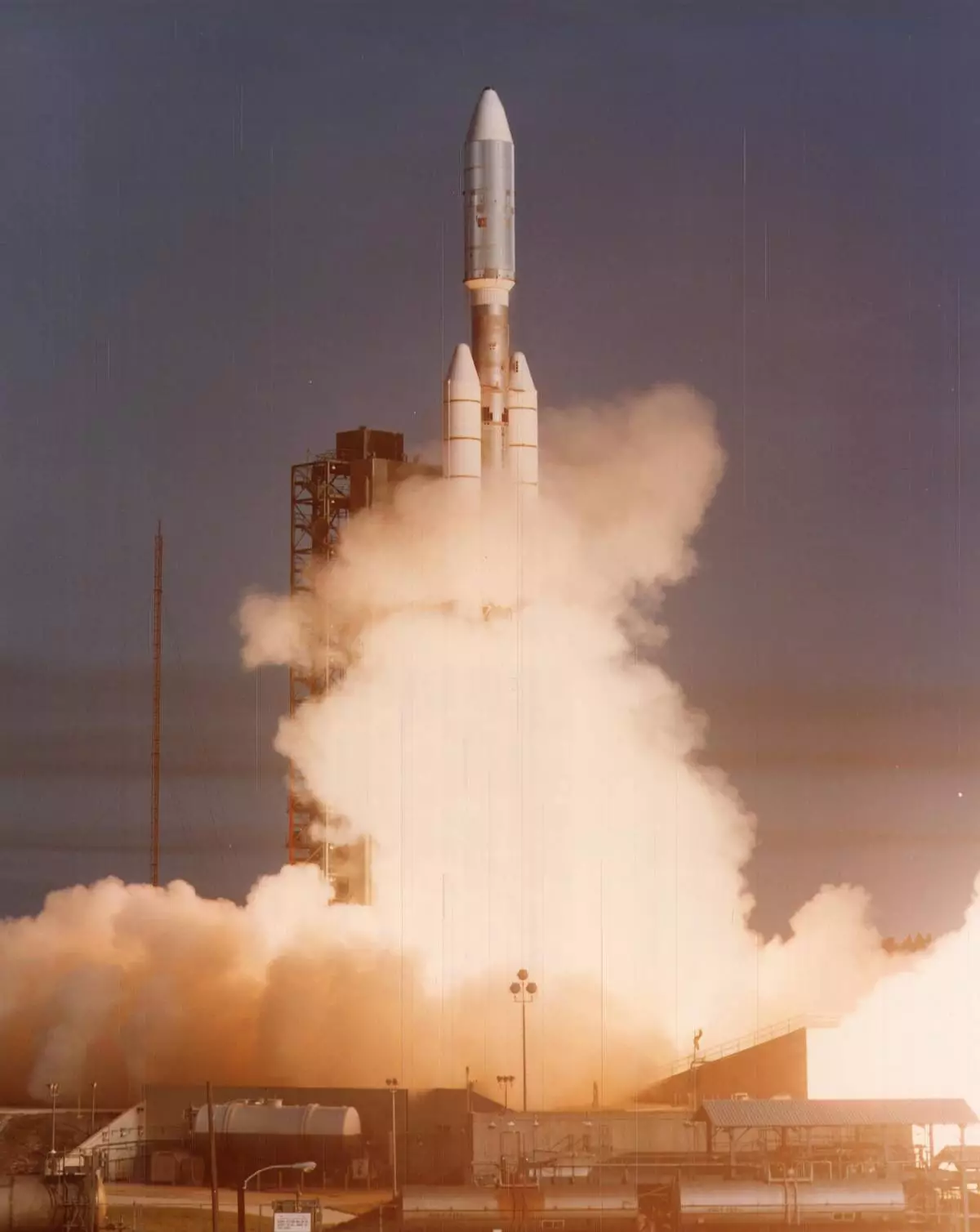
In this image provided by NASA/JPL-Caltech, NASA's Voyager 1 spacecraft launched atop its Titan/Centaur-6 launch vehicle from the Kennedy Space Center Launch Complex, Merritt Island, Florida on Sept. 5, 1977, at 8:56 a.m. local time. (NASA/JPL-Caltech via AP)

In this image provided by NASA/JPL-Caltech, NASA's Voyager 1 spacecraft launched atop its Titan/Centaur-6 launch vehicle from the Kennedy Space Center Launch Complex, Merritt Island, Florida on Sept. 5, 1977, at 8:56 a.m. local time. (NASA/JPL-Caltech via AP)

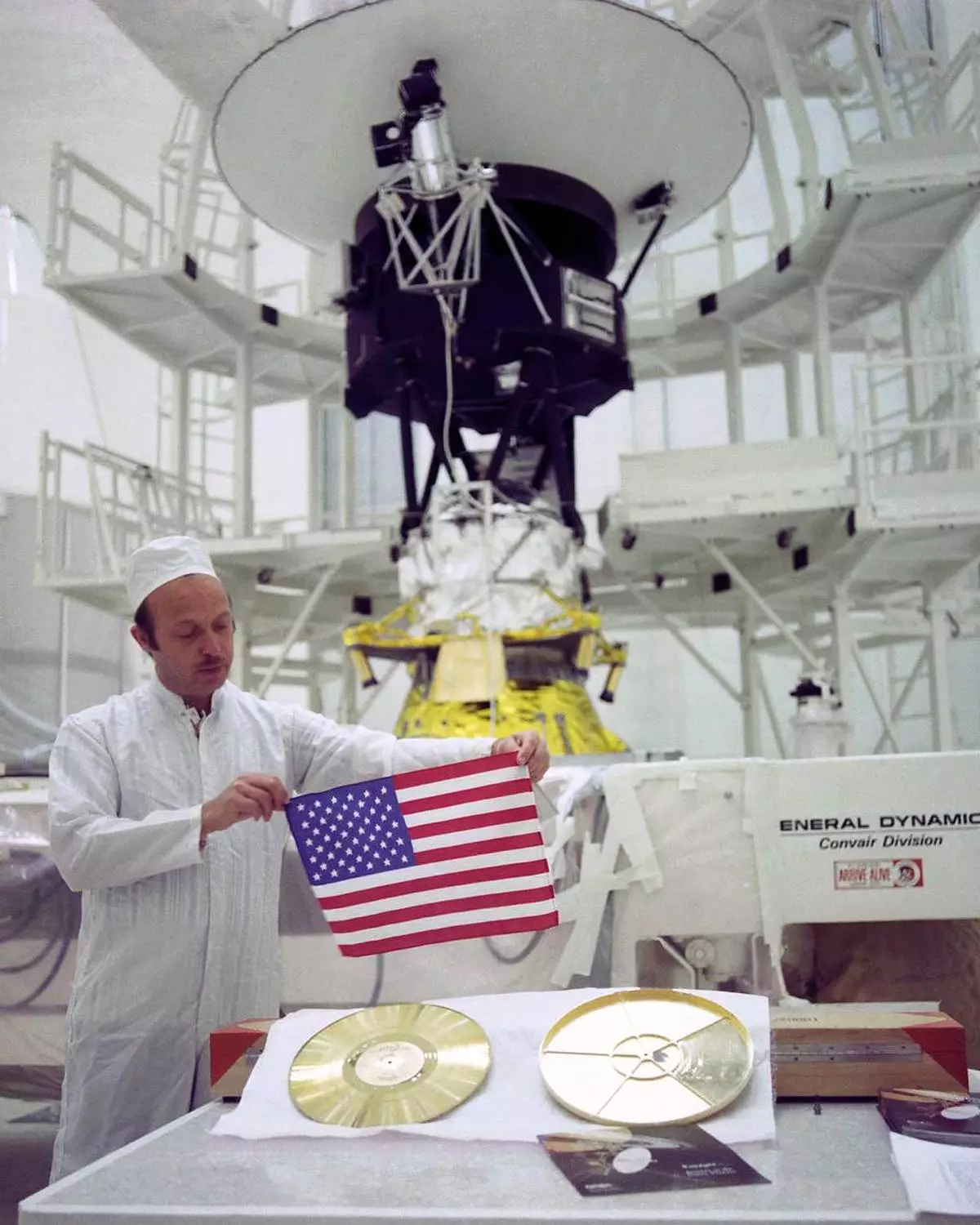
This image provided byNASA/JPL-Caltech shows as John Casani, Voyager project manager in 1977, holding a small Dacron flag that was folded and sewed into the thermal blankets of the Voyager spacecraft before they launched, below him lie the Golden Record, left, and its cover, right, in the background stands Voyager 2 before it headed to the launch pad, Cape Canaveral, Fla., Aug. 4, 1977. (NASA/JPL-Caltech via AP)

This image provided byNASA/JPL-Caltech shows as John Casani, Voyager project manager in 1977, holding a small Dacron flag that was folded and sewed into the thermal blankets of the Voyager spacecraft before they launched, below him lie the Golden Record, left, and its cover, right, in the background stands Voyager 2 before it headed to the launch pad, Cape Canaveral, Fla., Aug. 4, 1977. (NASA/JPL-Caltech via AP)

This image, provided by NASA/JPL-Caltech and taken on April 27, 1977, shows one of the Voyagers in the 25-Foot Space Simulator thermal vacuum chamber at NASA's Jet Propulsion Laboratory in Southern California. (NASA/JPL-Caltech via AP)

This image, provided by NASA/JPL-Caltech and taken on April 27, 1977, shows one of the Voyagers in the 25-Foot Space Simulator thermal vacuum chamber at NASA's Jet Propulsion Laboratory in Southern California. (NASA/JPL-Caltech via AP)

Recommended Articles