China's Shenzhou-23 astronaut crew has brought biological samples back inside the Tiangong space station after five months of exposure to the space environment, giving researchers material to study how radiation affects living organisms.
The samples - nanozymes, actinomycetes and plant seeds - were placed outside the station in a space radiation biology experiment device. They faced high-energy particle radiation, intense ultraviolet light, ultra-high vacuum and sharp temperature swings between the station's sunlit and shaded sides.
The crew retrieved and stored the samples and handled the experiment equipment. The specimens are set to return to Earth aboard Shenzhou-23 for analysis.
Experiments outside the station allow researchers to observe conditions that ground laboratories cannot fully reproduce. While labs can simulate ultraviolet light and vacuum, they cannot perfectly recreate the combined effects of atomic oxygen erosion, micrometeoroid impacts and extreme temperature changes.
The Chinese space station's external exposure platform is mounted outside the Mengtian lab module. It has two fold-out, wing-like platforms, one facing space and the other Earth, as well as a fixed platform on the module's exterior, providing 37 dedicated sample positions.
The samples are the fourth batch used in China's space-based radiation biology experiments. The country's first such exposure experiment began in June 2023. A first batch of nematodes, plant seeds and microorganisms returned to Earth in October that year in good condition. Archaea were added in April 2024, when biological samples were exposed to solar ultraviolet radiation for the first time.
The experiments have yielded data on radiation damage and organisms' ability to withstand space conditions.
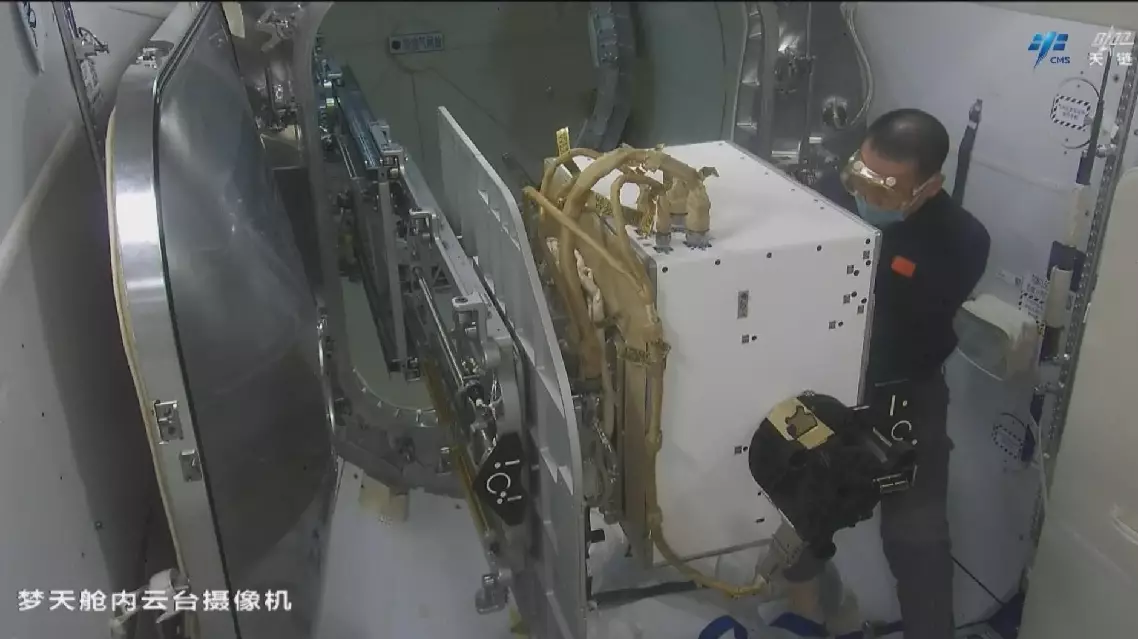
Chinese space station biological samples retrieved to probe how life withstands radiation
China's space station has made steady progress in its fourth round of space radiation exposure experiments over the past week, with samples including nanozymes, actinomycetes and plant seeds brought back after completing a five-month exposure outside the station.
The three Shenzhou-23 astronauts -- Zhu Yangzhu, Zhang Zhiyuan and Li Jiaying -- completed the retrieval, removal and storage of the samples, as well as the handling of the exposure device.
Once returned to Earth, the samples will undergo further analysis to help researchers better understand how space radiation affects living organisms.
The experiment is part of China's broader research into the effects of the space environment on biological systems, particularly the impact of prolonged exposure to space radiation.
The crew also carried out a range of scientific experiments and routine maintenance work aboard the Tiangong space station.
In a study of musculoskeletal responses to microgravity, the astronauts used foot-pressure measurement equipment to collect data during typical workdays. The findings will help researchers examine how the forces acting on bones and muscles vary under different conditions in orbit.
The astronauts also collected nasal and environmental surface swab samples for research into interactions between viruses and immune metabolism.
In addition, they completed assessments of their emergency decision-making abilities and tests of their emotional states in orbit. The data will help ground-based researchers track changes in the crew's decision-making and emotional responses over the course of a space mission. The trio continued routine maintenance of the station's living environment, monitoring cabin air quality through total volatile organic compound test and air cleanliness test. They also replaced components in the regenerative life-support system and the hot-air heating unit in the space kitchen, and cleaned the cabin.
All three astronauts kept to their exercise schedules and used equipment designed to counter the effects of weightlessness, including a device to help prevent bone loss, to maintain their health during the mission.
China's Tiangong space station has entered an era of long-term human habitation. The Shenzhou-23 spacecraft was launched on May 24, carrying three astronauts, two of whom are nearing the end of their sixth month in orbit, while the third is scheduled to remain in space for a full year.
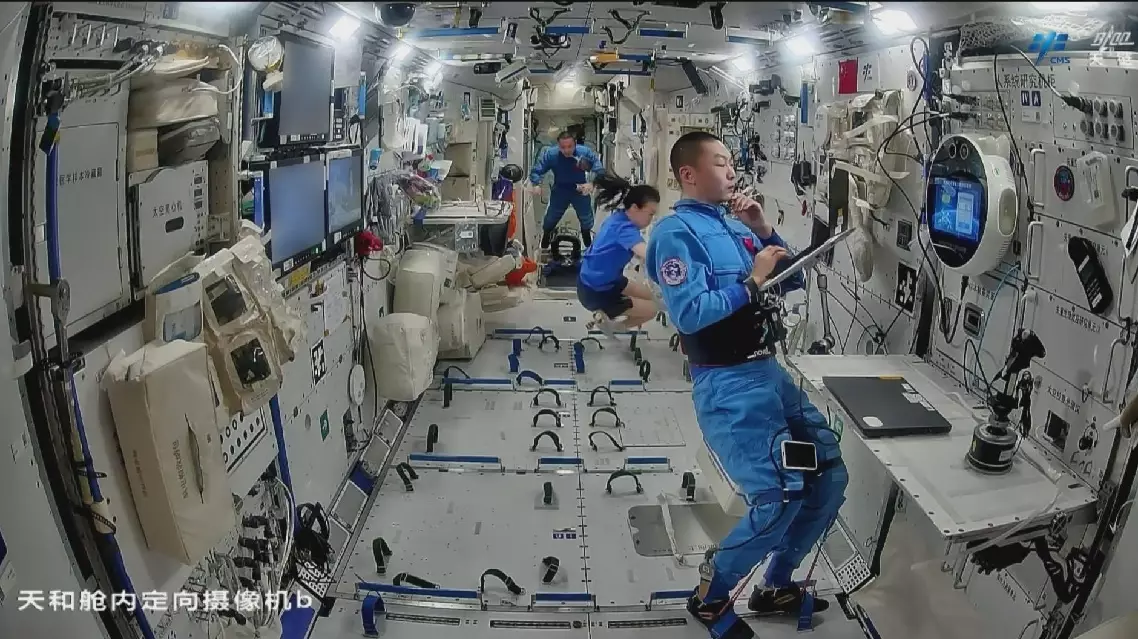
China space station advances fourth round of radiation exposure experiments