BATON ROUGE, La. (AP) — LSU senior guard MiLaysia Fulwiley will be charged with traffic citations but will not face any felony charges in connection with her arrest Saturday night after she allegedly attempted to evade police officers who tried to pull her over.
East Baton Rouge District Attorny Hillar Moore confirmed Friday that he would pursue only misdemeanor charges that include fleeing and resisting an officer, and refer Fulwiley to a diversion program to resolve those.
Initially, Fulwiley also was booked with aggravated battery and assault for allegedly driving her vehicle into that of an officer.
State police captain Russell Graham said Friday that his agency reviewed evidence with Moore and agreed with his decision.
“After a thorough review with all involved parties, the charges were amended based on the circumstances and evidence presented,” State Police said in a written statement provided by Graham.
Fulwiley has not played since her arrest and it is not clear when she will return to the team.
“Saturday night ended in a situation that never should have happened," Fulwiley said in a statement released by LSU. “I owe an apology to the officers involved and everyone who calls themselves a Tiger. I also want to apologize to my family and all those who love and support me.”
The traffic stop occurred near 102,000-seat Tiger Stadium as the a football game between LSU and Texas was ending.
“Rules and laws apply to everyone, including the instructions of officers working a game night in Baton Rouge,” Fulwiley said. "I respect the job those officers do, and I’ll let the legal process run its course. My focus is doing what this program asks of me and earning back the trust of the people who count on me.”
Fulwiley is averaging 17.8 points per game this season and scored a season-high 23 points during No. 9 LSU’s 101-37 victory over Denver on Nov. 13.
Sign up for Top 25 poll alerts here, visit the Top 25 here and see AP’s full college basketball coverage here

FILE - LSU guard Milaysia Fulwiley (23) dribbles the ball against Duke during the first half in the Sweet 16 of the NCAA college basketball tournament, March 27, 2026, in Sacramento, Calif. (AP Photo/Justine Willard, File)
JEFFERSON CITY, Mo. (AP) — Agrochemical maker Bayer will pay up to $7.25 billion over two decades to resolve thousands of claims from U.S. cancer patients asserting the company should have warned people that its popular weed killer Roundup could cause lymphoma, according to a settlement approved Friday by a Missouri judge.
The nationwide settlement applies both to Roundup users who already are ill and those who become diagnosed with non-Hodgkin lymphoma in future years. Participants could get an average of between $10,000 and $165,000, depending on how they used the product, how old they were when diagnosed and the severity of their illness.
For Germany-based Bayer, which denies that Roundup causes cancer, the settlement provides some financial certainty against mounting litigation costs that have led it to contemplate pulling the product from U.S. agricultural markets. Bayer already has changed the formula for its Roundup version sold to residential users.
Litigants also faced uncertainty. While the settlement was pending, the U.S. Supreme Court undercut one of the central arguments in the Roundup lawsuits. The high court ruled in June that Bayer cannot be sued in state courts on claims it failed to warn about cancer, because federal regulations don't require a cancer warning label and states are forbidden from imposing additional labeling requirements.
Though some attorneys for cancer patients contend the settlement payouts are too small, others argue the deal is better than getting nothing — which became a heightened likelihood after the Supreme Court ruling.
In a written judgment granting approval, St. Louis Circuit Judge Timothy Boyer said the average individual payouts are “fair and adequate” and the total dollar amount is “among the largest in the history of mass tort personal-injury class action settlements.” The approved settlement includes $600 million for attorneys' fees.
The judge said there was a risk Bayer would have filed for bankruptcy protection if the settlement had been rejected.
Bayer CEO Bill Anderson said in a statement that the court-approved settlement is “a decisive milestone in the company’s strategy to mitigate the risks of both pending and future Roundup litigation."
The decision could be appealed.
Missouri-based Monsanto debuted Roundup weed killer in 1974 with the chemical glyphosate as its active ingredient. The product quickly became one of the most widely used herbicides in agriculture. Roundup is designed to be used with genetically modified seeds that can resist the weed killer’s deadly effect, thus allowing farmers to produce more while conserving the soil by tilling it less.
The product also is commonly applied on lawns and gardens.
Bayer added Roundup to its portfolio when it acquired Monsanto in 2018. With it came a growing number of lawsuits alleging glyphosate causes non-Hodgkin lymphoma. But that remains in dispute. The World Health Organization’s International Agency for Research on Cancer classified the chemical as “probably carcinogenic” in 2015. The U.S. Environmental Protection Agency has determined that it’s not likely to cause cancer in humans when used as directed.
About 200,000 Roundup-related claims have been made against Bayer, many coming from people who used it on residential lawns and gardens. As a result, Bayer has removed glyphosate from its new versions of Roundup sold for residential markets.
The lawsuits have produced mixed results. Only a couple dozen cases have gone to jurors, some siding with Bayer and others with plaintiffs. In one case, a Georgia jury awarded plaintiffs $2.1 billion.
In the first Roundup verdict since the Supreme Court’s precedent-setting ruling, a Missouri jury in October sided with Bayer in a case alleging design defects, negligence and fraud. The verdict “should send a strong signal” that plaintiffs “will face significant challenges” pursuing Roundup-related cancer claims in the future, said Bill Dodero, Bayer’s U.S. general counsel and global litigation leader.
Bayer previously set aside $16 billion to cover legal costs related to Roundup cases. The new settlement, which is in addition to that, is designed to address most of the remaining lawsuits, as well as any additional cases brought in the coming years by people who were exposed to Roundup before the settlement was proposed in February.
“Today’s final approval order delivers guaranteed compensation to Roundup cancer victims who have waited more than a decade for justice," said Christopher A. Seeger, a court-appointed counsel for cancer patients in the case.
The settlement calls for Bayer to make annual payments into a special fund for up to 21 years, totaling as much as $7.25 billion. The amount of money paid out to individuals would vary. Agricultural, industrial or turf workers exposed at length to Roundup could receive an average of $165,000 if they were diagnosed with an aggressive form of the illness while younger than age 60. But anyone diagnosed at age 78 or older would get significantly less, with an average of $10,000.
Some attorneys have said the individual settlement amounts are too small and the terms too restrictive.
“This settlement is the scariest, worst future settlement that’s ever been contemplated,” attorney Gerson Smoger said during a September court hearing on whether the settlement was fair. He said it locked in future claimants for decades with no chance at punitive damages yet “kept the product that they were exposed to on the market, allowing the victims to continue to be exposed.”
The settlement was filed in St. Louis Circuit Court in Missouri, home to Bayer’s North America crop science division and the state where many of the lawsuits have been brought.
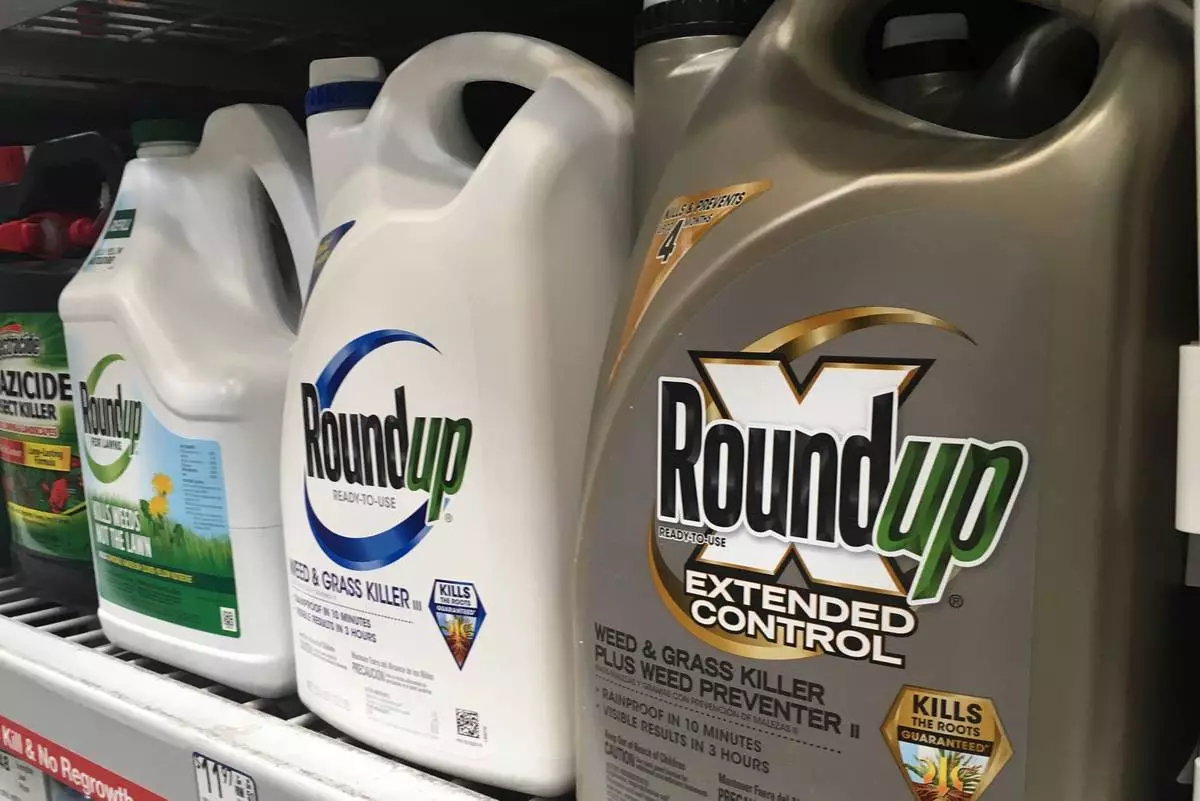
FILE - Containers of Roundup weedkiller are displayed on a store shelf in San Francisco, Feb. 24, 2019. (AP Photo/Haven Daley, File)