Skip to Content Facebook Feature Image

Big Earth Data report on SDGs highlights China's sustainable development practices

China

China

China

Big Earth Data report on SDGs highlights China's sustainable development practices

2026-11-21 09:07 Last Updated At:15:03

The "Big Earth Data in Support of the Sustainable Development Goals (2026)" report, released on the UN official website on Friday, highlights China's sustainable development practices, from ecological restoration in the national shelterbelt program in northeast, north, and northwest China to low-carbon urban transitions, offering practical examples for the world.

The 2026 one is China's eighth edition of the report since 2019, compiled under the leadership of the International Research Center of Big Data for Sustainable Development Goals (CBAS). The 2026 report reviews the latest global progress in sustainable development in 2025, providing scientific data references for understanding human development and environmental changes.

In the field of terrestrial ecology, the report shows that the net restored acreage of global dryland increased by 78.50 percent, with the Three-North Shelterbelt Forest Program in northeast, north, and northwest China cited as a typical case of success in global restoration.

""Land degradation is an important indicator of the UN Sustainable Development Goals. We have conducted continuous tracking and evaluation based on Big Earth Data. We can look at our latest assessment results. The green areas are where we assess that vegetation is recovering, and the red areas indicate where degradation exists. China's overall region is showing a state of significant restoration. The Three-North Shelterbelt Forest Program in northeast, north and northwest China has contributed about 14 percent of the net global land restoration in drylands, yet this area accounts for only six percent of the global dryland acreage. We have made important contributions to achieving zero net global land degradation," said Li Xiaosong, a researcher at CBAS.

Meanwhile, a night view of Beijing captured by satellite shows the city's ongoing energy optimization.

"The yellow lights here represent areas covered by illumination with traditional high-pressure sodium lamps, while in suburban areas like the Yizhuang Economic Development Zone and Tongzhou Sub-Center in Beijing, the lights are green energy-saving LEDs. More areas are transition zones between the two. Overall analysis shows that our energy-saving lighting methods are gradually replacing our traditional ones. This indicates that Beijing's lighting structure is undergoing tremendous changes," said Guo Huadong, academician with the Chinese Academy of Sciences and director of CBAS.

Big Earth Data report on SDGs highlights China's sustainable development practices
Big Earth Data report on SDGs highlights China's sustainable development practices

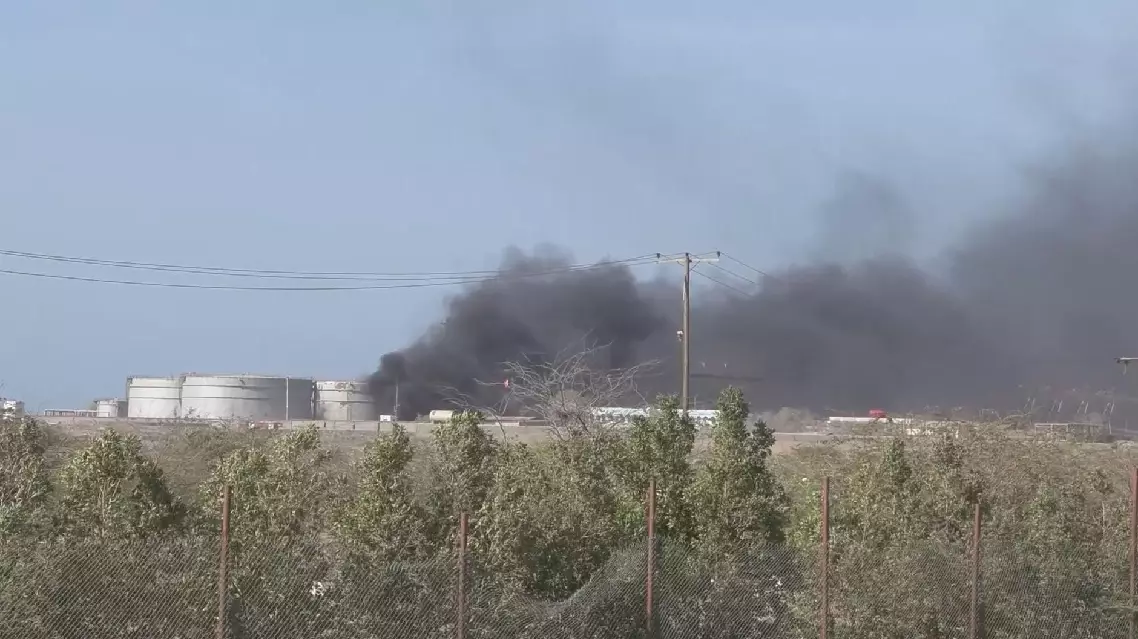
The Saudi-led coalition said it struck Yemen's Hodeidah port and targets in Sanaa, Saada and Taiz on Friday, while the Houthis claimed retaliatory attacks on a port and a power station in Saudi Arabia's Jazan province.

The latest escalation has extended the conflict between Saudi Arabia and Ansar Allah, known widely as the Houthis, to ports and energy infrastructure. The group said it targeted Jazan Port and the Shuqaiq power station in southwestern Saudi Arabia, and threatened further strikes on Saudi ports and power plants.

The Saudi-led coalition said its air defenses intercepted and destroyed two ballistic missiles targeting Jazan, and that shrapnel fell in the Shuqaiq area. It did not confirm the group's claim of direct hits.

"We cannot remain silent about the targeting of civilians and the continued targeting of civilians. Saudi Arabia must understand clearly that we will not stop and that we are prepared for this battle," said Ali al-Dailami, a member of Ansar Allah's Political Bureau.

The widening attacks put critical infrastructure essential to economic activity and public services at risk. The latest escalation followed an attack claimed by Ansar Allah that damaged the Public Investment Fund (PIF) Tower in Riyadh's King Abdullah Financial District, causing material damage but no casualties, according to Saudi civil defense.

Military expert in Sanaa Abdulghani al-Zubaidi warned that the group could broaden its attacks.

"It appears that Sanaa will use different types of weapons, possibly including large and heavy weapons that have not yet been used in this battle. At the same time, the list of potential targets in Saudi Arabia remains extensive. Sanaa may therefore adopt a stronger and more forceful approach than in the previous phase, as Riyadh has now begun targeting vital civilian infrastructure, including ports and electricity facilities," he said.

The strikes on Hodeidah have raised fears of serious humanitarian consequences. The port is a major entry point for food, fuel and humanitarian aid entering Yemen. As attacks continue between Saudi Arabia and Ansar Allah, concerns are growing that the confrontation could spread to other vital facilities. This could lead to further economic losses and worsen the humanitarian situation in Yemen.

Saudi-led coalition strikes Hodeidah, Houthis claim retaliation

Saudi-led coalition strikes Hodeidah, Houthis claim retaliation

Recommended Articles