The US-Israel-Iran war has put the Strait of Hormuz back in the crosshairs. The fighting threatens shipping lanes through this energy chokepoint, disrupting oil and natural gas shipments and triggering global shortages and soaring prices for oil, gas, and even chemical products.
When Hormuz Shakes
Japan took the first hit and was left trembling. Southeast Asia is also grappling with shortages of fuel and fertilizer.

Hormuz blocked; China cuts oil imports 23%, but fuel supply remains steady.
China, by contrast, is a picture of calm. The major energy consumer actively cut oil imports by 23% after the war broke out, yet its domestic fuel supply never skipped a beat.
In this episode of Pomegranate Podcast, Lo Wing-hung and Lee Tung head to Ningxia and Gansu to show how China keeps its "energy rice bowl" firmly in its own hands.
Click to Gallery
Hormuz blocked; China cuts oil imports 23%, but fuel supply remains steady.
How China holds its energy rice bowl firmly.
Aramid fiber: hair-thin, lighter, five times stronger than steel.
Dunhuang molten-salt solar tower: giant mirrors, future-world feel.

How China holds its energy rice bowl firmly.
Turning Coal Into Oil
For energy security, let’s take a look at the Ningdong Energy and Chemical Industry Base in Ningxia. Engineers here have pulled off something remarkable: turning coal into oil.

Aramid fiber: hair-thin, lighter, five times stronger than steel.
China has long been rich in coal but poor in oil, so researchers have spent years trying every possible way to convert one into the other. Think of it as kneading flour into bread, except the temperature and technology barriers are extraordinarily high.
After 39 months of grinding through the toughest technical problems, the world's largest single coal-to-liquids project came onstream. It turns out 4 million tons of oil and chemical products a year, including aviation kerosene and high-end materials such as aramid.
Aramid is a super fiber five times stronger than steel wire yet lighter than a strand of hair. It goes into aircraft doors and high-speed rail floors, and it has even ridden to the Moon alongside the national flag. The base's core oil-production technology has made the same journey in reverse: once a choke point where China was held back, it is now exported overseas.
When President Xi Jinping inspected the site in 2016, he put it plainly: "socialism is built through hard work". That line captures the spirit of practical endeavor behind everything here. None of these achievements were waited for or bought. They were earned through struggle.
Solar Power Bank
Fossil fuels are not the whole story. New energy matters just as much.
Mr. Lo Wing-hung once traveled in person to the Dunhuang molten-salt tower concentrated solar power station in Gansu, and the scene was stunning. More than 12,000 heliostats ring a 260-meter-tall heat-absorption tower. Their mirrors are immense, and a person standing among them feels transported into a future world.

Dunhuang molten-salt solar tower: giant mirrors, future-world feel.
These mirrors track the sun like sunflowers, concentrating its rays onto the top of the tower. There they heat a special "molten salt" past 600 degrees Celsius until it liquefies and flows into giant tanks. The result is a huge store of thermal energy, a power bank on a colossal scale.
When night falls and the light is gone, the station releases that stored heat to "boil water" and generate electricity.
The numbers are striking. The station generates 390 million kWh a year, enough to keep more than 200,000 households powered for a full day. It also cuts carbon dioxide emissions by 350,000 tons annually.
It is the country's first hundred-megawatt-class molten-salt tower concentrated solar power station, and it regularly draws foreign journalists and diplomats on special visits. Many describe it as a scene straight out of a science-fiction film.
More Solutions Than Difficulties
Gansu and Qinghai sit high on the plateau, where the sun is strong and the days are long. What looks like a harsh natural setting has become prime ground for the solar thermal industry.
Once photovoltaic panels go in, they shade the ground and slow evaporation. That makes room for a layered model: generate power above the panels, graze livestock below them.
In Gansu and Ningxia alike, high altitude, intense sunshine and vast, scarcely populated land were once seen as brakes on development. Step by step, the state and the people turned those limits into strengths, building new energy and photovoltaic industries brick by brick.
Faced with energy security tests, China can make oil from coal. It can also use storage to turn intermittent wind and solar power into a steady supply.
The lesson from these stories is simple: solutions usually outnumber difficulties.
To see more of how China keeps a firm grip on its energy rice bowl, the full Pomegranate Platform video is now online. Watch it here: https://www.bp-links.com/p/11874
Mao Paishou
** 博客文章文責自負,不代表本公司立場 **
In mid-November 2026, Shenzhen hosted the 33rd APEC Economic Leaders' Informal Meeting.
Taiwan Notices Shenzhen
Then came the surprise. For days, keywords like Shenzhen, APEC and Greater Bay Area did not just dominate trending searches on mainland social platforms. They flooded Taiwan's major mainstream media and political talk shows, and even the search bars of pro-green online outlets were overrun by the word Shenzhen.
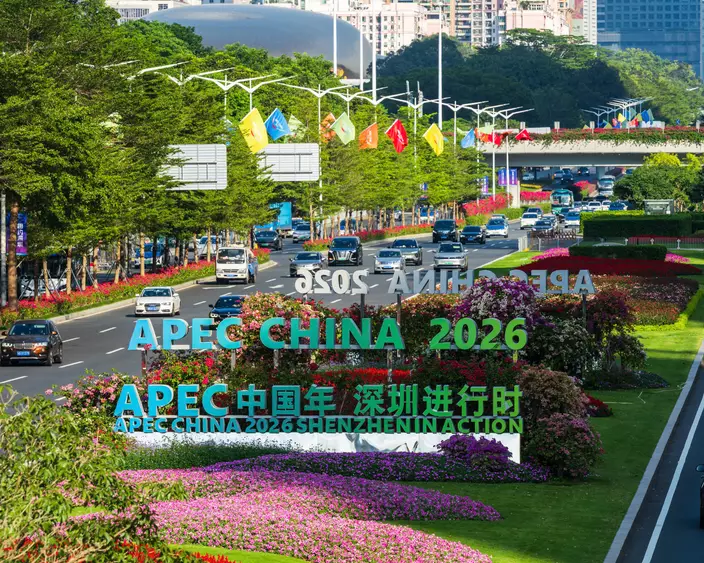
APEC flowerbed slogans line Shenzhen's main roads, building a strong home-court atmosphere across the city to welcome the mega event.
So why the collective U-turn? Taiwan's commentators, long accustomed to talking down the mainland from inside their information cocoon, were suddenly marveling at Shenzhen's technological and commercial muscle. The answer lies in the first-hand, on-the-ground details sent back by Taiwanese media and business figures.
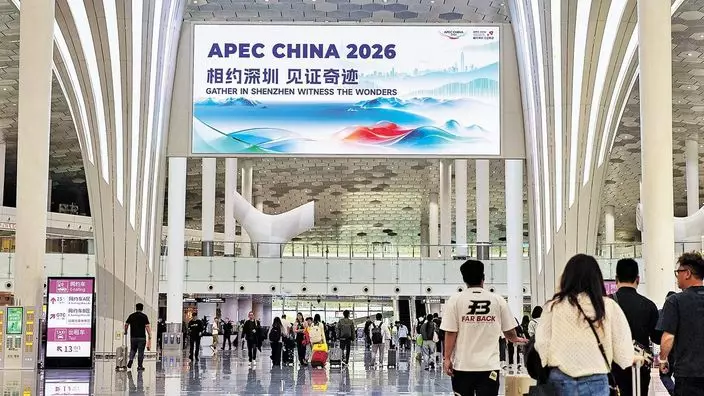
Giant APEC slogan greets arrivals at Shenzhen airport.
Around November 18, 2026, several major Taiwanese media outlets sent reporting teams to Shenzhen. They expected a routine diplomatic assignment. Instead, the moment they landed, the hardcore technology on display everywhere stopped them in their tracks.
Reporters from the China Times and United Daily News filed dispatches zeroing in on everyday street scenes: robots brewing coffee, drones delivering takeout. APEC topped the on-site search rankings at TVBS News and Storm Media, while CTi News and China Times News Network switched straight to round-the-clock live broadcasts.
Even Global Vision, a Taiwanese political talk show, produced a special feature casting Shenzhen as China's Silicon Valley flexing its tech muscles.
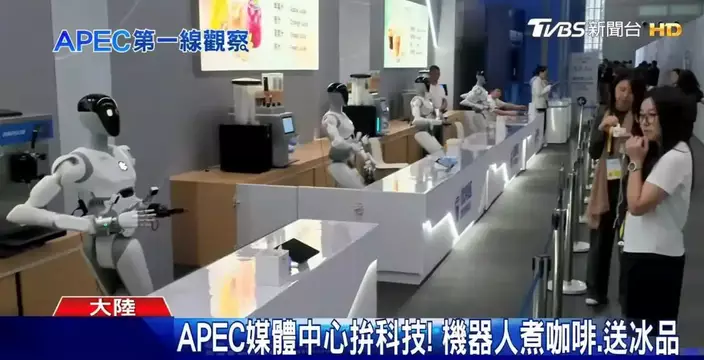
Robots serve coffee at APEC news center; Taiwan TV reports.
Judging the true worth of an international summit takes more than reading the official communiqués issued inside the meeting rooms. The real test is what the host city puts on display: a temporary bonsai staged for guests, or a complete industrial chain already woven into citizens' daily lives. For the Taiwanese contingent at this Shenzhen APEC, the shock came from the latter.
Everyday Tech Steals Scene
The diplomatic welcome rewrote the rules from the start. At past international summits, the motorcades were always a showcase for European and American luxury brands like Mercedes-Benz, BMW and Audi. This time in Shenzhen, Taiwan's Economic Daily News reports, the organizers simply fielded nearly 700 domestic high-end new energy vehicles, including Hongqi and BYD models, as the support fleet.
Major international gatherings set brutal requirements for the safety, range, stability and smart features of reception cars. The fact that nearly 700 homegrown vehicles carried the load shows just how mature the mainland's new energy vehicle supply chain has become.
What really opened Taiwanese reporters' eyes was the artificial intelligence woven into the conference center and the surrounding streets. A China Times News Network reporter walked into the APEC Meetings Week news center and wrote about what he found. Embodied intelligence and AI news-gathering tools were built straight into daily operations. Journalists from around the world could tap an order on a tablet and, about two minutes later, pick up a coffee freshly ground and brewed by a robot, topped with an APEC latte-art design.
Mainland tech firms such as DJI were also on site, lending camera equipment free of charge for interviews. Type instructions into a dialog box, and the system instantly generated multilingual news drafts. Step outside the news center, and driverless taxis shuttled through Shenzhen's streets while delivery drones flew overhead.
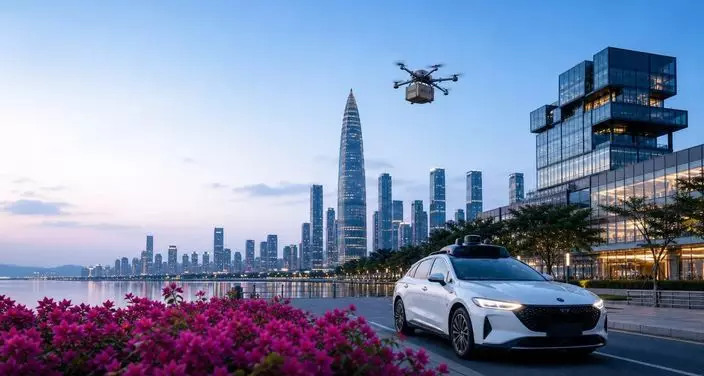
Driverless taxis, delivery drones now part of Shenzhen life.
Young Taiwanese working in Shenzhen spotted another highly symbolic detail: the China Media Group 4K ultra-high-definition outside broadcast truck parked on the city's streets, nicknamed the "Big Red Truck" by netizens.
Zhou Boyan, a Taiwanese youth based in Shenzhen, said in an interview that the Big Red Truck is instantly recognizable and reserved for major national and international events. He said it represents the most cutting-edge broadcast equipment, can transmit a stable signal worldwide, and beams China's host-broadcast ultra-high-definition footage directly to the world.
For Hong Kong people, heading north to Shenzhen on weekends to eat, drink and wander the malls has long been part of everyday life. Yet many still think of the city mainly as a place that offers good value for money. The collective astonishment from Taiwanese media gives Hong Kong people a fresh angle on the city just across the river. The Shenzhen streets they stroll through on shopping trips have already turned cutting-edge laboratory research into a "model future city" that leaves journalists from around the world in awe.
Giants Vote With Feet
If self-driving cars and robot-brewed coffee deliver a sensory shock, the moves of multinational business giants expose an even crueler commercial truth.
Western politicians have spent years talking up de-risking and supply chain decoupling, as if one order from Washington would send global companies fleeing China. But the abacus of the marketplace has always been far more honest than the slogans of politicians.
This year's APEC CEO Summit in Shenzhen drew representatives from 115 Fortune Global 500 companies, World Journal reported.
Taiwanese media figure He Huirong put it bluntly on a talk show: Shenzhen sits at the cutting edge of technology, and the multinational giants that showed up were not merely hunting for investment opportunities. They came, one could even say, to learn from the experience. In the business world, after all, the giants always vote with their feet, using real money.
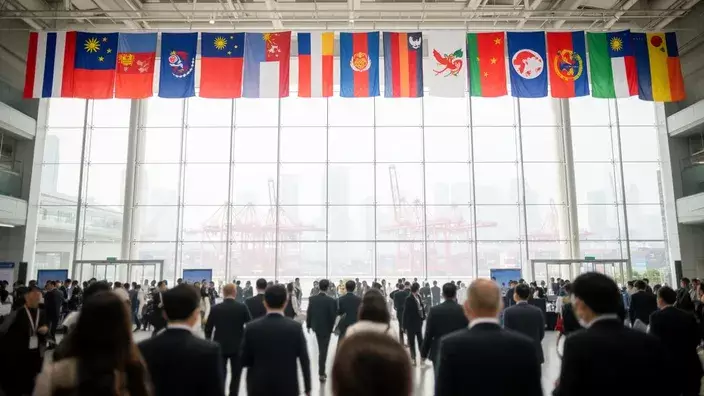
100+ Fortune 500 firms gather for Shenzhen APEC summit.
The summit's agenda drove home an even sharper sense of generational gap for Taiwan's industrial and business circles.
Taiwan's Commercial Times analyzed that the Shenzhen APEC meeting showed the mainland going all out in artificial intelligence, semiconductors and robotics, while already locking its sights on next-generation frontier tracks like quantum computing and brain-computer interfaces. The Shenzhen Initiative unveiled at the summit goes further still. It spans the AI innovation ecosystem, the Asia-Pacific Free Trade Area and digital economy cooperation, opening up entirely new space for regional trade and economic cooperation.
Taiwan's political arena, by contrast, has stayed mired in energy shortages and internal political strife in recent years. The contrast has left many in Taiwan's business community feeling a stark development gap.
This is China's third time hosting the APEC Economic Leaders' Meeting. The 2001 Shanghai meeting accelerated the country's integration into the world economy, the 2014 Beijing meeting pushed forward the building of the Asia-Pacific Free Trade Area, and the 2026 Shenzhen meeting zeroes in on new rules for artificial intelligence and the digital economy. China's role has shifted from "participant" to "rule-maker."
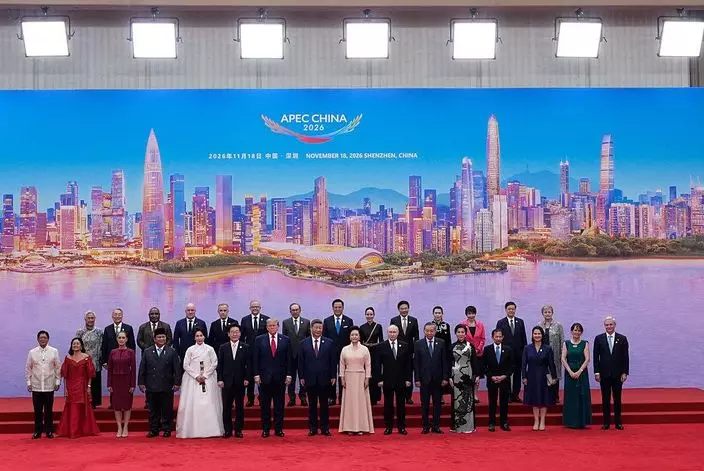
APEC leaders gather, pose in Shenzhen, showcasing China's clout.
As for the grand scene of political leaders from various countries gathering in Shenzhen, Chou Hsi-wei, vice chairman of the Want Want Group, said bluntly on an island political talk show that leaders of various countries are competing to take the stage. That, he argued, proves the focus of global politics and economics has shifted to the mainland, where the discourse power of the era is now clearly on display.
Politics Meets Reality
The most dramatic twist came in the Taiwan authorities' own before-and-after performance. In early November, island outlets hyped claims that the mainland's emailed invitation amounted to differential treatment. The relevant Taiwan authorities departments even went public with a demand for a written guarantee.
Then came the morning of November 18. Taiwan's leader's representative, Acer founder Stan Shih, landed right on schedule at Shenzhen Bao'an Airport aboard a China Airlines charter flight. Delegation members later checked with other economies and had to admit that every side had received exactly the same treatment.
Some scholars on the island put it bluntly. The level of attention and shock the Shenzhen APEC meeting generated across Taiwan was enough to leave the DPP authorities collectively shattered. The anti-China information wall they spent a fortune building in ordinary times collapsed in an instant, right in front of an international grand gathering on their own doorstep.
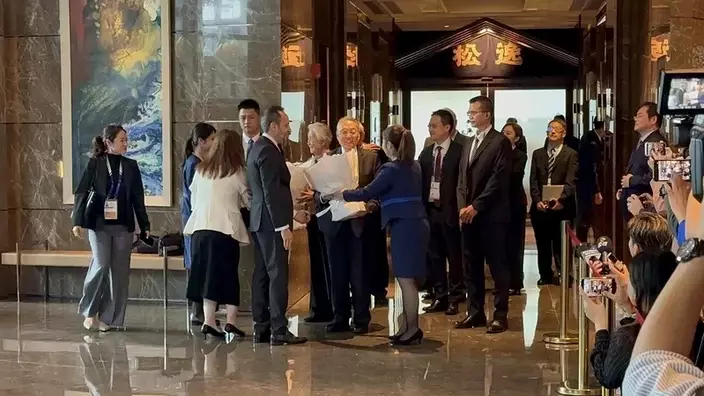
Taiwan representative Stan Shih arrives in Shenzhen to a warm welcome.
That contrast, shouting resistance while the body acts honestly, proves one thing. Against solid industrial strength and real development opportunities, any political resistance looks painfully strained.
As the world's multinational giants line up in Shenzhen to learn from its experience, the answer is already written in the city's streets and venues. This is where the Asia-Pacific region's innovation vitality and future business opportunities are converging.