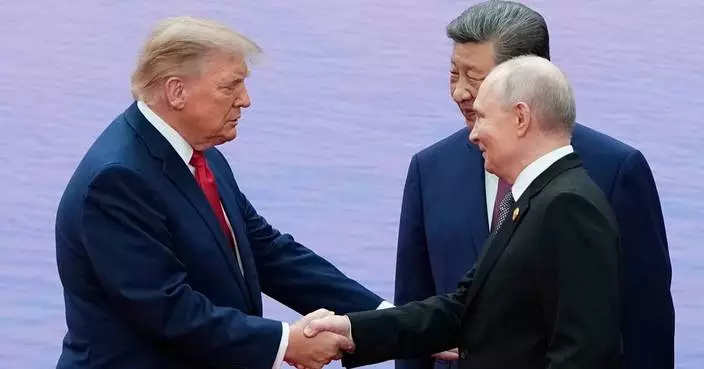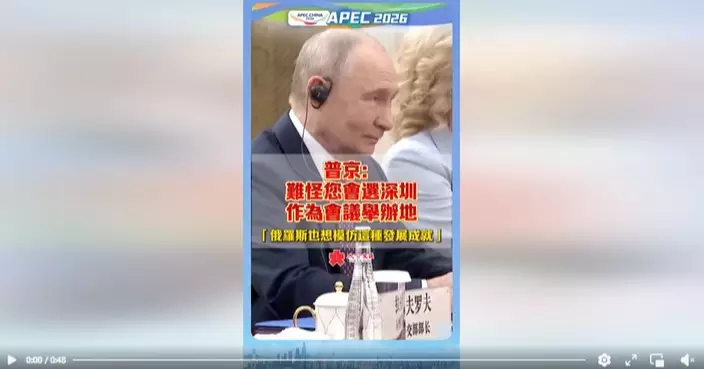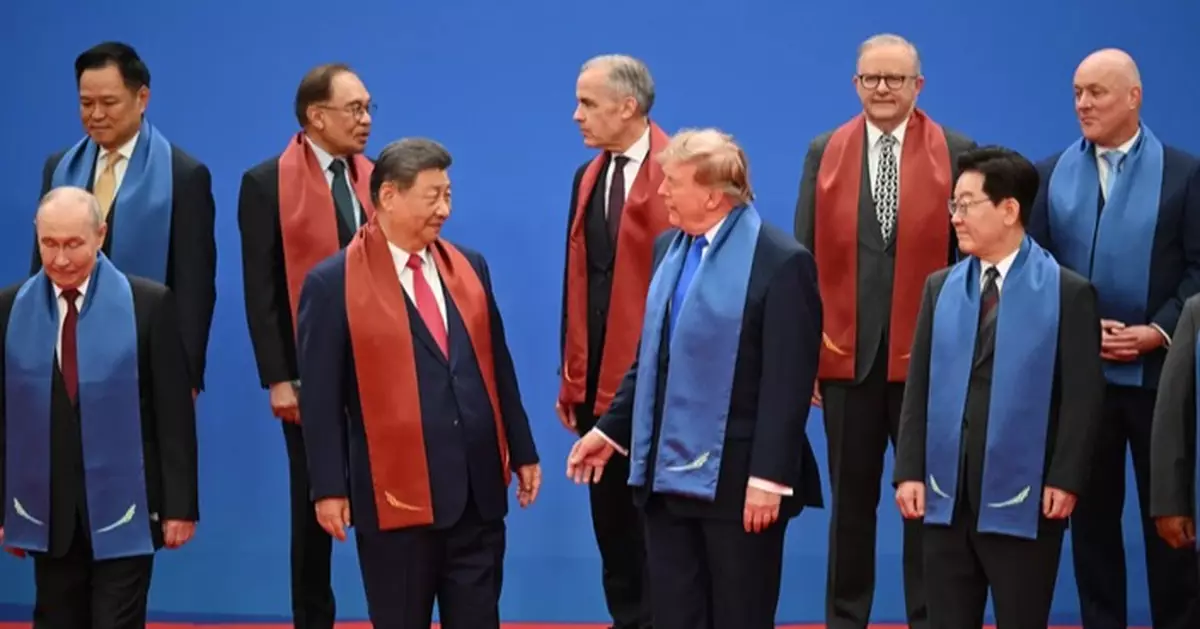
When the 33rd APEC Economic Leaders' Meeting convened in Shenzhen on November 19, the traditional "family photo" quickly went viral across social media. Draped around the necks of leaders and delegates from the participating economies were striking scarves in vibrant red or deep blue. Named Tongxin Hejin ("One Heart, Woven Together"), the piece symbolises unity of purpose and shared prosperity.
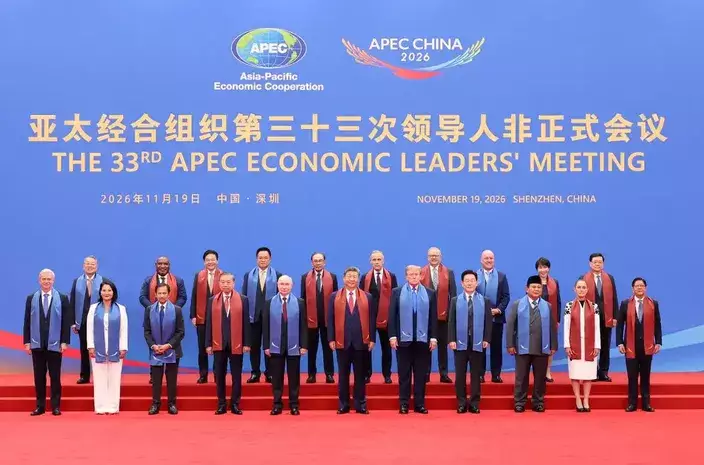
The red and blue scarves worn by leaders and representatives during the group photo became the visual focal point of the summit. (Photo/Xinhua)
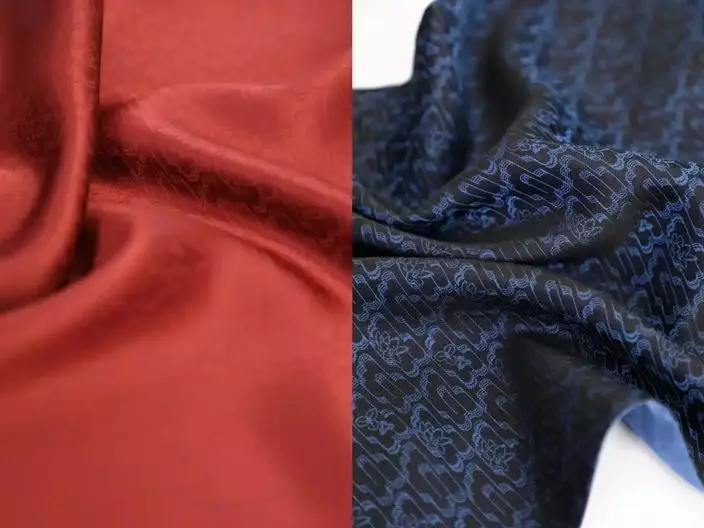
Measuring 180 centimetres long by 32 centimetres wide and woven from 100% mulberry silk, the scarves remarkably bring together four distinct intangible cultural heritage (ICH) crafts: Xiangyunsha (gambiered Canton gauze), Song brocade, Cantonese embroidery, and Suzhou embroidery. The red edition pairs Guangdong's signature Xiangyunsha with Cantonese embroidery, while the blue edition combines Song brocade with Suzhou embroidery.
Click to Gallery
The red and blue scarves worn by leaders and representatives during the group photo became the visual focal point of the summit. (Photo/Xinhua)
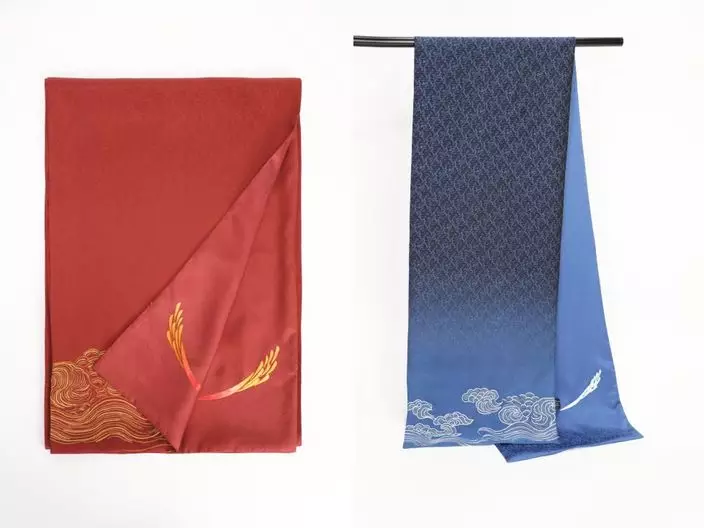
The APEC "family photo" scarves, "Tongxin Hejin": the red edition pairs Xiangyunsha with Cantonese embroidery, while the blue pairs Song brocade with Suzhou embroidery. (Photo/Shangguan News)
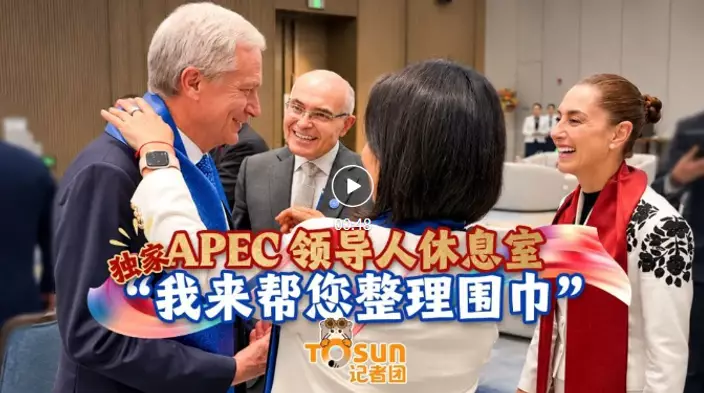
Leaders help one another adjust their scarves in the lounge prior to the group photo. (Screenshot/Xinhua)
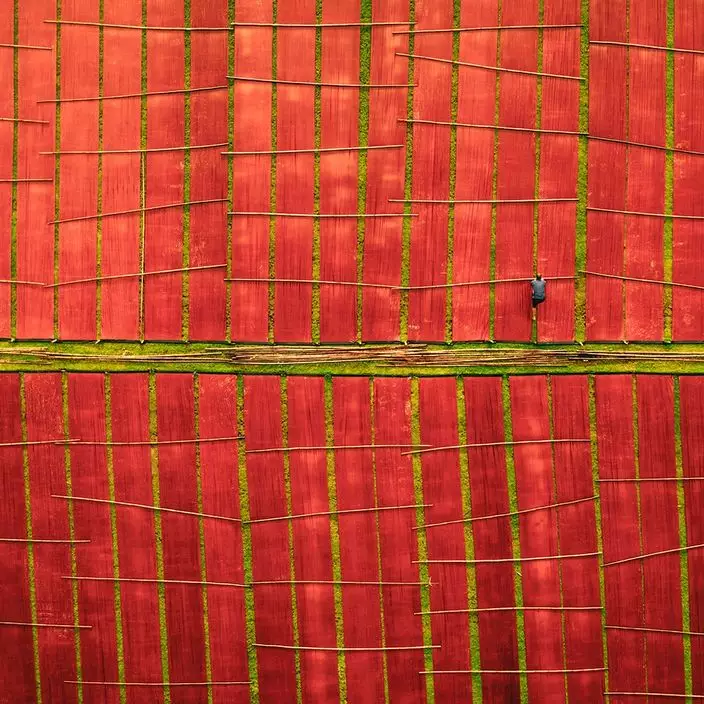
At a drying yard in Shunde, Xiangyunsha is crafted through the traditional process of "three soaks, nine boils, and eighteen sun-dryings." (Photo/Contemporary China)
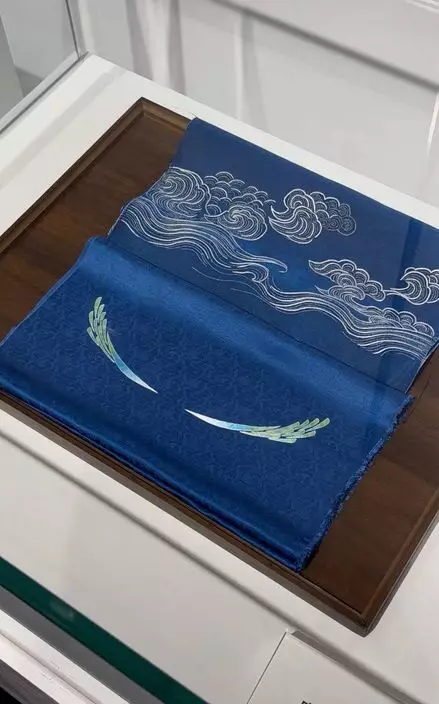
Auspicious cloud and ocean wave motifs woven into the blue scarf. (Photo/Yangtse Evening Post)
Kapok, bougainvillea, and auspicious clouds intricately woven into "Tongxin Hejin." (Photo/Xinhua)
The APEC "family photo" scarves, "Tongxin Hejin": the red edition pairs Xiangyunsha with Cantonese embroidery, while the blue pairs Song brocade with Suzhou embroidery. (Photo/Shangguan News)
Before stepping onto the stage, leaders were seen helping one another adjust their scarves—a moment in which the warmth of the "APEC family" was genuinely palpable. Behind these textiles lies the latest chapter in how China's living heritage is stepping onto the world stage.
Leaders help one another adjust their scarves in the lounge prior to the group photo. (Screenshot/Xinhua)
The Weight of "Soft Gold"
Consider first the red Xiangyunsha. Unique to the Lingnan region, this storied textile starts with a mulberry silk base, which is dyed a rich brownish-red using the juice of the gambier plant and then coated with iron-rich river mud to turn its surface a lustrous, deep black. Crafting it requires "three soaks, nine boils, and eighteen sun-dryings"—over thirty indispensable steps entirely at the mercy of the weather. Even master artisans take half a year to produce a single bolt. Because of its painstaking process and rarity, Xiangyunsha is revered as "soft gold" and was inscribed on China's national intangible cultural heritage list in 2008. This summit also marked the debut of Shunde Xiangyunsha as an official APEC state gift fabric—"following the 2014 Beijing APEC, which thrust Song brocade into the spotlight, this millennium-old gambiered silk has once again taken centre stage globally."
At a drying yard in Shunde, Xiangyunsha is crafted through the traditional process of "three soaks, nine boils, and eighteen sun-dryings." (Photo/Contemporary China)
The stature of a state gift was matched by an extraordinary feat of craftsmanship and logistics: to meet the summit deadline, artisans used over 5,000 metres of raw silk fabric to yield just 50 finished scarves, compressing a typical 180-day production cycle into 62 days.
Song Brocade, an "Old Acquaintance"
The primary fabric of the blue scarf is Song brocade. Originating in Suzhou, this intricate weave is hailed as the "crown of silks" and was inscribed in 2009 on UNESCO's Representative List of the Intangible Cultural Heritage of Humanity as part of "Sericulture and silk craftsmanship of China." Wu Jianhua, whose workshop supplied the fabric, was also the textile creator behind the celebrated "New Chinese-style attire" worn at the 2014 Beijing APEC—where his team stood out among 768 contenders nationwide and sparked a revival in Song brocade. From the 2014 attire to Tongxin Hejin, the same heritage craft has graced the APEC stage twice. As Wu noted, using the Greater Bay Area as a window allows artisans to "demonstrate the responsibility of a major nation through cultural confidence."
Auspicious cloud and ocean wave motifs woven into the blue scarf. (Photo/Yangtse Evening Post)
Every Stitch and Thread Tells a Story
The embroidery gracing the scarves carries equal pedigree: both Suzhou and Cantonese embroidery were among the very first batch of crafts named to China's national ICH list in 2006. Thoughtful design weaves rich storytelling into the fabric—the base motifs blend Lingnan kapok (known as the "hero flower") with Shenzhen's city flower, bougainvillea, while auspicious clouds and rolling waves evoke the historic routes of the Maritime Silk Road. Running through both ends of each scarf are 21 strands of natural wild silk, carrying a clear message: the 21 APEC member economies are tightly bound together. Coarser and less prone to shrinkage, these wild silk threads also serve as a structural anchor to maintain the fabric's dimensional stability—uniting symbolism with practical engineering.
Kapok, bougainvillea, and auspicious clouds intricately woven into "Tongxin Hejin." (Photo/Xinhua)
From State Gift to Global Stage
The greatest pitfall for traditional heritage going global is remaining locked behind museum glass. The brilliance of this year's APEC showcase lay in making heritage hands-on and tangible: inside the media cultural experience zone, Chinese and international journalists were invited to feel the crisp texture of Xiangyunsha firsthand, with several foreign reporters taking home Xiangyunsha fabric keepsakes as souvenirs. A single scarf wove the lustre of "soft gold," the memory of the Maritime Silk Road, and the unity of 21 economies around the shoulders of world leaders—giving the "Chinamaxxing" of traditional heritage its finest showcase yet.
A Cultural Security Signal Woven in Silk
Interlaced within those 21 silk threads is more than exquisite artistry—it is a quiet statement on resilience. Cultural security forms a vital pillar of the holistic approach to national security: for a heritage craft to become a state gift admired worldwide, its artisanal roots must first be preserved and its cultural voice firmly anchored. From handwoven warmth that industrial looms can never replicate to the renewed convergence of millennium-old Xiangyunsha and Suzhou Song brocade on the international stage, China is blending preservation with innovation to turn cultural agency into confidence for opening up. Security and openness are never at odds: only by safeguarding one's own cultural tapestry can a nation weave a shared future with the world.
Chinamaxxing
** 博客文章文責自負,不代表本公司立場 **