An invasive brain-computer interface (BCI) implant has enabled a paralyzed patient in east China's Jiangsu Province to control a wheelchair mentally.
The breakthrough was achieved at the Affiliated Hospital of Nantong University. The patient, identified by the pseudonym Xiaoxiao, is still receiving treatment in the hospital's clinical research ward for BCI and neuromodulation.
She sat in an electric wheelchair without making any physical movement. As her thoughts shifted, the wheelchair started smoothly and moved forward at a steady speed, stopping naturally when it encountered an obstacle, then turning to adjust its route. The whole sequence flowed smoothly and continuously, with no assistance from others.
"I imagine moving forward, and the wheelchair moves forward, then turning left, right, or backward. The system is based on the model I trained earlier, which then controls the wheelchair," Xiaoxiao said.
A year ago, Xiaoxiao was tragically injured in a car accident that left her with severe cervical spinal cord damage and quadriplegia. On June 5 this year, she became the first patient in Jiangsu to receive a flexible electrode system implant for an invasive BCI.
"The flexible electrodes are as thin as a piece of hair, actually thinner than it, with a diameter of only two or three micrometers. Each of the eight electrodes carries 32 recording contacts, or probes, making 256 in total. These eight flexible electrodes are surgically implanted into the hand motor area, where they can collect all the brain signals generated there. As soon as she thinks about moving her hand, specific brain signals are generated and transmitted to our decoder, which decodes them using a certain algorithm," said Shi Wei, director of the Center of Neurological Diseases at the Affiliated Hospital of Nantong University.
In just a few months of training since the system was activated in late June, Xiaoxiao progressed from basic cursor tracking and clicking to riding a brain-controlled wheelchair out of the ward, a leap that has left her thrilled and hopeful about the future.
"If I can go out, I won't need my parents to wheel me anymore. Maybe I can just think about moving forward and off I go. Getting around might be easier than before. I feel so lucky and grateful to live in such a good era, where even with an illness like this, technology can still change our life," Xiaoxiao said.
From controlling a cursor mentally to riding a brain-controlled wheelchair out of the ward on her own, Xiaoxiao's progress shows that the eight flexible electrodes implanted in her brain have formed a long-term, stable neural connection with her motor cortex.
The hospital said it will continue to refine its clinical BCI adaptation technology and leverage the strengths of non-invasive, semi-invasive and invasive approaches, applying them to more scenarios of neurological disease to benefit more patients.
"We will apply it to other areas of neurological disease beyond spinal cord damage and conduct related research based on our work in stroke. We believe a case like this can further demonstrate how we use our innovative technology to serve our patients," Shi said.
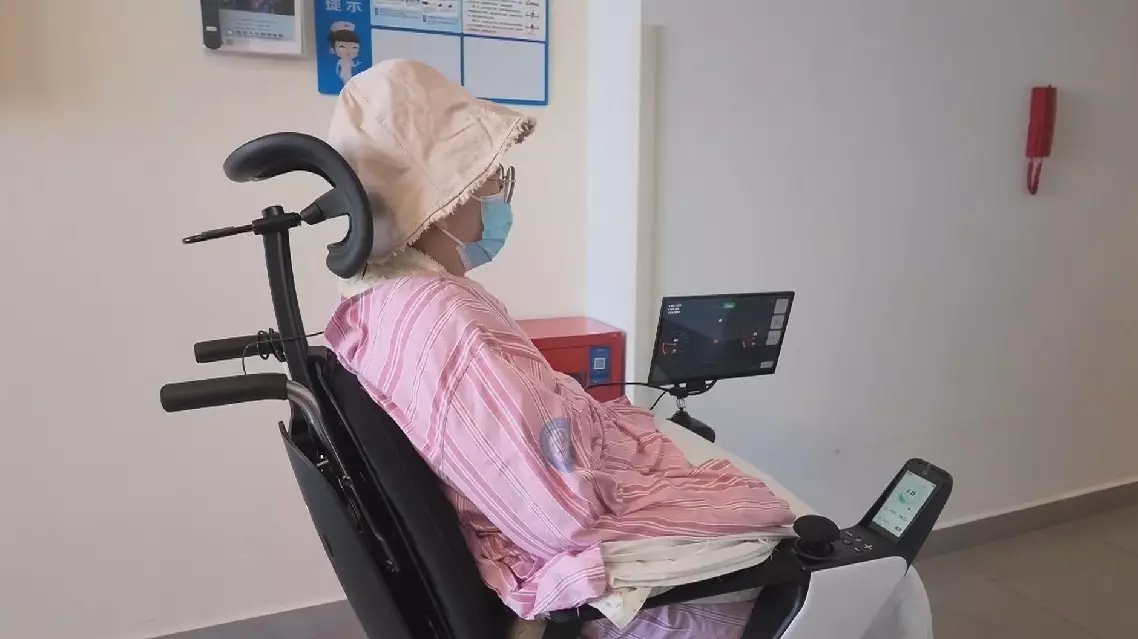
BCI implant enables paralyzed Jiangsu patient to control wheelchair mentally