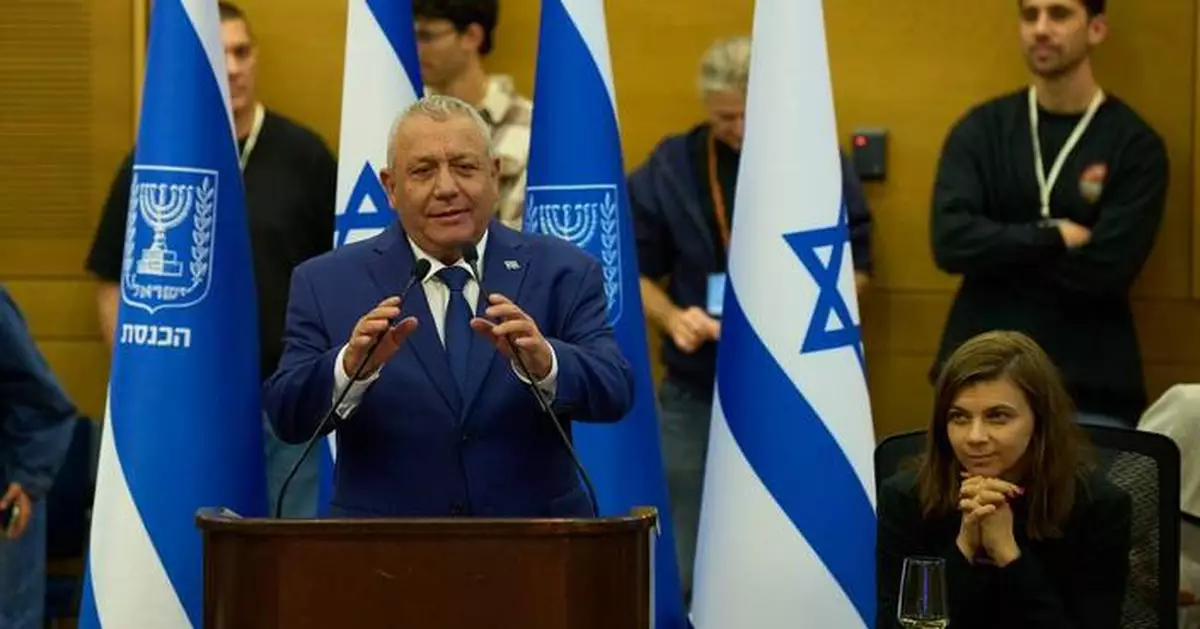
JERUSALEM (AP) — Israel's Prime Minister Benjamin Netanyahu and opposition leader Gadi Eisenkot met Sunday morning to discuss forming a unity government, three weeks after Israel's president tasked Eisenkot with trying to form a government for the deeply divided country after inconclusive national elections.
The discussions took on new urgency after Netanyahu announced Saturday night that he was willing to have Eisenkot become prime minister first in a rotation arrangement under a possible unity deal.
A joint statement by their parties on Sunday afternoon said the meeting began with a security briefing and then moved to discussing “the formation of a national unity government,” with “both sides seeking to bridge the substantial differences between them.”
For months, Eisenkot has called Netanyahu, Israel's longest-serving prime minister, unfit for office and a threat to Israel’s future. Netanyahu has led a relentless campaign against partnering with Arab-led parties — whose historic gains in the Oct. 27 elections turned them into likely but politically fraught allies for the opposition bloc.
“Unity government is another name for kicking the Arabs out,” said Tamar Hermann, who directs the Israel Democracy Institute’s Viterbi Center for Public Opinion and Policy Research in Jerusalem.
She added that while Israelis expressed worry in opinion surveys about a lack of unity in the country, those who voted for change would see a shared Netanyahu-Eisenkot government as a betrayal by Eisenkot.
Yousef Jabareen, the leader of the Joint List, a coalition of three Arab-led parties, urged rejecting Netanyahu's offer. “It’s time to fulfill the shared will of the entire public — Jews and Arabs alike — and oust Netanyahu this week,” he said.
Yair Lapid, a leader of the Jewish-majority opposition parties who briefly served as prime minister in a coalition government formed in 2021 that ended 12 years of Netanyahu's rule, called the offer a scam.
However, Naftali Bennett, who also served as prime minister in the coalition government with Lapid, welcomed Netanyahu’s offer to let Eisenkot serve as premier first and said a unity government should be built around parties representing Israelis who perform military or national service.
While Netanyahu’s party, Likud, garnered most votes in the country’s election, the right-wing and ultra-Orthodox parties that have historically backed him failed to maintain their parliamentary majority and won fewer seats than his opponents in the country’s 120-member Knesset.
Neither bloc received the needed 61-seat majority, which left both Eisenkot and Netanyahu without an easy postelection path toward forming a government.
If no deal is reached by Dec. 6, Eisenkot could ask Israel's president to grant him a two-week extension for a final chance to strike a deal. If that fails, Netanyahu could get the next opportunity — and new elections might be called if he also fails.
Parties backing Eisenkot have disagreed over whether to include Arab-led or ultra-Orthodox parties in a potential coalition.
In addition, negotiations among the parties touched on some of the election’s most sensitive issues, including mandating military service for ultra-Orthodox Jews and a state-led investigation into the security failures surrounding the Hamas-led Oct. 7, 2023, attacks.
The country is still reeling from that trauma and the more than three years of wars that followed in Gaza, against Iran-backed Hezbollah militants in Lebanon, and in the war against Iran, which Israel and the United States jointly attacked on Feb. 28.
Associated Press writer Koral Saeed in Abu Snan, Israel, contributed to this report.
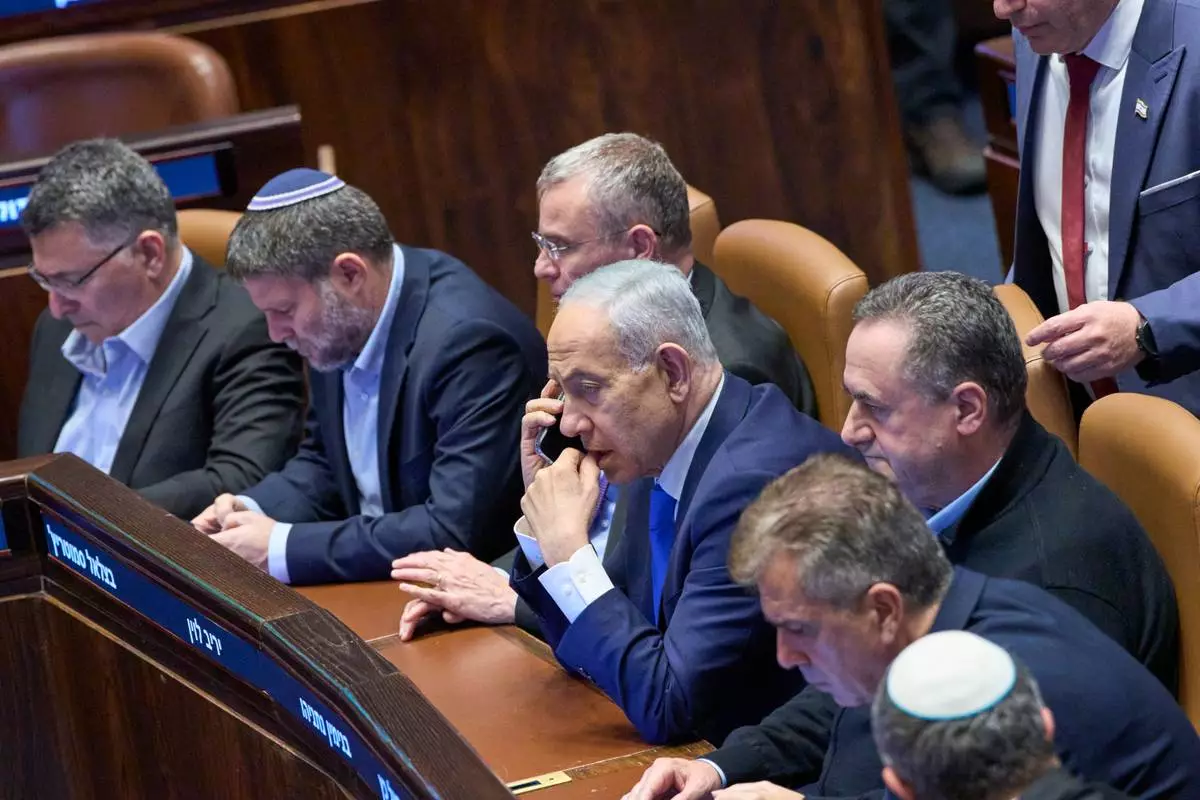
Israeli Prime Minister Benjamin Netanyahu and other Israeli lawmakers attend a parliamentary session at the Knesset, Israel's parliament, in Jerusalem, during a vote to elect MK Matan Kahana as the new Speaker of the Knesset, Tuesday, Nov. 17, 2026. (AP Photo/Ohad Zwigenberg)
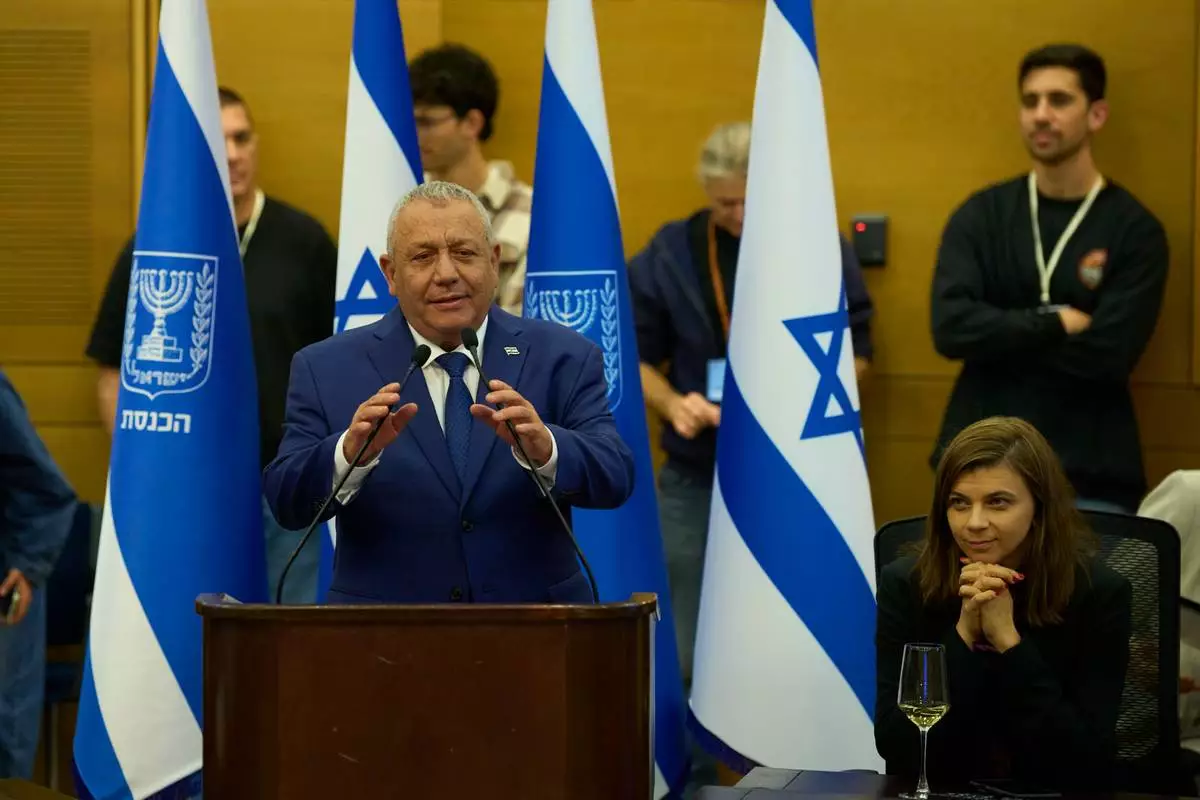
Gadi Eisenkot, leader of the Yashar party, congratulates newly elected Knesset Speaker MK Matan Kahana following a vote to elect a new Speaker at the Knesset, Israel's parliament, in Jerusalem, Tuesday, Nov. 17, 2026. (AP Photo/Ohad Zwigenberg)
ISLAMABAD (AP) — Pakistan's military announced Sunday that it will send troops to help strengthen Saudi Arabia’s defenses against relentless attacks by Yemen’s Iran-backed Houthi rebels.
It will be Pakistan's first known troop deployment under a joint defense agreement that Saudi Arabia signed with Islamabad and Turkey in August.
Pakistan's statement said troops would carry out duties within Saudi territory under existing defense cooperation arrangements. It did not disclose the number of soldiers, specific assignments, duration of the deployment or when troops would arrive.
Saudi Arabia, a major U.S. ally, has faced mounting pressure since the Iran war erupted in February with U.S. and Israeli strikes on the Islamic Republic. It has turned to regional allies, including Egypt and Syria, to strengthen its defenses in the face of Houthi missile and drone strikes, some of them deadly.
The kingdom has been fighting the Houthis over the past decade in neighboring Yemen’s civil war, backing the internationally recognized government in the south. The Houthis control Yemen's most populous areas, including Sanaa.
Fighting in Yemen escalated this summer. The Houthis have also launched direct attacks on Saudi Arabia's military, aviation and oil infrastructure and imposed a blockade on its shipping in what has been viewed as an extension of the U.S.-Iran war.
In recent months, the rebels made their biggest land grab in years, capturing Yemen’s Red Sea coast. This, along with the temporary closure of a key Saudi pipeline, strengthened their ability to choke off Saudi oil exports, pushing up global fuel prices and giving Iran greater leverage.
Islamabad’s announcement came two days after Pakistani, Turkish and Saudi defense and military officials met in Islamabad and reaffirmed their support for Riyadh under the trilateral Mecca Joint Defense Agreement that treats an attack on one member as an attack on all.
The three countries also backed diplomatic efforts to ease regional tensions.
Pakistan, Saudi Arabia and Turkey signed the agreement on Aug. 7. They have described it as defensive and said it is not directed against any particular state.
The agreement builds on decades of Pakistani military service in Saudi Arabia, where an unspecified number of Pakistani troops have been stationed since the early 1980s to train and advise Saudi forces.
Last month, Egypt said it would provide military support to Saudi Arabia to help it defend itself against Houthi attacks, without giving details.
A regional official briefed on the matter said at the time that Egypt would deploy air defense systems and aircraft to help repel missiles and drones. The support was defensive in nature and wouldn't include ground troops in Yemen, the official said on condition of anonymity because he wasn’t authorized to speak to reporters.
Sunday's statement reaffirmed Pakistan’s commitment to protecting Islam’s two holiest mosques in the Saudi cities of Mecca and Medina. It said the troop deployment would strengthen Saudi Arabia’s defensive capabilities amid “emerging security concerns."
Saudi Arabia has accused the Houthis of firing missiles and drones toward Mecca and Medina since the summer escalation. The Houthis have vehemently denied attacking Islam’s two holiest cities.
The deployment follows a meeting in Riyadh last month at which the three countries agreed to implement their collective defense commitments, including arrangements for the rapid deployment of military forces and equipment to Saudi Arabia.
Pakistani Defense Minister Khawaja Muhammad Asif previously said Pakistan would use “whatever means are available” to defend the kingdom against Houthi attacks.
Pakistan is also pursuing diplomatic efforts with countries including Qatar to bring the United States and Iran back to negotiations. Islamabad brokered an interim agreement between the two sides in June that quickly fell apart.
A senior Houthi official lashed out at Pakistan and Turkey over their alliance with Saudi Arabia.
Mohamed Ali al-Houthi, a member of the Supreme Political Council, said in a statement Saturday that Ankara and Islamabad had ignored “the (Saudi) aggression, the blockade, the killings and the ongoing crimes” in Yemen.
“Just as the previous coalition against our country … ended in failure, any future coalition will likewise fail,” he said.
Al-Houthi was referring to the 2015 U.S.-backed, Saudi-led coalition that joined the Yemen civil war against the Houthis in a bid to restore Yemen’s internationally recognized government to power.
In early November, the Houthis claimed that Pakistan had joined Saudi Arabia in strikes in Yemen. The rebels' acting information minister, Omar al-Bukhaiti, said at the time that Pakistani fighter jets had struck rebel-held areas on Nov. 6 in “an extremely dangerous escalation that cannot be accepted or left unchallenged.”
Pakistan has rejected the Houthis’ claims.
Magdy reported from Cairo.
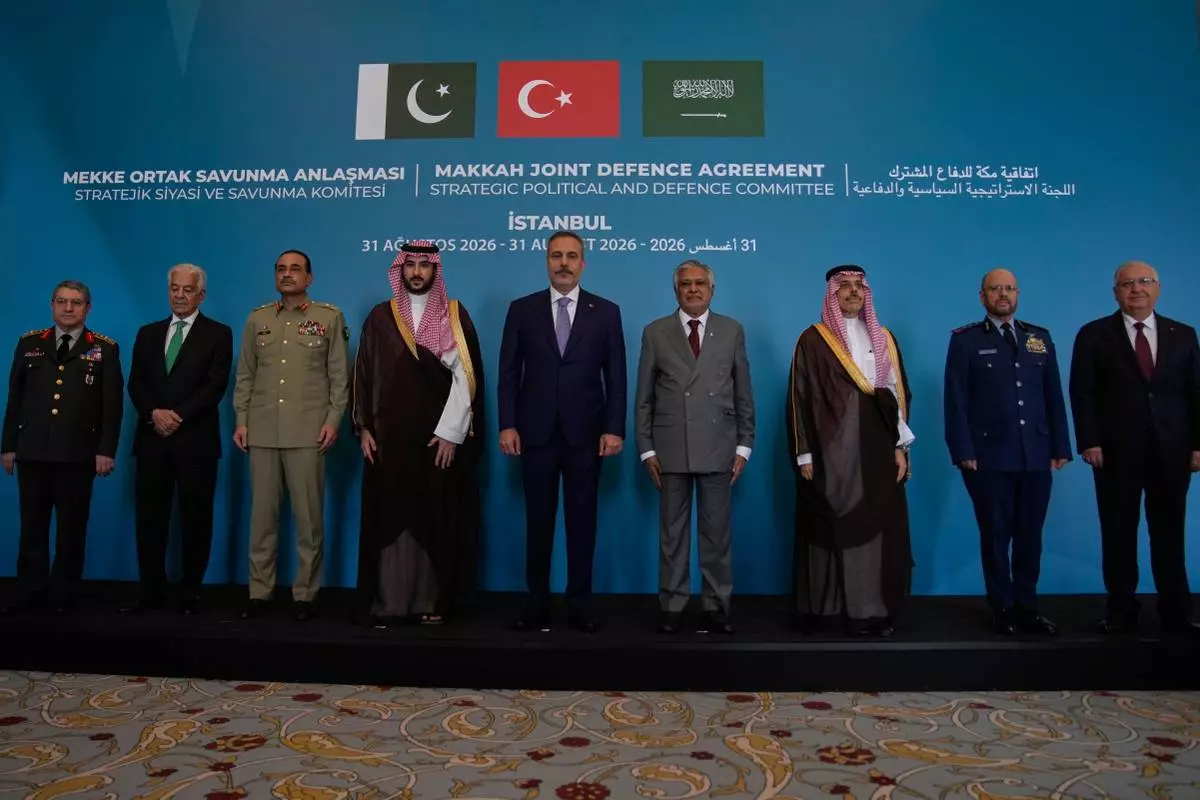
FILE - From center, Turkish Foreign Minister Hakan Fidan poses for a family photo with Pakistan's Foreign Minister Ishaq Dar, right, Saudi Foreign Minister Prince Faisal bin Farhan Al Saud, second right, and senior military and civilian officials from Turkey, Pakistan and Saudi Arabia at the first meeting of the Strategic Political and Defense Committee established under the Makkah Joint Defence Agreement in Istanbul, Turkey, Aug. 31, 2026. (AP Photo/Khalil Hamra, File)