CHICAGO--(BUSINESS WIRE)--Nov 29, 2026--
At the Radiological Society of North America (RSNA) 2026 Annual Meeting, GE HealthCare (Nasdaq: GEHC) will showcase more than 40 bold innovations designed for the next era of medicine to help health systems advance precision care, improve efficiency and support more confident clinical decision-making.
This press release features multimedia. View the full release here: https://www.businesswire.com/news/home/20261128467723/en/
According to the American Medical Association, 45.2% of radiologists reported experiencing at least one symptom of burnout, placing radiology among the medical specialties with the highest burnout rates. ii Workforce pressures are also increasing: a 2026 study found that annual U.S. radiologist attrition more than doubled from 1.1% in 2014 to 2.5% in 2022. iii Together, these pressures underscore the need for solutions that can help care teams manage workload, support efficient workflows and enable clinicians to focus more time on patient care.
“Radiologists are navigating growing demands in an increasingly complex environment. We have an opportunity to connect imaging, pharmaceutical diagnostics, AI, software and cloud-enabled solutions to turn data into actionable insights, simplify workflows and improve care across the patient journey,” said Peter Arduini, President and CEO of GE HealthCare. “At RSNA, we're demonstrating how our innovations deliver value for our customers and help make precision care a reality in everyday practice.”
Connecting innovation across the care pathways
At RSNA 2026, GE HealthCare will showcase how solutions focused on precision care, and connected across care pathways, can create meaningful clinical impact and measurable clinical, operational and economic outcomes for customers. Through a new immersive, patient-centered experience, the GE HealthCare booth will bring to life how these capabilities can support clinicians and impact patients across the care journey, from screening and diagnosis to treatment planning and follow-up. The experience will also highlight technologies designed to streamline imaging workflows — from pre-scan preparation and image acquisition to post-scan processing and review — helping radiology departments manage equipment readiness, improve operational efficiency and serve more patients.
GE HealthCare will showcase its latest innovations, including:
GE HealthCare will also highlight other recently announced innovations, including:
Additionally, GE HealthCare is committed to advancing the evolution of MR toward more autonomous, AI-enabled workflows with the vision of simplifying complex imaging processes and supporting greater consistency and efficiency and will showcase this development xi as part of a co-creation experience.
“For radiologists and care teams, the value of innovation comes down to how well it supports the work they do every day,” said Philip Rackliffe, President and CEO of Advanced Imaging Solutions at GE HealthCare. “Our focus is on developing solutions that fit into existing clinical workflows and help radiologists navigate evolving demands without adding unnecessary complexity.”
Advancing precision care through pharmaceutical diagnostics
GE HealthCare’s Pharmaceutical Diagnostics (PDx) business complements the company’s imaging technologies with diagnostic agents used across imaging modalities to help clinicians see, understand and characterize disease. Across contrast media and radiopharmaceuticals, GE HealthCare continues to invest in innovations aimed at advancing precision care.
At RSNA 2026, GE HealthCare will highlight recent advances across PDx, including Phase 2 results from its LUMINA clinical trial of mangaciclanol, an investigational manganese-based MRI contrast agent. The company also recently announced its agreement to acquire SOFIE Biosciences, a U.S. contract manufacturer of PET radiopharmaceuticals.
Subject to closing conditions, including regulatory approvals, the planned acquisition would establish a U.S. time-critical “final mile” footprint for PET radiopharmaceutical supply and broaden GE HealthCare’s participation across the radiopharmaceutical care pathway.
AI, software and cloud-enabled capabilities designed around customer realities
To help customers address current challenges and meet the needs of the future, GE HealthCare is developing AI-powered innovations aimed at helping clinicians turn data into actionable insights and deliver precise diagnoses and treatment plans faster than before.
Key highlights this year include:
Industry collaborations to drive innovation with purpose
GE HealthCare collaborates with customers, academic institutions and companies across the healthcare ecosystem to advance innovation with a purpose and help create a world where healthcare has no limits. We are actively shaping the future of healthcare through:
For more information on GE HealthCare and these innovative solutions at RSNA 2026, visit booth #7330, explore the press kit, or view the RSNA 2026 events page.
About GE HealthCare Technologies Inc.
GE HealthCare is a leading global healthcare solutions provider of advanced medical technology, pharmaceutical diagnostics, and AI, cloud and software solutions that help clinicians tackle the world’s most complex diseases. Serving patients and providers for 130 years, GE HealthCare is delivering bold innovations designed for the next era of medicine across its Advanced Imaging Solutions, Pharmaceutical Diagnostics and Patient Care Solutions segments to help clinicians deliver more personalized, precise patient care. We are a $20.6 billion business with approximately 54,000 colleagues working to create a world where healthcare has no limits.
GE HealthCare is proud to be among 2026 Fortune World’s Most Admired Companies™.
Follow us on LinkedIn, Facebook, Instagram, or visit our website for our latest news and perspectives.

The GE HealthCare booth (#7330) will spotlight innovations that bring together advanced technology, AI and software capabilities, and pharmaceutical diagnostics.
MADRID (AP) — Millions of Spaniards are voting Sunday in an election dominated by concerns over housing affordability that could see the far right enter the national government for the first time since Spain’s dictatorship ended more than a half-century ago.
The election is seen as a referendum on incumbent Prime Minister Pedro Sánchez. The left-wing leader of the Socialist party has governed Spain for eight years through numerous crises, but also a period of economic growth that, for many voters, has been eclipsed by cost-of-living concerns.
No issue has galvanized Spaniards in recent years quite like access to affordable housing. Soaring home and rental costs in cities and tourism hot spots have caused widespread discontent, especially among the young.
Last month, Sánchez announced an early election after right-wing parties in parliament voted down measures that his government introduced to alleviate housing pressures. Nationwide protests sprang up after the dramatic eviction of an 87-year-old woman from her apartment in Madrid.
Sánchez has warned voters that a conservative government wouldn't make their lives more affordable, and frequently has said that his opponents would take the country of 50 million backward.
“I'm feeling optimistic,” Sánchez told reporters after casting his vote on Sunday, saying he expected “a huge turnout.”
Participation by 2 p.m. was at 45%, about five percentage points higher than in the previous national election in 2023.
Opposition leader Alberto Núñez Feijóo of the conservative Popular Party, or PP, has promised voters more stability and better governance.
He has criticized Sánchez's record not just for his government's failure to improve Spaniards' housing woes, but also for two fatal train crashes this year on Spain's high-speed rail network, a nationwide blackout in April 2025 and a border crisis in Spain's North African exclave of Ceuta.
Feijóo also pilloried Sánchez — who relied on backing from far-left and separatist parties to cling to power in 2023 — for not being able to pass a budget in nearly four years, lacking parliamentary support.
“I ask Spaniards not to vote with fear, but with memory,” Feijóo said in Madrid after casting his ballot. “Today is a day when the Spanish people take the helm and will decide the future, the destiny, and the direction of Spain.”
It's widely expected that Feijóo will attempt to form a coalition with the far-right Vox party, led by its bearded, barrel-chested leader Santiago Abascal, who has campaigned on an immigration crackdown.
Vox is betting that its hard-line stance will win over voters and enable it to play kingmaker with the PP.
“Spain is deeply divided. There is a lot of fear on both sides, and I believe we need to soften the tense atmosphere and redirect what has been done wrong during the past eight years,” said Paloma Jiménez-Ontiveros, a 65-year-old real estate agent in Madrid, after voting.
Spain has welcomed millions of people, mainly from Latin America, but also from Africa and elsewhere in Europe. One in five residents was born outside Spain, according to census data. Earlier this year, the Spanish government legalized the status of nearly 1.2 million immigrants living in the country without authorization.
Feijóo and Abascal have portrayed Sánchez's immigration-friendly policies as harmful to ordinary Spaniards, pointing to the country's insufficient housing stock and strained public services. Both candidates have condemned the migrant legalization measure.
If Vox entered a new government as a junior member with the PP, it would mark the return of a nationalist, far-right party to power for the first time since the death of dictator Gen. Francisco Franco in 1975.
The result will also be closely watched across Europe before an election-packed 2027, in which voters will head to the polls in France, Italy, Greece and Poland.
In France, the far-right National Rally is aiming to take power, while in Italy, Premier Giorgia Meloni's right-wing coalition is expected to seek another term.
About 39 million people are eligible to cast ballots. Voting generally takes place in schools, community centers, town halls and other municipal facilities. Spaniards can also vote by mail.
Votes are tallied quickly and the result is usually known within hours. That doesn’t mean it’s quickly clear who will govern.
A Spanish prime minister will be elected by the new parliament resulting from a vote that will be convened next month. A candidate needs the support of an absolute majority — or at least 176 lawmakers — in the first parliamentary vote, often relying on coalition agreements or support from other parties.
Several opinion polls conducted before Sunday showed Sánchez’s Socialist Party behind the combined support of the PP and Vox. Sánchez will likely need backing from smaller parties to the left of the Socialists. However, infighting between those parties in the lead-up to the election is expected to weaken Sánchez’s chance at forming a progressive coalition like he did three years ago.
Sánchez, a Madrid native and former economics professor, became a hero to the global left for his government's opposition to the Israel-Hamas war in Gaza, and his resistance to U.S. President Donald Trump. He has criticized the U.S. and Israel over the Iran war, and was one of Western Europe’s first major leaders to formally recognize Palestinian statehood.
Sánchez's government has turbocharged Spain's climate commitments, pledging to source all its energy from renewable sources by 2050. The country already generates more than half its electricity from noncarbon sources. But his critics say that his overreliance on renewables was responsible for the 2025 blackout.
He's the first Spanish prime minister to speak comfortably in English.
Sánchez's party, including members of his inner circle, has been dogged by legal cases involving corruption. The cases have implicated a former minister and top officials, eroding voters' trust.
Feijóo, in contrast, is a lifelong civil servant-turned-politician from rural northwestern Galicia who doesn't speak English and projects himself as a sensible, moderate and effective administrator.
Joseph Wilson contributed to this report from Barcelona, Spain.

Braulina and Sebastian, originally from the Dominican Republic, who moved to Spain in 2003, wait with their daughters, Thiara and Alaia, to cast their ballots at a polling station during Spain's general election in Barcelona, Spain, Sunday, Nov. 29, 2026. (AP Photo/Emilio Morenatti)

People line up outside a polling station to cast their ballots in Spain's general election in Madrid, Spain, Sunday, Nov. 29, 2026. (AP Photo/Francisco Seco)

People line up at a polling station to cast their ballots in Spain's general election in Madrid, Spain, Sunday, Nov. 29, 2026. (AP Photo/Manu Fernandez)
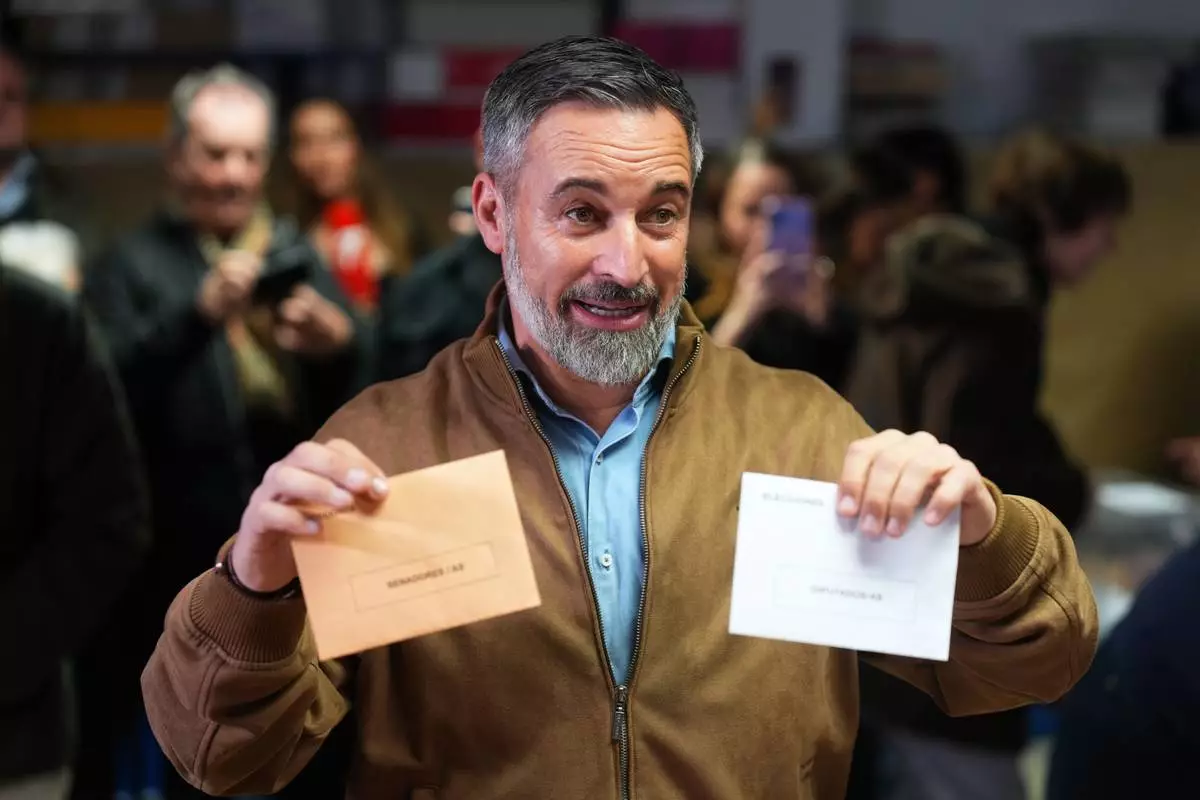
Vox leader and candidate Santiago Abascal poses with his ballots when voting in Spain's general election at a polling station in Madrid, Spain, Sunday, Nov. 29, 2026. (AP Photo/Manu Fernandez)

Voters select their ballots at a polling station during the general election in Barcelona, Spain, Sunday, Nov. 29, 2026. (AP Photo/Emilio Morenatti)

Popular Party candidate Alberto Núñez Feijóo casts his ballot in Spain's general election at a polling station in Madrid, Spain, Sunday, Nov. 29, 2026. (AP Photo/Bernat Armangue)
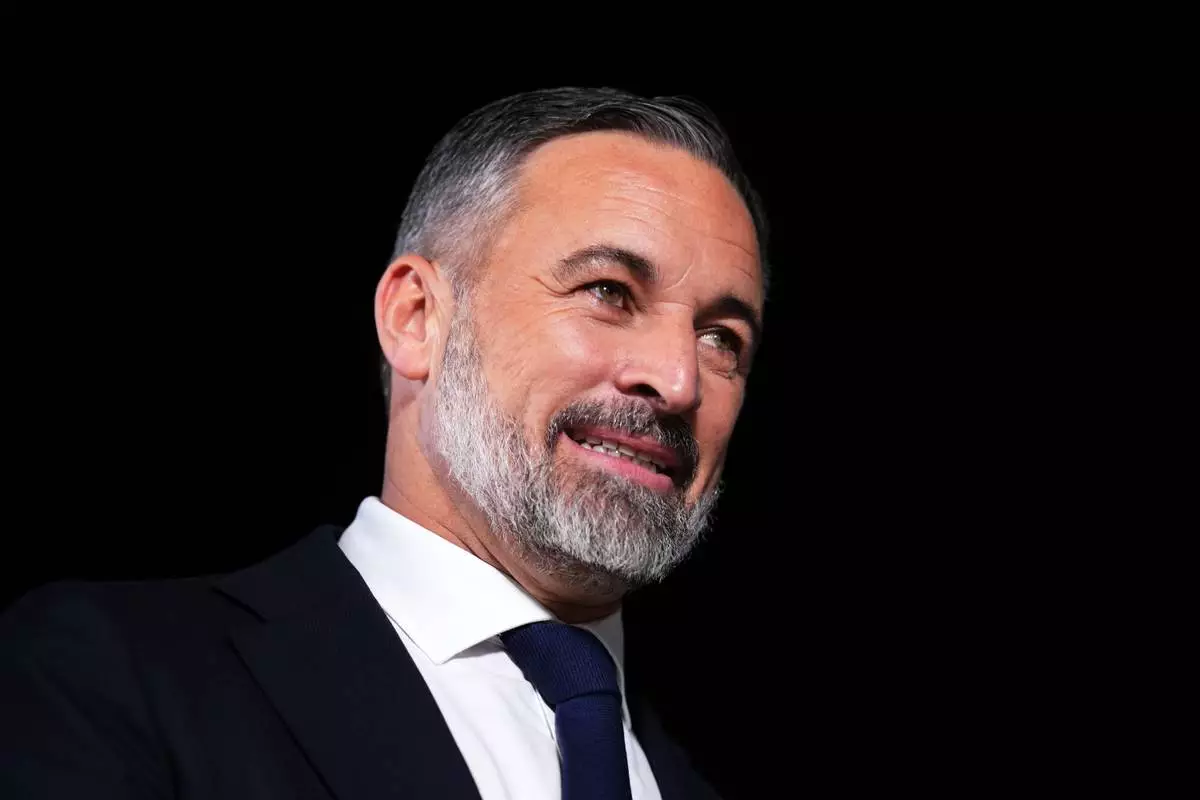
Santiago Abascal, leader of Spain's far-right Vox party, arrives for a live televised debate in Madrid, Spain, Thursday, Nov. 26, 2026. (AP Photo/Manu Fernandez)

A person picks a ballot to vote in Spain's general election at a polling station in Madrid, Spain, Sunday, Nov. 29, 2026. (AP Photo/Manu Fernandez)

Spain's incumbent Prime Minister Pedro Sanchez votes in Spain's general election at a polling station in Madrid, Spain, Sunday, Nov. 29, 2026. (AP Photo/Francisco Seco)

Voters pick up ballots before voting at a polling station in Spain's general election in Madrid, Spain, Sunday, Nov. 29, 2026. (AP Photo/Manu Fernandez)
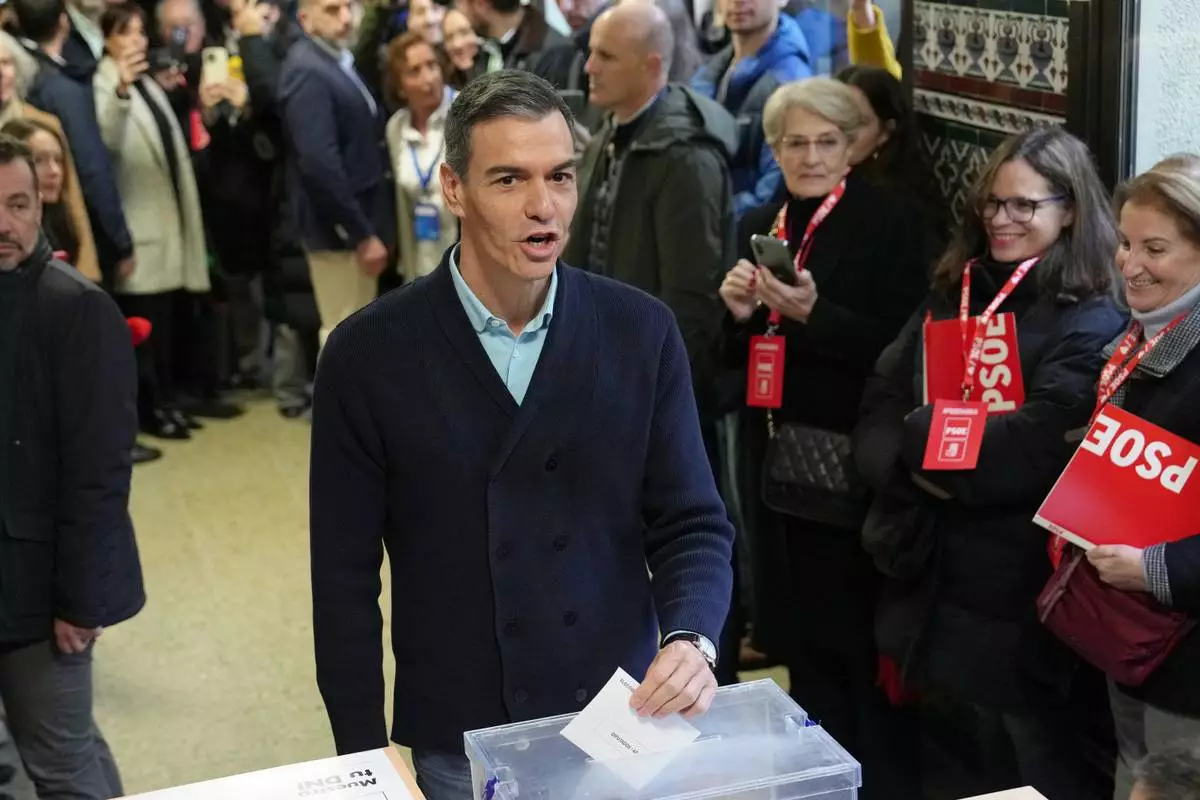
Spain's incumbent Prime Minister Pedro Sanchez votes in Spain's general election at a polling station in Madrid, Spain, Sunday, Nov. 29, 2026. (AP Photo/Francisco Seco)
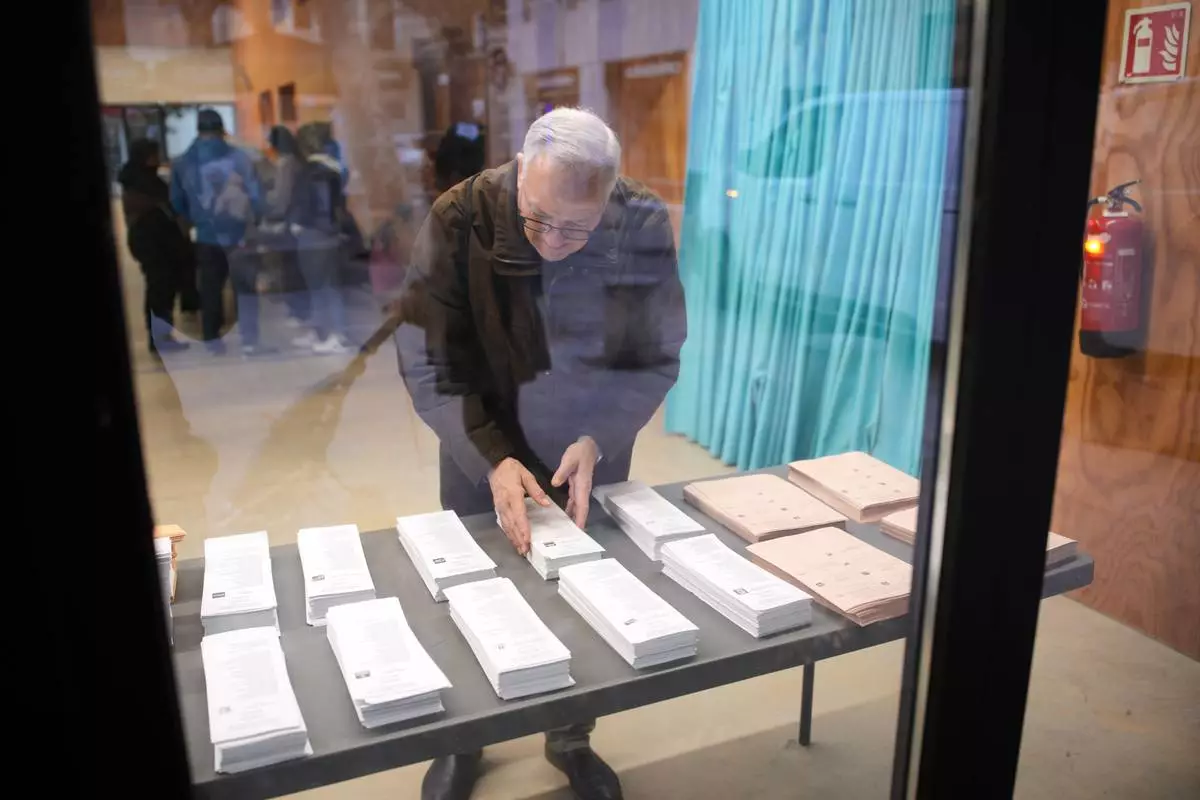
An election worker organizes ballots at a polling station in Spain's general election, in Barcelona, Spain, Sunday, Nov. 29, 2026. (AP Photo/Emilio Morenatti)

Spain's Prime Minister and Socialist Party Secretary-General Pedro Sánchez waves to supporters at the final campaign rally ahead of Sunday's general election in Madrid, Spain, Friday, Nov. 27, 2026. (AP Photo/Francisco Seco)

Popular Party candidate Alberto Nunez Feijoo waves to supporters during a campaign rally ahead of the general election in Madrid, Spain, Wednesday, Nov. 25, 2026. (AP Photo/Francisco Seco)

FILE, Santiago Abascal, leader of the far-right Vox party, arrives to an electoral rally in Madrid, Friday, Nov. 13, 2026, on the first day of the campaign ahead of general elections. (AP Photo/Francisco Seco, File)

Popular Party supporters wave Spanish flags as they listen to speeches during a campaign rally ahead of the general election in Madrid, Spain, Wednesday, Nov. 25, 2026. (AP Photo/Francisco Seco)

From left, the leader of the far-right Vox party, Santiago Abascal, Spain's Prime Minister and Socialist Party Secretary-General Pedro Sánchez and Popular Party candidate Alberto Núñez Feijóo pose for a photo at the start of a live televised debate in Madrid, Spain, Thursday, Nov. 26, 2026. (AP Photo/Manu Fernandez)