I shouldn't laugh but…
Italy's Olympic bigwig Giovanni Malago said he wanted to file an official complaint with organizers that Hong Kong's nail-biting fencing win against Italy was unfair.
Why? Because the referees were from South Korea and Taiwan, he thundered. He indicated that he believed that since those two places were neighbors of China, they would be biased towards China! Obviously!
Oops.
Er. Actually, Giovanni…
Someone needs to quietly explain to him that Taiwan is a "giant weapons depot" (so said the New York Times) for the US to use against Chinese people, and plans are far advanced for South Korea to become another one, filled with nukes, no less.
So not exactly supporters of Mainland China, then.
Pizza Hut in Hong Kong is offering free extra pineapple chunks in a humorous reference to the Italy-Hong Kong showdown in the Olympic fencing finals -- narrowly won by Hong Kong.
Conventional wisdom says that Italians are horrified by pizza served with pineapple. Wars have been started for less!

The Olympics top ten list is ALWAYS a list of countries, but one city has crept on to that list, ahead of almost 200 nations, one glorious day, just after the games opened.
Memories of media trickery:
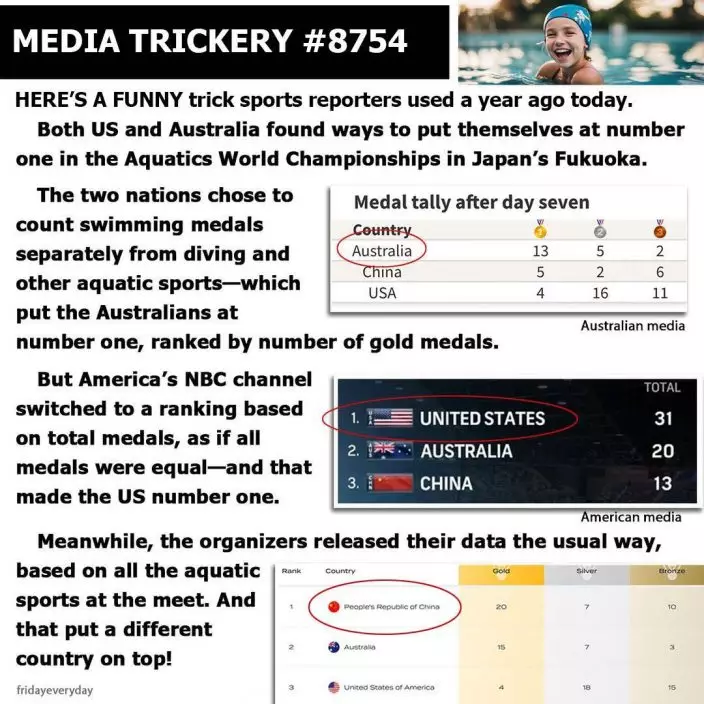
I'm not going to get into the US trick of re-jigging Olympic results to change who is number one medal winner, but it's nice to have statistics confirm that our tiny, underdog city looks like it is number one on a per head basis, at least for this moment.

by Nury Vittachi
Lai See(利是)
** 博客文章文責自負,不代表本公司立場 **
A White Booster Fragment Reopens an Old Mystery
A chunk of ballistic missile booster debris appeared in the Raghwan area of northern Marib Governorate, Yemen on September 14.
Images show the missile body painted an unusual white and marked with “DF-15A.” Its structure and dimensions point to China's DF-15 short-range ballistic missile.
Open-source defense analysts read that as a likely Saudi missile fired at a Houthi target inside Yemen.
For now, the available evidence is just a few social media photos. Saudi Arabia has not confirmed it, and no authoritative third-party institution has verified it.
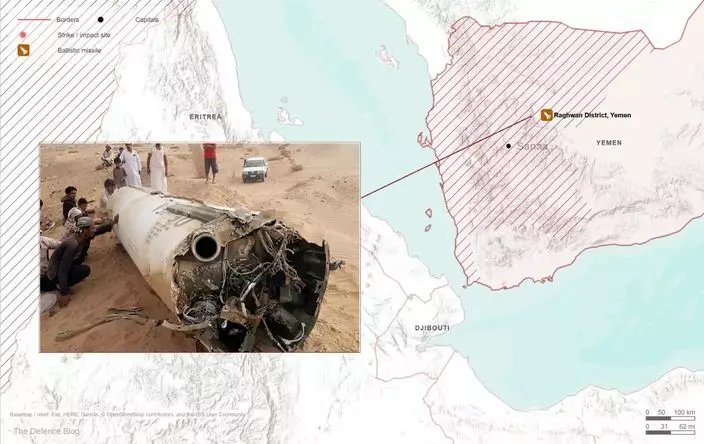
DF-15A debris in Yemen—fired from a Saudi base?
The DF-15 is a mature single-stage solid-fuel tactical ballistic missile made by China.
It is about 9.1 meters long and 1 meter in diameter, with a total weight of 6.2 tons. Its maximum range is 600 kilometers, and it can carry a warhead of nearly 1 ton.
It uses a wheeled high-mobility launch vehicle and has a rapid-response capability of “stop and launch.”
For more than a year, outsiders have speculated whether Saudi Arabia possesses the DF-15.
Yoel Guzansky, a scholar at an Israeli think tank, has analyzed the question. He argues that while the Royal Saudi Strategic Missile Force introduced long-range deterrence, it very likely secretly procured short-range ballistic missiles such as the DF-15 to build a layered strike capability.
Then there is the 2013 model. When Prince Fahd, then Saudi Deputy Defense Minister, visited the Strategic Missile Force headquarters, the commemorative model he received showed three missiles side by side. Many at the time speculated they corresponded to the DF-15, DF-21, and the older DF-3.
Those early details are now being raised again because of the debris on the Yemen battlefield.

A gift model fueled years of DF-15 speculation.
Saudi Arabia's ballistic missile dealings with China go back to the 1980s. During the Iran-Iraq War, the “War of the Cities” missile attacks made Saudi Arabia feel security pressure.
In 1987, the two sides reached a defense project codenamed “Golden Wheel Project.” Saudi Arabia imported the DF-3 medium-range liquid-fuel ballistic missile and used it to build the Royal Saudi Strategic Missile Force, independent of the army, navy, and air force.
The liquid-fueled DF-3 required long preparation time and complex maintenance, with obvious operational limitations. After 2000, Saudi Arabia has introduced the DF-21B solid-fuel medium-range ballistic missile, with a range close to 2,000 kilometers and markedly improved strike accuracy.
If the DF-15 was indeed among the purchases, its timing would roughly fall between the two.
So why use missiles in Yemen instead of sending aircraft?
Why Jets Alone No Longer Solve the Problem
Saudi Arabia has one of the largest air forces in the Middle East. Its F-15SA and Typhoon fleets together number in the hundreds, and their payload capacity and precision-guided strike capability are first-rate. Two F-15s carrying several tons of precision-guided bombs usually deliver more against a target inside Yemen than a single DF-15A with a warhead of less than half a ton. On pure strike efficiency, the aircraft should be the first choice. The problem isn't the aircraft. It's the conditions needed to keep them flying sortie after sortie.
A modern air force cannot be made operational simply by buying a few fighter jets. Behind a single F-15 sortie is an entire chain: secure bases, intact runways, aviation fuel, ammunition depots, maintenance personnel, spare parts supply, and aerial refueling formations. If any link in that chain is continuously disrupted, the number of aircraft on paper separates from the number of sorties that can actually be flown each day.
The Houthis have built their recent tactics around exactly this logistics chain. On September 8, they said they used missiles and drones to hit King Khalid Air Base, Saudi Aramco oil facilities near Abha, and multiple targets in Jizan and Najran. Saudi authorities later confirmed attacks in several locations and said there were injuries.
By September 14, the Houthis again claimed to have struck hangars, radar, runways, and ammunition depots at Khamis Mushait Air Base. None of these targets were frontline positions. They were the core logistical hubs for Saudi air force operations, and the Houthi aim was to directly degrade the ability of Saudi warplanes to sustain sortie generation.
For Saudi air force planners, this means a higher cost per sortie. In the past, an F-15 taking off from Khamis Mushait had a very short flight to target areas in Yemen and could fly multiple waves in a day. The base can still be used now. But before each sortie, more time must be spent assessing runway safety, ammunition stocks, and fuel reserves. If missions are pulled back to Taif or even bases in central Saudi Arabia, the distance to Yemen nearly doubles, dependence on aerial refueling increases sharply, and the number of daily sorties from the same aircraft fleet declines.
In this context, ballistic missiles become far more attractive. They do not need runways, pilots, or tanker aircraft. They do not consume sortie capacity at harassed forward bases, and they do not expend U.S.-provided precision-guided bombs. With solid-fuel propulsion and pre-set parameters on mobile launchers, they can hit targets directly from several hundred kilometers away.
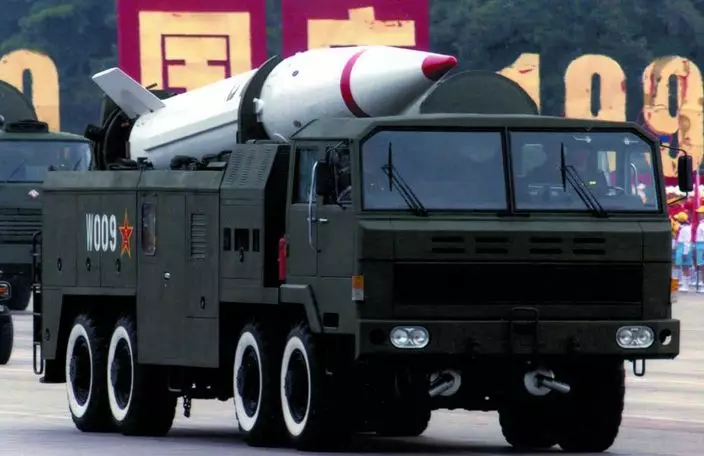
Truck-mounted missiles strike fast—no air bases needed
A Two-Tier Strike System Takes Shape
The DF-15A is a short-range ballistic missile that China finalized in the 1990s and brought to the international market in the 2000s. It is not cutting-edge by today's standards, but its attributes strike at Saudi Arabia's current pain points.
It also has shortcomings. It is not cost-effective against moving targets, costs more than a conventional airstrike, and is less accurate than laser-guided bombs. So it will not replace aircraft. Instead, it backfills specific scenarios: striking fixed command posts, frontline assembly areas, storage facilities, or conducting high-intensity area denial as the Houthis advance.
If the reports are true, what is Saudi Arabia trying to convey by using the DF-15? It does not look like a gesture aimed solely at Iran. Iran does not need a piece of wreckage to confirm that Saudi Arabia has ballistic missiles.
Nor does it necessarily mean Saudi Arabia is short of warplanes. Saudi Arabia still maintains hundreds of advanced fighter jets, and its force structure has not changed. What is really being tested is the sortie rate of frontline aircraft and persistently high combat costs.
The signal truly worth noting is that Saudi Arabia is adjusting its strike system. It is moving from an air-heavy approach to a two-tier structure of 'air plus ballistic missiles.'
When the air chain is functioning normally, F-15s and Typhoons carry the main precision-strike burden. When bases are disrupted, fuel is tight, precision munitions must be conserved, and the cost of forward sorties is too high, ballistic missiles take over some conventional missions.
This is an adjustment made under battlefield pressure by a military of considerable size. It is not a sign of desperation.
This piece of wreckage on the battlefield in northern Yemen, whether or not it is ultimately confirmed, has already put a question on the table. When ballistic missiles move from the strategic deterrence arsenal into the conventional strike sequence, it shows that battlefield friction has become large enough to change a country's approach to striking.
If this wreckage is ultimately confirmed, it would also mean another thing: a Chinese-developed DF-series ballistic missile has left a record of actual combat use for the first time.
Since the DF-3 was exported to Saudi Arabia in 1987, the series has for decades been synonymous with strategic deterrence. Its purpose has been 'to keep others from acting' rather than 'to be fired.'
For more than thirty years, it has never truly fallen on a battlefield.
The First Combat Mark, and Why Caution Still Matters
This time, the difference is in kind. Moving the missile from the strategic deterrence stockpile into the conventional strike sequence turns it from a showpiece trump card into an expendable combat asset.
Once that threshold is crossed, the positioning that follows will shift too, but overselling its significance should be cautioned. A short-range ballistic missile hitting a staging area in northern Yemen has limited tactical value. It cannot change the course of the battlefield.
What has truly changed is how the outside world sees China's exported ballistic missiles. In the past, their capabilities stayed mostly on specification sheets and parade grounds. Now battlefield data exists, whether good or bad, and it becomes a verifiable reference in the international arms trade market.
Until the evidence firms up, the phrase "the world's first combat use" still calls for caution. The rare white missile body may indicate something, but it cannot indicate everything.