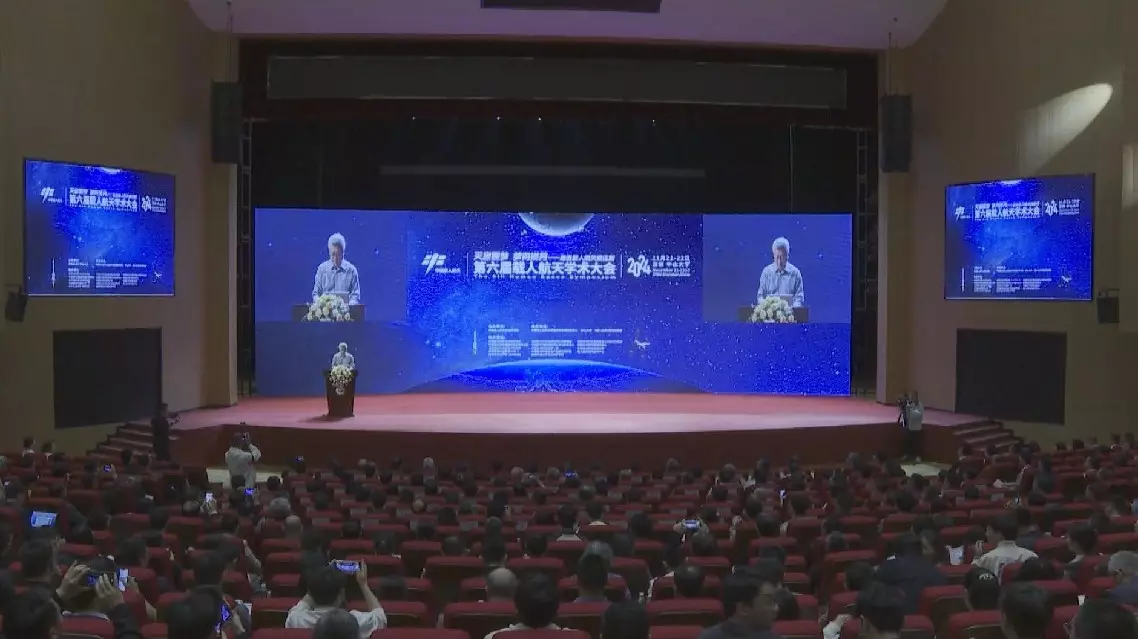
China's manned space program has entered an advanced stage of space station application and development, and the manned lunar exploration project is progressing steadily, according to experts at the ongoing sixth Human Space Symposium.
The two-day symposium started on Thursday in Shenzhen, south China's Guangdong Province, and brought together over 800 experts and scholars from the manned space field to share cutting-edge academic research results and discuss the development blueprint of China's manned space program.
"Our space station is currently a three-cabin configuration, but it is designed with a capacity to be expanded to twice its current size. In the next 10 years, we will focus on the fields of human science, life science, microgravity science, astronomy, and basic physics," said Zhou Jianping, chief designer of China's manned space program, at the symposium.
Experts said that the research and construction of various elements of the manned lunar landing and exploration project are currently progressing steadily.
China plans to land an astronaut on the moon before 2030, and make breakthroughs in key technologies such as manned round-trip travel between the Earth and the Moon, short-term stays on the lunar surface, and joint human-machine exploration.
Key equipment for the lunar project, including the Long March-10 carrier rocket, the Mengzhou manned spacecraft, the Lanyue lunar lander, the lunar spacesuit, and the manned lunar rover, are currently undergoing prototype production and ground testing, and ground facilities at the Wenchang launch site are under construction.
China's manned lunar mission progressing smoothly