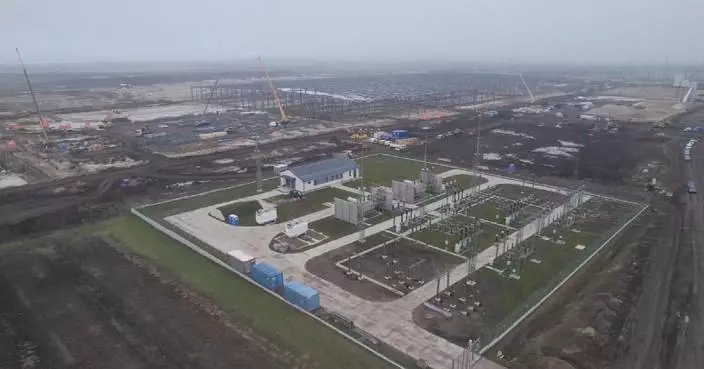
Young developers of the world's first urban megawatt-level airborne wind turbine shared the story of their striving towards the goal, stressing that the achievement was made thanks to China's complete industrial system and development of new quality productive forces.
The wind turbine, S2000, was successfully put into stable operation on Jan 5 in Yibin, southwest China's Sichuan Province, generating 385 kilowatt-hours of power in a single day.
Sawestoone Company, developer of the turbine, was founded by a young team with an average age of less than 32. Two of its core founders, Dun Tianrui and Weng Hanke, were both born in 1998.
Dun and Weng were high school classmates, born and raised in south China's Shenzhen City. In 2018, with the quiet rise of artificial intelligence, the two young men had the idea of starting up their own business.
"In fact, we have had many fantasies about the sky and outer space since we were young. When I was in school, the education I received was about the deeds of our predecessors in the 'Two Bombs, One Satellite' project. So I am actually quite interested in rockets, satellites and missiles," Weng said.
The "two bombs and one satellite" referred to the nuclear bombs (atomic and hydrogen bombs), the missile, and the space satellite. It was a general term for China's efforts to develop its own nuclear and space technologies. In the 1950s, facing Western nuclear threats and political blackmail, the first-generation leadership of the Communist Party of China assessed the world situation and decided that China needed to develop its own atomic bombs, missiles and space satellites.
"We spend our holidays together every year and share the new achievements we've made throughout the year. Actually, we had a lot of plans in mind back then," Dun said.
After numerous discussions, Dun and Weng decided to focus their startup on high-altitude wind power generation. As a barren land in the field of new energy, a series of world-class technical challenges were faced by the young people.
In 2020, after two years of technical research and industry chain investigation, they began technical verification of airborne wind power generation. After experiencing failures and losses, Dun and Weng led their team to successfully launch the second model, overcoming core challenges such as initial attitude control and power transmission.
"Before the company was established, this small dream team had already begun to work towards its goals. However, what truly brought about a qualitative change for us was the year [2023] in which the country proposed the development of new quality productive forces. In that year, entrepreneurship suddenly became a completely feasible thing for us, making things that we had never dared to imagine accessible and achievable," Dun said.
In June 2023, Sawestoone was officially established in Beijing. Within a year, it completed three rounds of financing, securing investments from numerous well-known institutions and establishing strategic partnerships with top academic institutions such as the Tsinghua University and the Aerospace Information Research Institute of the Chinese Academy of Sciences.
"It was the collective will of the times that led to our success. My personal will was merely a small spark in the process. What truly set this massive wheel running was the well-established industrial system, the comprehensive engineering system, and the immense national will that was driving the nation's progress. Most importantly, we share the ultimate dream of this era: to lead development of the coming era," Dun said.
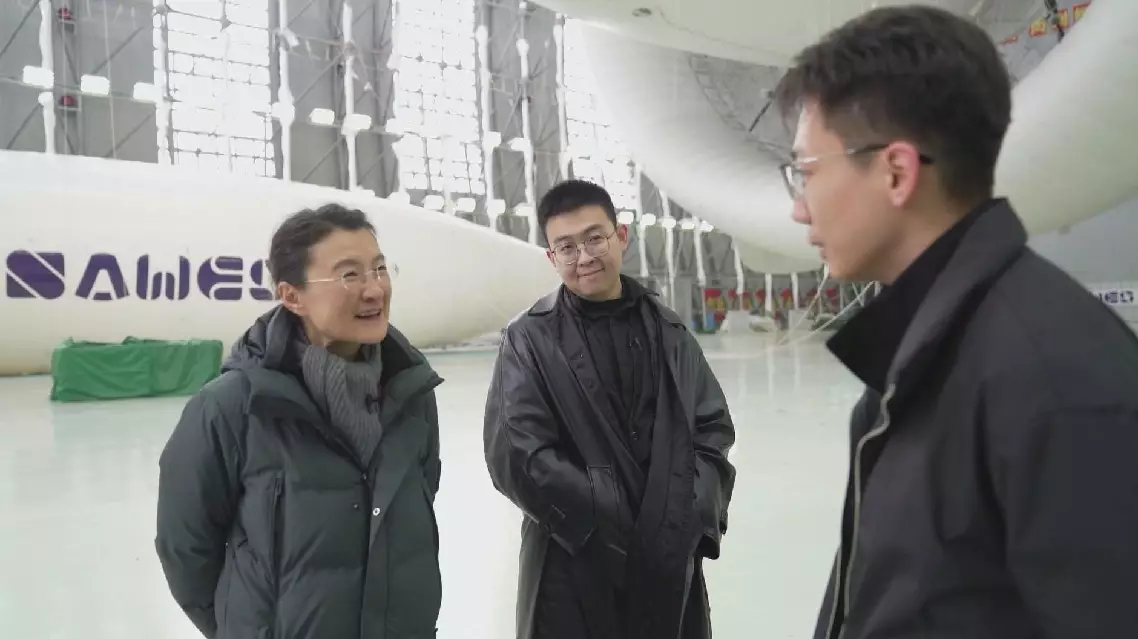
Young entrepreneurs share story behind China's airborne turbine