Chinese researchers on Thursday unveiled three-dimensional facial reconstructions of the Yunxian Man skull fossils, marking the world's first scientific effort to restore the appearance of human ancestors dating back one million years. The facial reconstruction project, spanning nearly eight years, was a collaborative endeavor involving multiple institutions including the Hubei Provincial Museum, Shanxi University, and the Chinese Academy of Sciences.
A high-resolution industrial scanner was employed to reconstruct the models of the Yunxian Man skull fossils No. 1 and No. 2. Based on these models, the research team used sculpting, painting, and computer imaging to recreate the original appearance of the skulls, with lifelike facial features such as eyes, noses, mouths, ears, skin textures, and hair being rebuilt.
The findings suggest that the skull No. 1 belonged to a female and No. 2 to a male, both aged between 25 and 45, who lived approximately one million years ago.
"After completing the reconstruction, it was immediately clear which one was male and which was female. The most important task was identifying their species—whether they were Homo erectus or early Homo sapiens. Based on the features such as the brow ridge, bridge of nose, cheekbones, and overall facial structure, they are closer to Homo erectus. About 60 percent to 70 percent of their traits are quite primitive," said Professor Feng Xiaobo from the School of History and Culture of Shanxi University.
In 1989, 1990, and 2022, archeological teams discovered three ancient human skull fossils in Yunyang District, Shiyan City, Hubei Province, which were later named Yunxian Man skull fossils No.1, No.2, and No.3. They are believed to be the most complete ancient human skulls of their era ever discovered in Eurasia, filling a crucial one-million-year gap in the human evolution timeline from the Yuanmou Man, to the Lantian Man and the Peking Man.
These fossils provide vital evidence for studying the evolution of Homo erectus in East Asia and offer insights into the origins of humans in the region.
"Yunxian Man was at a critical juncture in the emergence and development of humans in Eurasia. These skull fossils provide invaluable evidence for studying the origins of humans in the East. In addition, after the reconstruction, we can compare their key features with those of humans from the same period or earlier and later stages of evolution, which provides significant academic support for research into the history of human evolution," said Wang Xianfu, deputy director of the Hubei Provincial Museum.
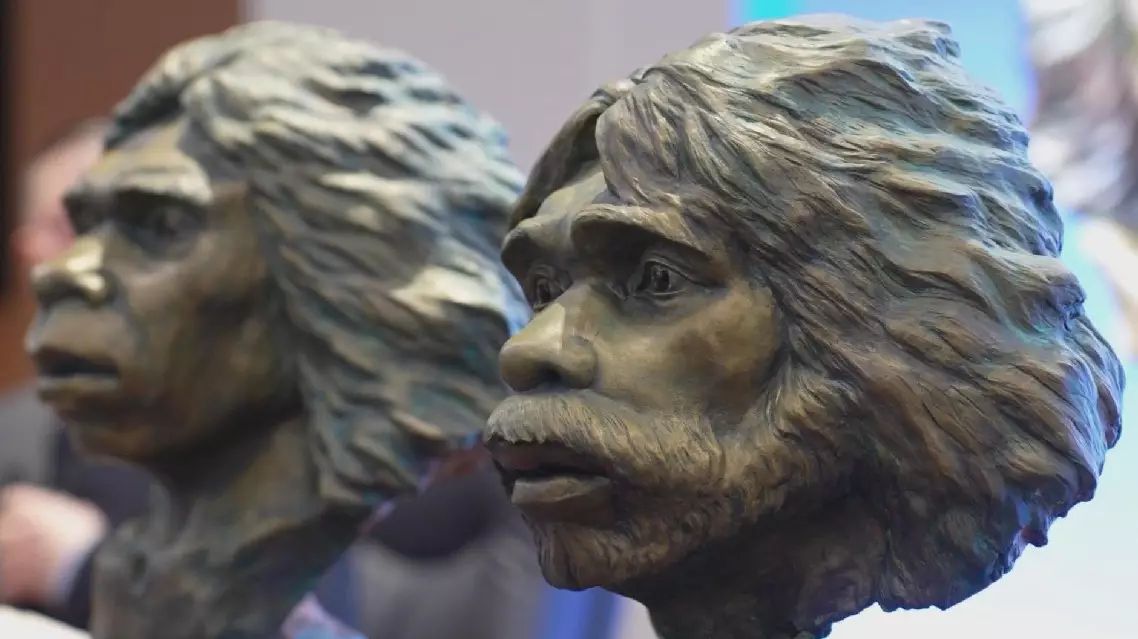
China unveils facial reconstruction of million-year-old human fossils