China's economic and trade exhibition sector experienced steady growth in 2024, with a total of 3,844 events held, according to a report released by the China Council for the Promotion of International Trade (CCPIT) on Friday.
The report was released at the 20th China Expo Forum for International Cooperation (CEFCO), a key annual event in the global exhibition industry, which opened in north China's Tianjin Municipality on Thursday.
Themed "Empowering a Sustainable Future with New Quality Productive Forces," the three-day forum has attracted over 600 industry professionals from 20 countries and regions, including China, the United States, Canada, and the United Kingdom, with participants sharing insights and discussing the future prospects of the global exhibition industry.
The report shows that in 2024, a total of 3,844 economic and trade exhibitions was held nationwide (excluding Hong Kong, Macao and Taiwan regions), with a total exhibition area of 155 million square meters.
The number of exhibitions remained basically the same as the previous year, while the exhibition area increased by 10.1 percent year on year. The average exhibition area per exhibition increased from 35,900 square meters in 2023 to 40,300 square meters, an increase of 12.3 percent.
"In terms of exhibition scale distribution, it has continued to optimize. In 2024, the number of small exhibitions with an area of 10,000 square meters or less dropped sharply, a year-on-year decrease of 25.8 percent; the number of large and medium-sized exhibitions with areas of 50,000 to 100,000 square meters increased significantly, a year-on-year increase of 11.8 percent," said Wu Shengrong, head of the department of exhibition under the China Council for the Promotion of International Trade.
The report also shows that China's outbound exhibitions are showing a strong momentum of development. In 2024, the number of overseas exhibition projects approved by CCPIT and actually fulfilled reached 1,166, including 99 overseas exhibitions hosted by Chinese units. These projects involved 68 organizers and more than 50,000 exhibitors from 60 countries or regions.
The top three countries in terms of the number of China's outbound exhibition projects in 2024 are Germany, the United States, and Russia.
"We don't look at it as competitiveness, we look at it as cooperation. I do think that our industry, more than many industries, recognize that if the China trade show industry is strong, and the U.S. trade show industry is strong, we all benefit. I do feel that the collaboration is increasing, and I think that 2025 is really (great). The optimism is that we can all have a great year, this coming year," said Vincent Polito, CEO of Society of Independent Show Organizers.
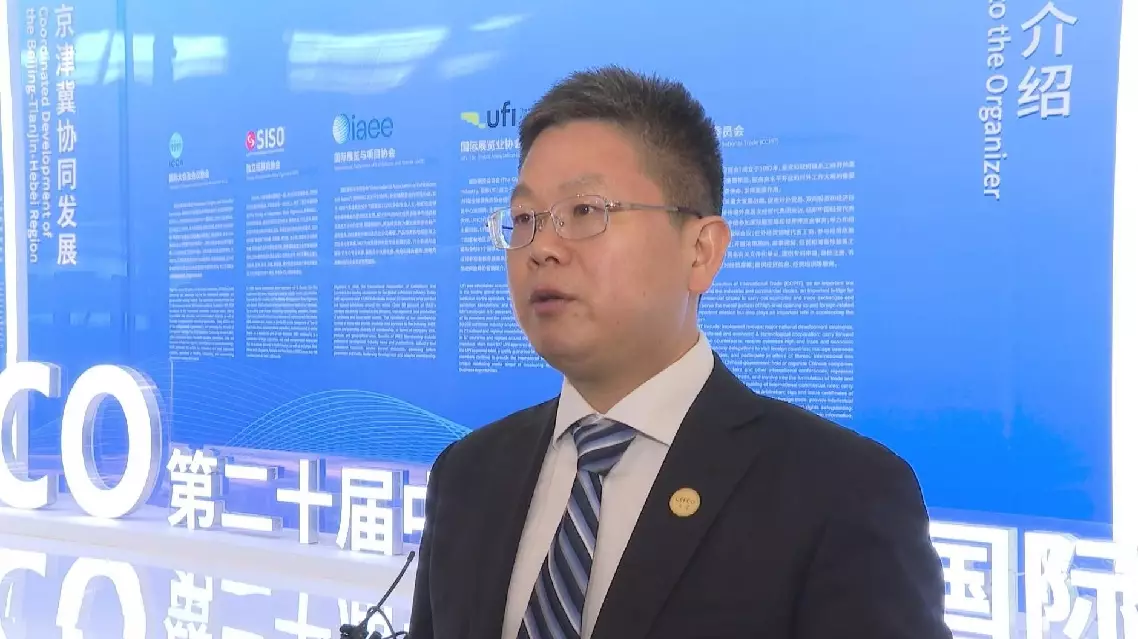
China's exhibition industry shows steady growth in 2024: report
A Chinese research team has successfully mass-produced rocket propellant tank domes using their pioneering cryogenic forming technology, which can reduce production cycle time by more than 90 percent.
The team, from the lab of high-performance precision manufacturing at Dalian University of Technology's School of Mechanical Engineering, has developed the world's first large cryogenic forming press to make one-piece rocket propellant tank domes over two meters in diameter from aluminum alloys.
In cooperation with a Chinese company, they have realized the production capacity of about 1,000 tank domes per year.
"The key to cryogenic forming is cooling large plates into the cryogenic zone. This equipment has broken through the challenges of rapid transport and precise temperature control of large-volume liquid nitrogen, as well as coordinated loading control of multiple parameters, including temperature, pressure, and displacement. It enables the control of liquid nitrogen at minus 190 degrees Celsius, the designed cooling of materials, and thus stable manufacturing of large components. It can reduce the production cycle time by 90 percent from more than one week to just a few hours," said Fan Xiaobo, a researcher at the school.
The cryogenic forming press can make a rocket propellant tank dome out of a four-millimeter aluminum alloy plate in a single step, with a thickness deviation of less than 0.3 millimeters.
The core enabler of the stable operation of this equipment is the aluminum alloy cryogenic forming technology pioneered by the team.
"Generally, metals become brittle at cryogenic temperatures, so they are considered harmful. However, our research team discovered that aluminum alloys in a specific state not only avoid cold brittleness but also exhibit higher elongation and hardening indexes at cryogenic temperatures. Using this abnormal phenomenon, we have developed the world's first aluminum alloy cryogenic forming technology, and transformed the conventional approach of 'heating when ambient temperature fails' to a cryogenic approach, enabling us to make a monolithic tank dome from a thin plate in one go. The forming press can generate a finished product that can be used directly, requiring no further welding or milling," Fan said.
The new tank domes have been successfully applied in flight missions of Long March-12 and Long March-7A Y14 carrier rockets.
"This technology enables the production of one-piece tank domes, which is especially critical for reusable rockets. We will continue to push forward and apply this cryogenic forming technology to enable self-reliance in aircraft and unmanned systems and to promote low-cost manufacturing of thin-walled structures for new-energy vehicles and high-speed trains," said Qi Chang, head of the school.
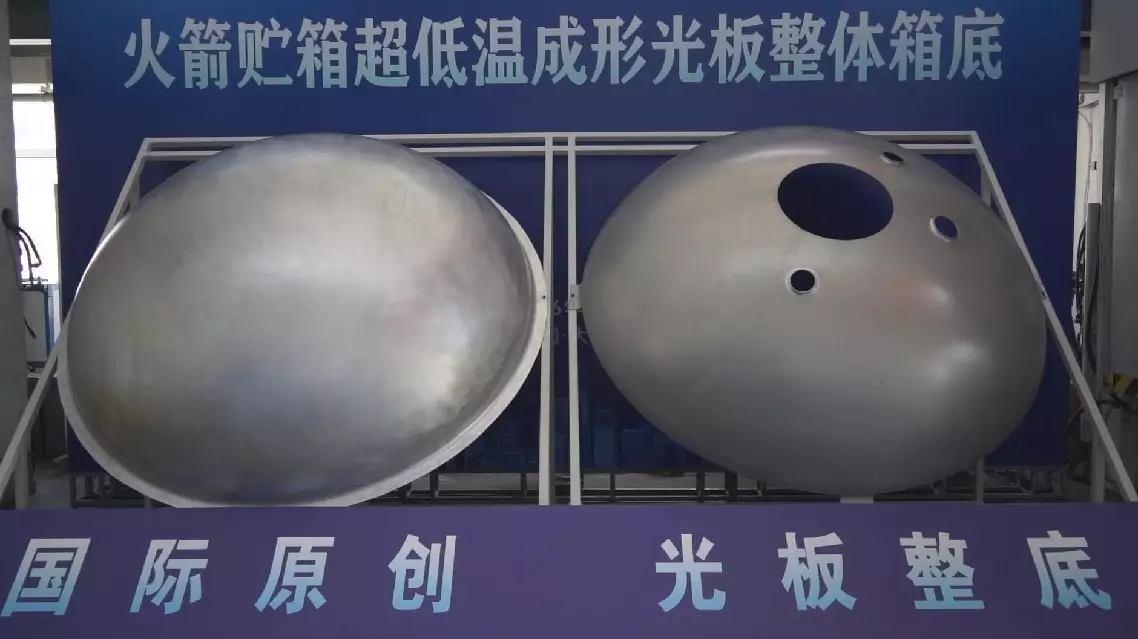
China achieves mass production of rocket propellant tank domes using cryogenic forming technology
China achieves mass production of rocket propellant tank domes using cryogenic forming technology