The Ethiopia-China Economic and Trade Forum was held in the capital Addis Ababa on Monday, bringing together high-level officials and business leaders from both nations.
The event also served as a promotion conference for the upcoming third China International Supply Chain Expo which is slated for July 16-20.
Co-hosted by the China Council for the Promotion of International Trade, Ethiopian Investment Commission, and Ethiopian Chamber of Commerce and Sectoral Associations, over 200 people, including officials, business representatives and media of both countries attended the forum.
Negus Kebede, director-general of Middle East, Asia and Pacific Affairs at the Ethiopian Ministry of Foreign Affairs, noted that over the decades, Ethiopia and China have deepened their cooperation across multiple sectors, making Ethiopia one of the pioneering African countries to embrace the China-proposed Belt and Road Initiative (BRI).
"Ethiopia is undergoing an economic transformation, opening vast investment opportunities across multiple sectors. Our all-weather strategic partnership with China has been instrumental to deepen our collaboration in key economic sectors," Kebede said.
During the meeting, representatives of both sides introduced their respective business environments, conducted corporate matchmaking, and had discussions on deepening cooperation.
"We've noticed some demands from Africa in infrastructure and mining. We hope to conduct in-depth conversations with Ethiopian proprietors and project leaders to further discuss cooperation opportunities," said Chen Yu, representative of a Chinese manufacturing company.
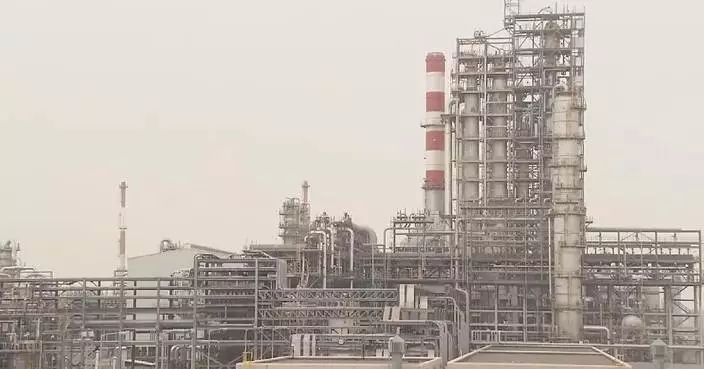
"For us, a petrochemical company, we have crucial projects in South Africa, Egypt and Nigeria. We hope to extend our projects to more countries in Africa, so as to further enhance their industrialization level and promote China-Africa economic and trade cooperation," said He Zhaowang, representative of a Chinese petrochemical enterprise.
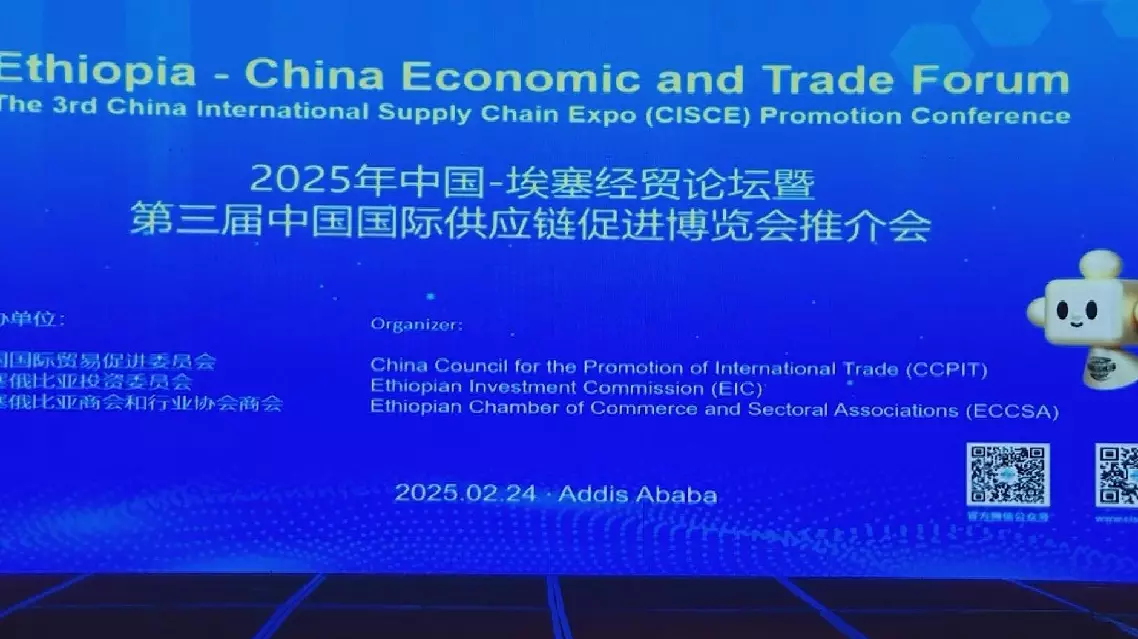
Ethiopia-China Economic and Trade Forum kicks off in Addis Ababa
Uruguay's Ambassador to China Anibal Cabral said China's five-year plan should be examined closely as a "basic input" to understand how the world will develop when talking about the significance of China's "two sessions" in a recent interview with China Central Television.
The "two sessions," or the annual gatherings of the National People's Congress (NPC) and the Chinese People's Political Consultative Conference (CPPCC), are currently being held in Beijing. The draft outline of the 15th Five-Year Plan (2026-2030) for China's national economic and social development was submitted to the fourth session of the 14th NPC for review on March 5.
Cabral said Uruguay is paying close attention to the new five-year plan, highlighting the growing ties between the two countries. He shared his views about China's development blueprint and its global importance.
"China has been Uruguay's main trading partner for the past 14 years, both for exports and imports. Of course, since it is a planned economy with five-year plans, we are always very interested in studying them. In fact, many staff members at the Ministry of Economy asked me to obtain a copy of the five-year plan so they could study it. What can we see in the five-year plan? The modernization of China, the rejuvenation of its population, and its development. It includes some of the highest planned growth rates today -- around 5 percent. But above all, it also emphasizes the consolidation of its domestic market and internal economy. The growth of income among the Chinese population is very important, as it creates a consumer base for the entire world and a very advantageous market. We should also highlight the developments China has achieved in green economy," he said.
Cabral also stressed China's positive role in promoting global stability, suggesting that China's five-year plans are good references to studying future development trends.
"It is a very uncertain world, with many changes, but China provides us with stability. With China, Uruguay shares very important principles in the international arena, especially the promotion of multilateralism, respect for international rules, and compliance with the regulations of the World Trade Organization -- topics on which Uruguay and China share a vision. This vision is part of a broader goal of a more multipolar, more democratic world with stronger global governance. I believe that nowadays, because of China's importance, most economists, politicians and international analysts are studying the Chinese five-year plan and examining it closely as a basic input to understand how the world will develop in the next five years," said the ambassador.
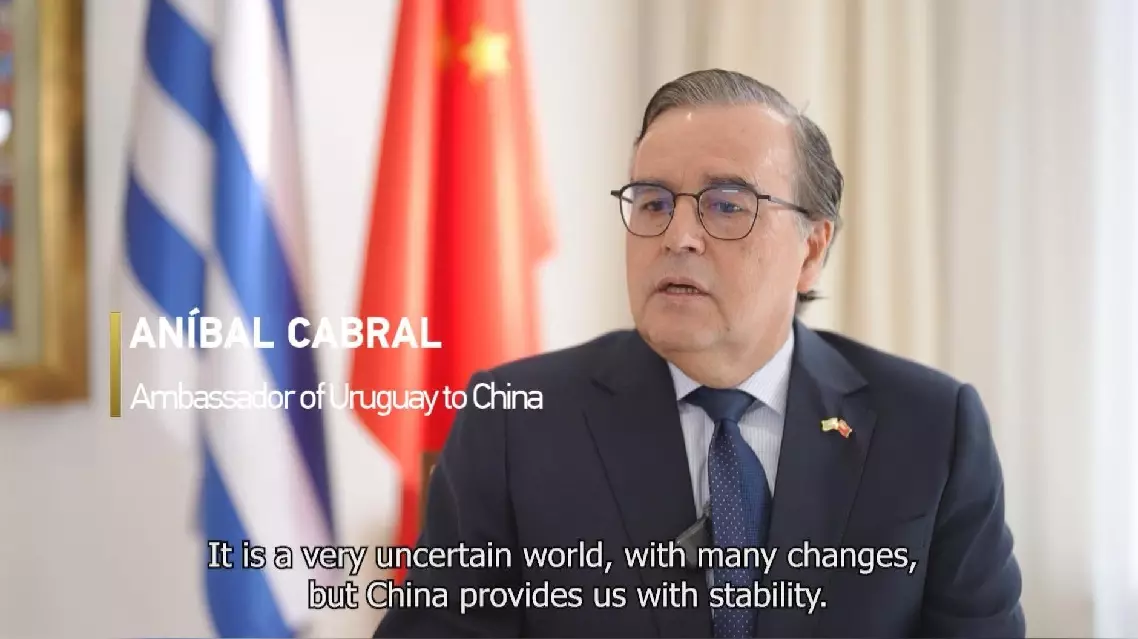
Uruguay's Ambassador calls China's five-year plan "basic input" to understand future world development