China's first intelligent infrared de-icing equipment for wind turbines successfully completed a trial operation at the Datang Wugong Mountain Wind Farm in east China's Jiangxi Province on Saturday.
This milestone signifies a new technological breakthrough in the field of intelligent ice removal for large-capacity wind turbines in the country.
This equipment simulates the principle of solar radiation, using infrared rays to rapidly warm up the wind turbine blades for quick thawing.
A single unit of equipment can melt three centimeters of ice on the blade surface within 20 seconds and start shedding ice accumulation within one minute in the irradiated area. The energy output is five to eight times that of sunlight in summer.
Furthermore, it also features two intelligent modes, "anti-freezing" and "de-icing". It functions like a real-time "weather forecaster", monitoring the environment to prevent icing in advance.
In cases of severe ice accumulation, it can accurately de-ice the entire wind turbine within one hour, enabling the giant blades equivalent to a 30-story building in height to resume operation.
This technology adopts a non-contact design and has currently been successfully validated on the wind turbine with a capacity of five megawatts (MW).
It is particularly suitable for the complex environments of wind farms in frigid alpine areas.

China's first intelligent infrared de-icing equipment successfully completes trial operation

China's first intelligent infrared de-icing equipment successfully completes trial operation
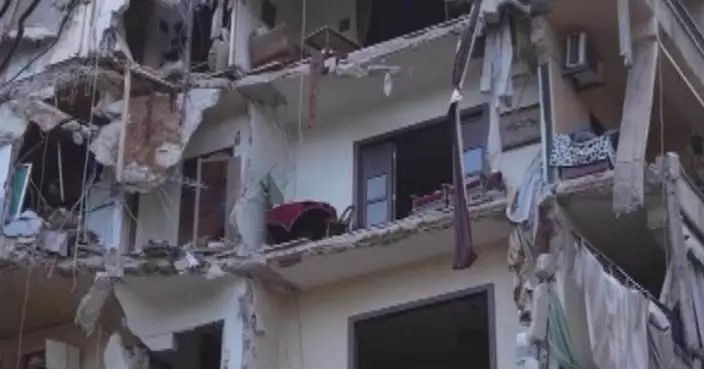
Lebanon is struggling to cope with mass displacement, with many facilities ill-equipped to host the numerous refugees displaced as a result of Israel's attacks on the country.
In a little over a month, more than a million Lebanese citizens have been displaced, a quarter of whom are children. The United Nations High Commissioner for Refugees (UNHCR) said Israeli attacks on Lebanon have left many facing a worsening humanitarian situation by the day.
To accommodate the mass exodus, the government has turned many of its buildings into shelters, including a football stadium where some 1,500 citizens are seeking refuge.
"Some people came here and maybe they find another place they feel it's better. Some others don’t find any place, because the number of refugees is very big," said Nagi Hamoud, general manager of the Institution of Sports Facilities, speaking at the stadium.
Mehdi Alazhar, 67, is one of the refugees staying there. His house is in the southern district of Beirut, the Hezbollah stronghold. The comfort his home brings is just minutes away from this stadium, but he can't get near it. His family, including his spouse with a disability, have been struggling to get through each day.
"The government is stumbling. If they bring breakfast, we don't get lunch, and if we get lunch, there will be no dinner. It's midday, and no one brought us breakfast. They can't catch up with the demand. People are hungry and in dire conditions. No one knows when we're going back home. Everyone is on their phones, following the news, waiting to learn when they can go back," he said.
A government educational institution has also been turned into a shelter, accommodating some 3,000 citizens, many of whom believe that coping with displacement is a form of resisting the Israeli occupation.
"I have been displaced for years. They demolished my home, they erased my entire village, and they bombed it. Nothing is left. Even the tombs -- they dug them out. They are occupiers. We fight them to push them away from our country. And we will stay until the last drop of our blood is shed to prevent them from advancing into our country," said Hasnaa Jaber, a displaced Lebanese citizen.
Half of Lebanon's public schools have been turned into shelters, as the Israeli military advances further into the southern Lebanese territories. Many more now live on the streets, camping in tents and struggling to find basic services.
Meanwhile, public servants are striving to catch up with the immense demand they need to fill, working tirelessly and without days off.
"We have no working hours. We work all the time, day and night. We have no weekends because we are in a state of war. This is what makes the ministry's team special. Public servants are flexible to honor the humanitarian duty we do," said Suheir El Ghali, a crisis management coordinator with the Beirut Ministry of Social Affairs.
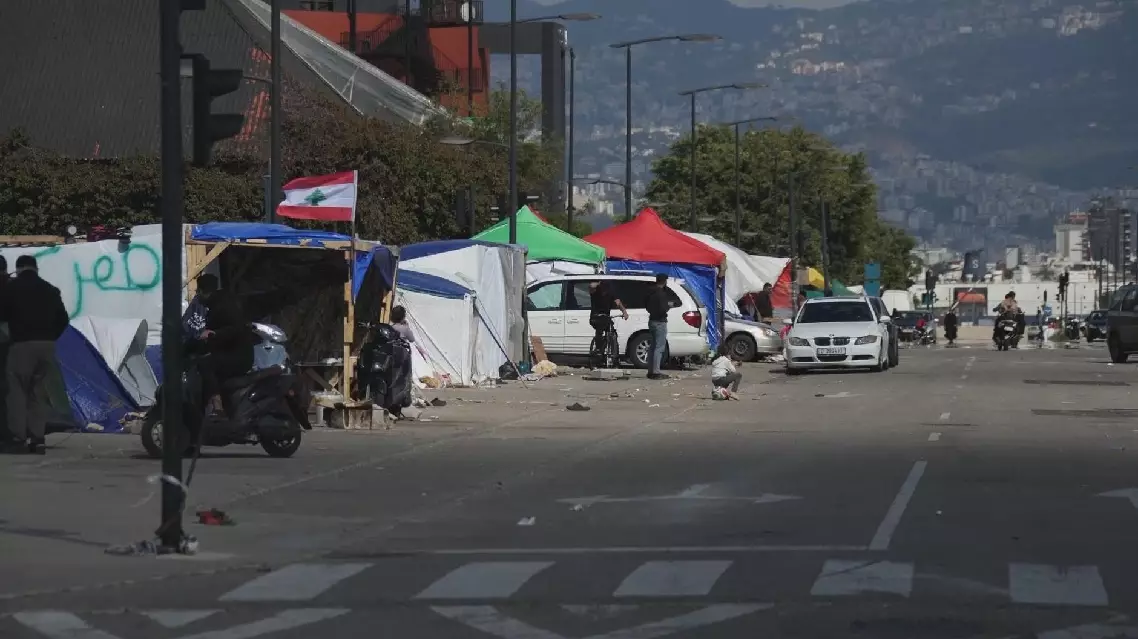
Displaced Lebanese citizens struggle to find shelter