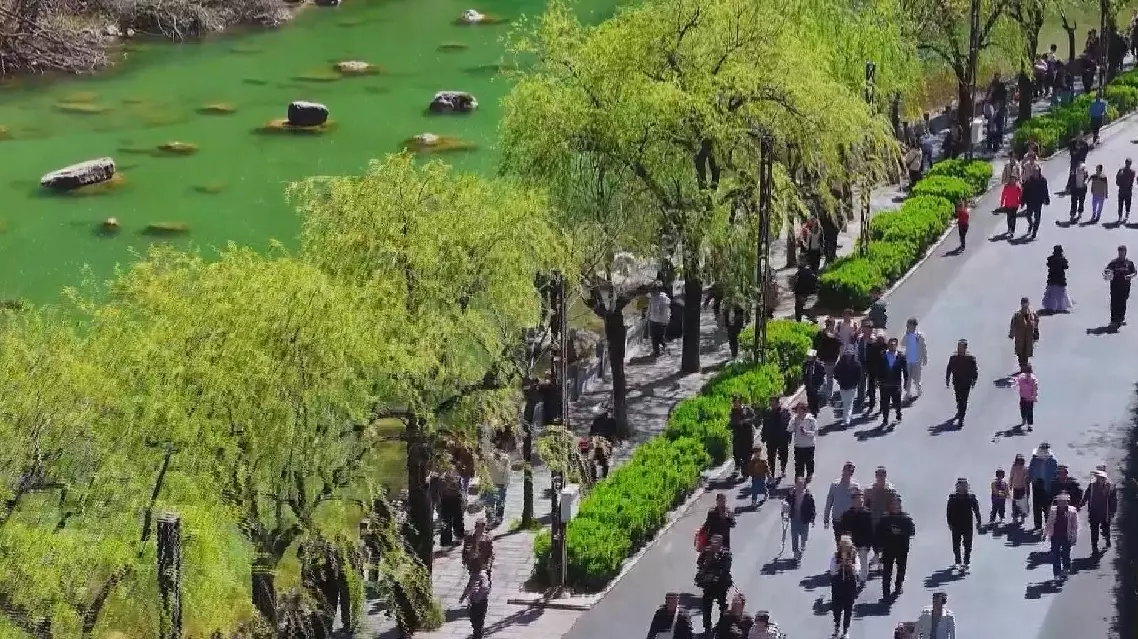
A growing number of Chinese are traveling in traditional clothes during this year's Qingming holiday as scenic areas offer increasing cultural products and performance to cater to visitors.
The Qingming Festival traditionally falls on the 15th day after the Spring Equinox, and China's three-day Qingming Festival holiday started on Friday this year.
As a time for Chinese to enjoy the greenery of springtime and to commemorate ancestors at their graveyards, the holiday also marks a busy period for cultural and tourism activities in the country.
As one of the cultural landmarks in Xi'an, the provincial capital of Shaanxi in northwest China, the Huaqing Palace, a former winter resort for emperors in the Tang Dynasty (618-907) and now a park for ordinary people, has offered tourists cultural feasts with music performances, rounds of dances, and traditional Chinese operas.
The palace is famous for the legendary romance between Tang Emperor Li Longji and his favorite concubine Yang Yuhuan.
"I'm particularly fond of the culture of Tang Dynasty. From the moment I stepped into the garden, I feel as if I were living in the dynasty, which was more than 1,000 years ago. Activities and scenes in the park are meticulously recreated to capture historical authenticity and it feels really great to be able to tour in Hanfu costumes around the scenic area and enjoy the spring blossoms," said Zhang Yijia, a tourist.
Hanfu is the traditional clothing of the Han ethnic group and was formed in the main residential areas of the Han ethnic group in ancient times.
It is renowned for its distinctive design, exquisite craftsmanship, and its profound cultural significance.
Traditional culture fans also flocked to Yuntai Mountain in Jiaozuo City, central China's Henan Province, where they are dressed as sprites, adding more poetic sense to the spring landscapes that have been attracting flows of visitors.
Experiencing traditional cultural activities was also a holiday option for visitors at a tea garden in Yangzhou City, east China's Jiangsu Province, with many of them trying tea picking and immersing themselves into the fresh fragrance.
In major cities like Beijing, cultural events such as touring in Hanfu, praying for good luck and making handicrafts featured by parks and scenic spots offer novel experience to holiday goers.
In one of the city's flower parks, hundreds of Hanfu enthusiasts interacted with tourists as they walked among Spring blossoms.
"People here are wearing a wide variety of Hanfu costumes, from those with wide-sleeved robes to more fitted designs. It feels like people from different dynasties gather in the flower garden and it creates a good atmosphere for spring blossom viewers," said a tourist surnamed Wu.
The flower park also set a market for tourists to experience traditional weaving and buy some handicrafts.
The Gubei Water Town in Miyun District of Beijing also amazed visitors with rounds of dance and traditional folk music performances.
As night fell, thousands of river lanterns were offered to visitors for free, which they could release onto the water, carrying their best wishes for their dear ones.
More Chinese go sightseeing in traditional clothing