China's fast-growing robotics sector is defying trade tensions and making global strides, with companies pushing ahead with record-breaking output and forming new international partnerships as this rapidly-evolving technology attracts greater global interest.
In the southern city of Shenzhen, seen as one of the country's main innovation hubs, the total output value of the robotics sector hit a record 27 billion U.S. dollars, and global buyers are taking notice.
At the three-day "Fair of AI and Robotics, plus" (2025 FAIR plus) which wrapped up on Saturday, China's entire robot supply chain was on display as over 190 companies gathered in Shenzhen with their latest tech offerings.
Among the biggest draws attracting the hundreds of international buyers in attendance were the latest generation of humanoid robots. These high-tech innovations have been making waves in recent months for their increased mobility function, which was put to the test at the world's very first humanoid half-marathon event held in Beijing earlier this month.
However, the more practical warehouse bots generated greater interest at the Shenzhen fair and saw several deals being sealed, with many hailing these Chinese-made machines as being the best in the business.
"We prefer to buy here than in the USA. It's easy, more intelligent -- that's it," said Ricardo Garcia, a buyer from Mexico.
With more than half of the over four million industrial robots currently in operation worldwide now based in China, the country's domestic market is booming thanks to a mature and efficient supply chain. This advantage is also evident in a broader global sense in the production of specialty products like portable 3D scanners.
"We're still selling to the U.S., and business is good. Our robotic products can be used in a wide range of scenarios, including surveying, exploration, mining, underground mines, as well as in film, television, and entertainment industries. Since we manufacture all components in-house, we have a cost advantage for overseas clients," said Wang Yuhao, an innovation engineer at XGRIDS, a firm specialized in 3D intelligent spatial computing technology.
Away from the exhibition halls, a number of European executives also took the opportunity to tour local firms around Shenzhen, exploring potential partnership opportunities with fast-growing startups.
"I think especially when it comes to new technologies like this, China is very innovative. You see all those teams here being consisting of very young people, very skilled people. And I think that's something very refreshing. This company is very interesting when it comes to software solutions also," said Uwe Weiss, CEO of the Weiss Group, a German system supply firm.
Local entrepreneurs credit China's supportive tech environment for helping the sector to flourish, with firms like the Shenzhen-based Youibot Robotics noting the strong level of investment in manufacturing and automation and welcoming more collaboration.
"You're going to have more and more European or North American companies interested in licensing from you," said Vivian Desmonts, a partner at the international law firm Gowling WLG, as he met with Youibots representatives.
As Chinese companies look beyond the U.S. amid the current tariff turmoil, Europe is also emerging as a key strategic market, and with more European leaders expected to visit China for high-level talks in the coming months, industry insiders are hopeful for deeper cooperation.
"The facts are that China is the industrial production house of the world, so there is no alternative to cooperation. The question is how long does it take for our politicians to learn it?" said Juergen Kurz, founder of the HEUFT Services and Technology company.
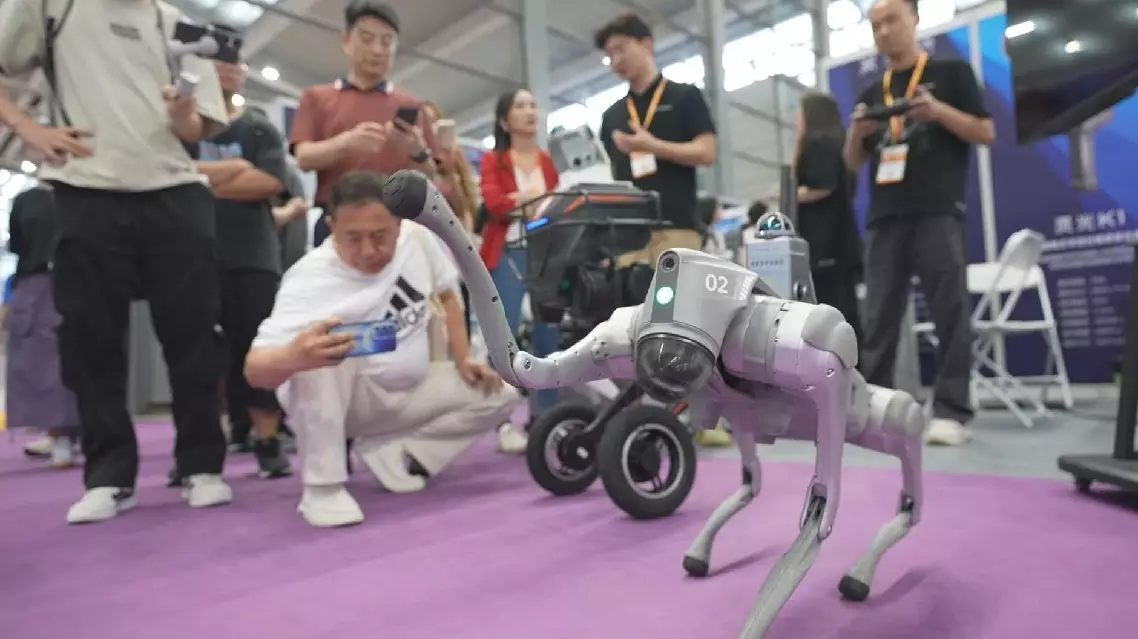
China's robotics industry expands amid global demand despite tariff turmoil