Home sales across China continued a recovery trend in the first quarter of this year, with the transaction volume continuing to increase, thanks to a series of supportive policies to boost housing market demand.
Since the beginning of the year, the number of inquiries and offline visits to new housing projects in Beijing has increased significantly. The latest data show that in the first quarter of the year, the number of newly built apartments whose sales contracts were signed online reached 9,700 in the Chinese capital, a year-on-year increase of 12.3 percent.
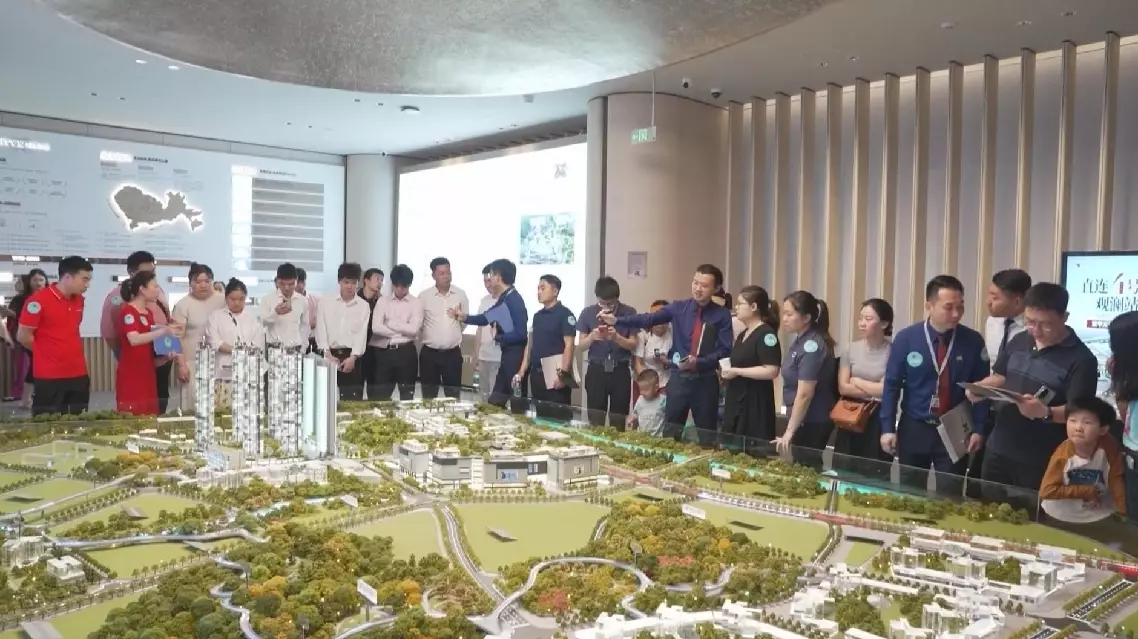
Staff members at the sales office of a newly built property project in Beijing said that they would receive an average of 200 to 300 groups of customers every day recently, and the number is even higher on weekends.
"Basically, we have never stopped receiving customers, and we often have to receive several groups of customers at a same time. From subscription to contract signing, and then to the subsequent online signing of documents, there has been a significant shortening of the cycle of transactions. I can feel that customers' enthusiasm and confidence in buying apartments have increased," said Pei Ruonan, sales manager of the agency.
The real estate transaction volume in other first-tier cities has also been running at a high level. In the first quarter of this year, the total area of new properties whose sales contracts were signed online in Guangzhou, south China’s Guangdong Province was 2.1856 million square meters, a year-on-year increase of 17.7 percent, and the registered transaction area of pre-owned houses was 2.8258 million square meters, a year-on-year increase of 27.6 percent. In the three-month period, the transaction area of new commercial houses in Shanghai increased by 10.5 percent year on year.
"Some projects in Shanghai may have 100 property units put to sale at a time, but in actual survey there could be 300 or 400 households who want to buy the apartments. The market demand is very strong," said Yan Yuejin, vice president of Shanghai E-House Real Estate Research Institute.
The heat of real estate market in the first-tier cities is spreading to more second- and third-tier cities, where the transaction volume is also increasing significantly.
In the first quarter of this year, the transaction volume of new properties in Wuhan, central China's Hubei Province, exceeded 18,000 units, an increase of more than 30 percent year-on-year, and the transaction volume in Guiyang, southwest China’s Guizhou Province, continued to increase on a yearly basis, with market confidence steadily recovering.
"In March, our sales performance increased by about 20 percent year-on-year and more than 100 percent month-on-month," said Fan Jiangtao, manager of a pre-owned property sales agency in Wuhan.
Experts said that since the beginning of this year, the continuous strengthening of the role of various favorable policies has effectively boosted the confidence of property buyers, which led to an increasingly active market.
"The implementation of a series of financial and tax policies will provide financial support for families with rigid demand. Encouraged by the continued recovery of the housing market, their confidence has also been restored. So, many of them are changing their wait-and-see attitude and taking actions to make purchases, which has led to active transactions in the new and pre-owned housing markets," said Wu Jing, director of the real estate research center of Tsinghua University.
Real estate market continues recovery trend in January-March