Skip to Content Facebook Feature Image

Shenzhou-20 crew conducts space science experiments, emergency drill

China

China

China

Shenzhou-20 crew conducts space science experiments, emergency drill

2025-05-18 14:06 Last Updated At:23:47

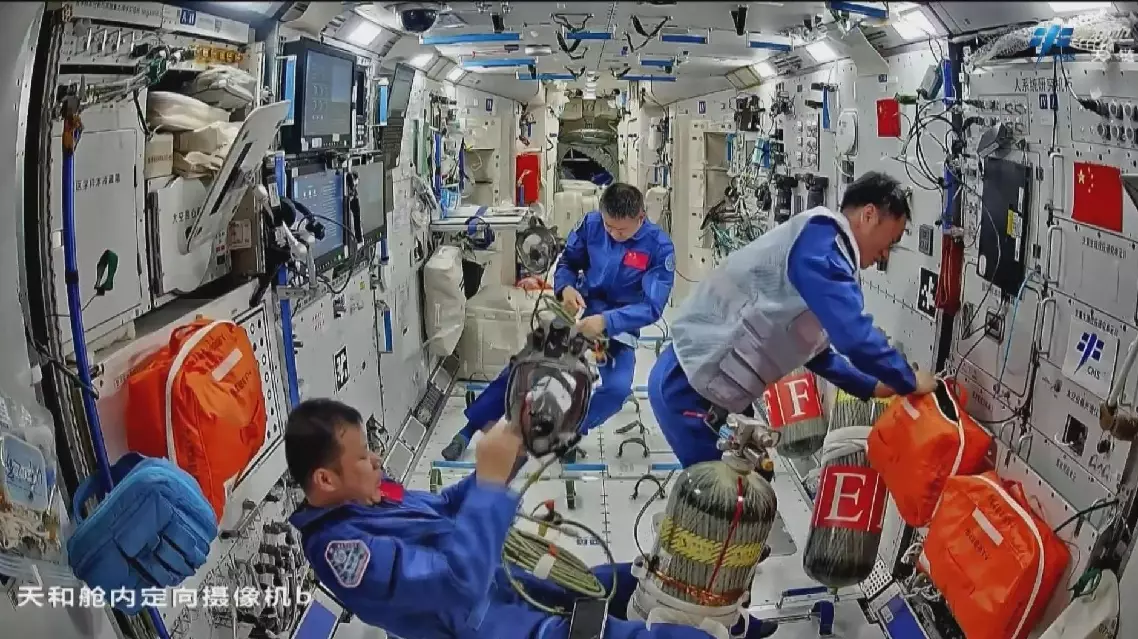
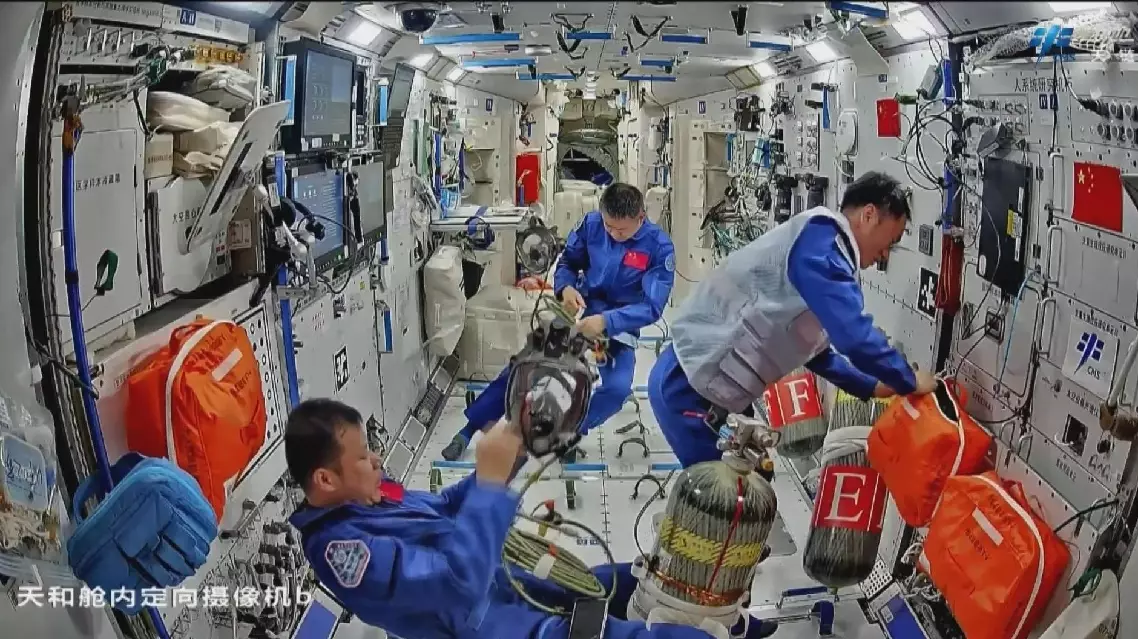
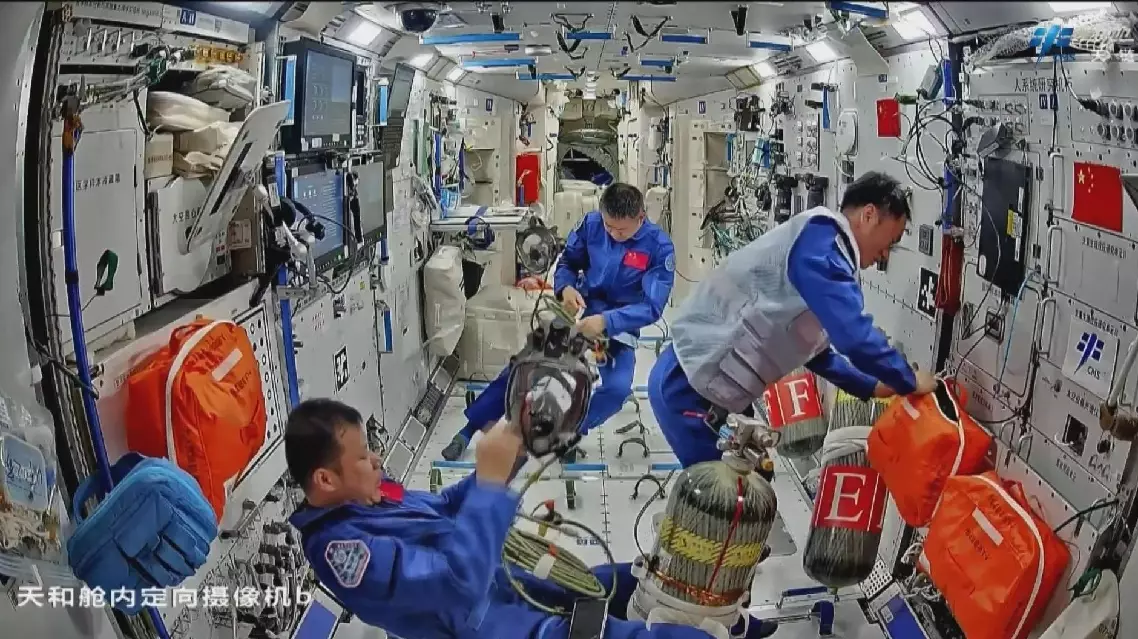
The three astronauts aboard China's Shenzhou-20 spaceship - Chen Dong, Chen Zhongrui, and Wang Jie - carried out a series of tasks within the Tiangong space station last week, including space science experiments, a full-system pressure emergency drill, and equipment inspections and maintenance.

Since their arrival on April 25, the crew has been actively engaged in research activities in Tiangong space station, which functions as a national space laboratory.

Last week, the astronauts focused on observing samples for studying the microbial effects on cell tissue culture modules.

In collaboration with ground-based researchers, the Shenzhou-20 crew successfully completed their first full-system pressure emergency drill. The drill simulated an internal pressure loss aboard the space station, with the astronauts and ground personnel working together to complete the emergency response procedure.

The crew also performed an inspection of the low-temperature storage device in the Wentian lab module, which is critical for preserving biological samples. This device ensures the long-term storage of samples, an essential component for space biological science experiments.

In addition to scientific work, the astronauts carried out regular inspections and maintenance on three extravehicular spacesuits. They also checked and adjusted various pieces of equipment onboard.

Maintaining a clean and organized environment is another key responsibility for the crew.

Last week, the crew cleaned the node module of the Tianhe core module and the airlock cabin of the Wentian lab module, organized and transferred supplies, and handled waste storage and disposal.

Physical health and well-being are also a priority. In addition to daily exercise, the astronauts underwent several medical checks, including ECG tests, dynamic electrocardiograms, blood pressure monitoring, and lung function tests. The data gathered from these tests helps ground researchers keep a close watch on the astronauts’ health while they are in orbit.
Shenzhou-20 crew conducts space science experiments, emergency drill
Shenzhou-20 crew conducts space science experiments, emergency drill
Shenzhou-20 crew conducts space science experiments, emergency drill

Shenzhou-20 crew conducts space science experiments, emergency drill

Shenzhou-20 crew conducts space science experiments, emergency drill
Shenzhou-20 crew conducts space science experiments, emergency drill
China aims to achieve secure and reliable supply of key core artificial intelligence (AI) technologies by 2027, with its industrial scale and empowerment level remaining among the world's forefront, according to a recent government action plan.

The plan, jointly issued by eight departments including the Ministry of Industry and Information Technology, the Cyberspace Administration of China, and the National Development and Reform Commission, outlines an ambitious push to deeply integrate AI with the manufacturing sector, foster new quality productive forces and comprehensively empower new industrialization. By 2027, the plan targets the deep application of three to five general-purpose large AI models in manufacturing, the development of specialized, full-coverage industry-specific large models, the creation of 100 high-quality industrial datasets, and the promotion of 500 typical application scenarios.

It also aims to cultivate two to three globally influential ecosystem-leading enterprises, a batch of specialized and sophisticated small and medium-sized enterprises, and a group of enabling service providers proficient in both AI technology and industry know-how.

Furthermore, China plans to build a world-leading open-source ecosystem, enhance security governance capabilities, and contribute Chinese solutions to global AI development.

The document outlines measures including promoting the coordinated development of AI chips' hardware and software, supporting innovations in model training and inference methods, fostering key industry-specific large models, and deeply embedding large model technology into core production processes.

The plan also emphasizes making breakthroughs in key technologies such as security protection for industrial model algorithms and training data protection.

China aims for secure, reliable supply of AI core tech by 2027

China aims for secure, reliable supply of AI core tech by 2027

Recommended Articles