Skip to Content Facebook Feature Image

Green efforts bring 80 pct of north China's Maowusu Desert under control

China

China

China

Green efforts bring 80 pct of north China's Maowusu Desert under control

2025-06-05 21:22 Last Updated At:22:27

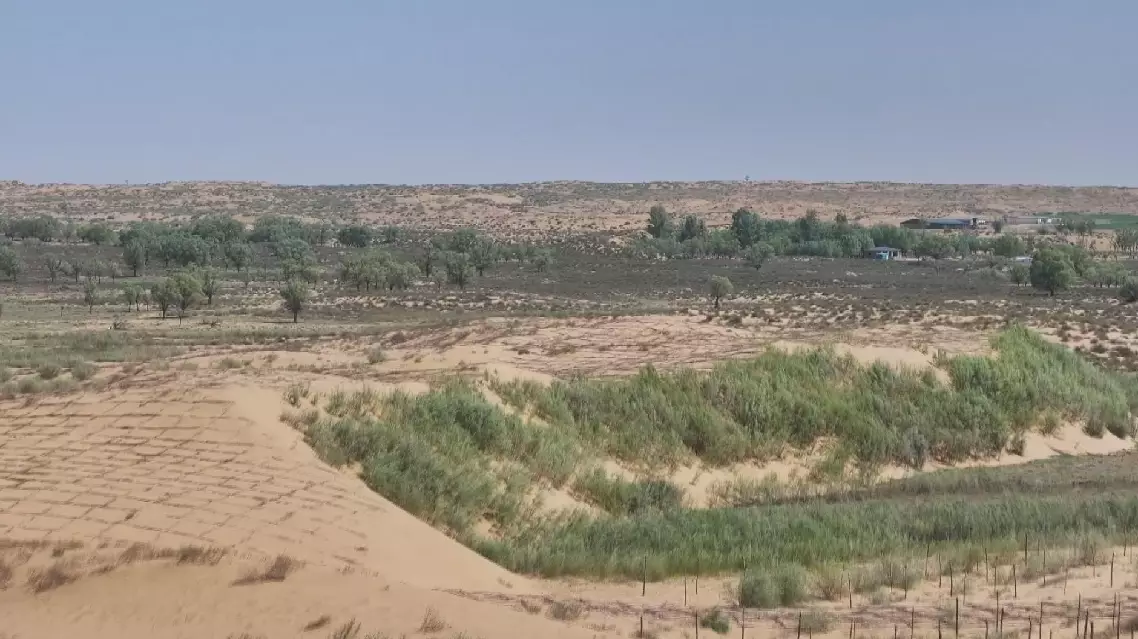
Around 80 percent of the Maowusu Desert in north China's Inner Mongolia Autonomous Region has been brought under control thanks to local people's organized grass and tree planting efforts of over six decades.

Spanning 38,000 square kilometers, the Maowusu Desert stretches across parts of northwest China's Ningxia, Shaanxi, and Inner Mongolia, with nearly 70 percent of its total area located within Ordos City in Inner Mongolia.

Anti-desertification efforts in the desert have been underway since the 1950s, with the implementation of a series of key national ecological projects.

"This used to be an endless expanse of desert, but now they are all my 'children,'" said Yin Yuzhen, a villager of Wushen Banner in Ordos City, located at the heart of the Maowusu Desert.

The "children" Yin referred to were the trees in the desert. Since the 1980s, Yin and her husband have been planting trees in the Maowusu Desert for over 30 years, turning over 4,000 hectares of sandy area into green land.

The Maowusu Desert has become a focal point for China's desertification control efforts. More than a dozen research stations have been established across the region, attracting leading experts in soil science, forestry, grassland management, and ecological restoration from nationwide.

The Maowusu Desert project is one of the main battlegrounds in the large-scale afforestation project -- Three-North Shelterbelt Forest Program (TSFP). It is also a testing ground for cutting-edge anti-desertification techniques and innovative approaches to ecological restoration.

Local communities now use advanced tools such as drones for seed broadcasting and robotic systems capable of planting trees in just 10 seconds, revolutionizing reforestation efforts.

These greening initiatives have introduced over 300 new plant species in the area, fostering a vibrant ecosystem where mammals like hares and foxes are now frequently spotted.

"I grew up in the heart of the Maowusu Desert, and I've planted trees and grass on this sandy land during my childhood. Currently, our city achieves an average daily desertification control area of over 1,000 hectares. Moving forward, we will continue to implement major national ecological restoration projects to consolidate further the achievements in managing the Maowusu Desert," said Suyalatu, director of the Ecological Environment Bureau of Ordos City.
Green efforts bring 80 pct of north China's Maowusu Desert under control
Green efforts bring 80 pct of north China's Maowusu Desert under control
Chinese Foreign Minister Wang Yi said on Thursday that UN Security Council actions must not provide legal cover for unauthorized military operations, nor should they heighten tensions or escalate conflict.

Wang, also a member of the Political Bureau of the Communist Party of China Central Committee, made the remarks in a phone conversation with Kaja Kallas, the High Representative for Foreign Affairs and Security Policy of the European Commission.

Kallas shared her views on the situation in the Middle East and commended China's active diplomatic mediation efforts to ease the situation, including the latest five-point joint initiative issued by China and Pakistan for restoring peace and stability in the Gulf and the Middle East.

The European side has not been involved in this war but has suffered from its spillover effects, she said, expressing hope for swiftly de-escalating the war and resuming dialogue and negotiations.

The European side supports UN humanitarian operations, the protection of civilians and non-military targets, and will make every effort to ensure the opening of navigation through the Strait of Hormuz, she said.

Wang said that amid the current international turmoil, it is the shared responsibility of China and Europe to step up communication and exchanges, and to uphold the UN-centered international system and the international order based on international law.

Wang elaborated on China's principled position on the Middle East situation, noting that the five-point initiative proposed by China and Pakistan reflects a broad international consensus, whose core elements include a cessation of hostilities, the start of peace talks as soon as possible, ensuring the security of non-military targets and security of shipping lanes, and safeguarding the primacy of the UN Charter.

A ceasefire and an end to hostilities are the strong call of the international community, and also the fundamental solution to ensuring safe navigation through the Strait of Hormuz, Wang said, adding that all parties should build greater consensus and create the necessary conditions to that end.

The UN Security Council actions should focus on cooling down the situation and de-escalating tensions, Wang said, adding that China stands ready to maintain communication and cooperation with the European side to promote an early end to hostilities and restore regional peace.

The two sides also exchanged views on China-EU relations. Wang said that China's development represents opportunities for Europe, and that the challenges Europe faces do not originate from China. Protectionism does not enhance competitiveness, and decoupling from China means decoupling from opportunities, Wang said, expressing hope that the European side will develop a comprehensive and objective perception of China and maintain the correct direction of China-EU relations.

Kallas said that the European side views China as an important cooperation partner, does not seek decoupling from China, and looks forward to maintaining dialogue and communication between the two sides.

Chinese FM says UN Security Council actions should not legitimize unauthorized military operations

Chinese FM says UN Security Council actions should not legitimize unauthorized military operations

Recommended Articles