Skip to Content Facebook Feature Image

Japan’s rice prices soar as farmers face rising costs, declining production

China

China

China

Japan’s rice prices soar as farmers face rising costs, declining production

2025-06-12 11:13 Last Updated At:11:37

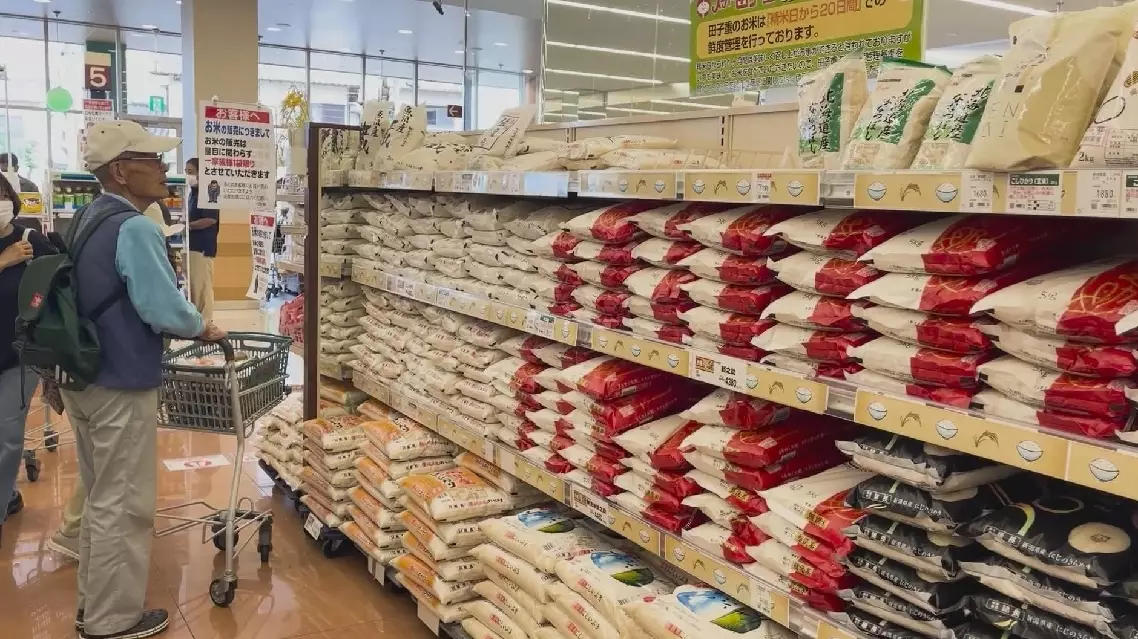
While Japanese consumers are struggling with rising rice prices, farmers say growing rice is no longer profitable due to shrinking farmland and soaring production costs.

In Hamamatsu City, Shizuoka Prefecture, Jun Miyamoto, who cultivates around 25 hectares of rice paddies and harvests 120 tons of rice annually, is considered a major rice grower. He said business inquiries have increased noticeably this year.

"A lot of companies have already contacted me, saying they want to buy rice from us. I'm negotiating prices with different buyers almost every week," he said. Japan's rice production has been declining steadily. In the 1970s, the country had over two million hectares of rice fields and produced about 12 million tons of rice annually. By 2023, the total rice-growing area dropped to 1.344 million hectares, with only 1.244 million hectares used for staple food rice. Combined with extreme heat and drought, total rice output fell to 7.165 million tons, with only 6.61 million tons used as staple food. "For years, they (the government) kept saying we had too much rice, so [the government] discouraged us from growing it. They offered subsidies if we converted rice paddies into dry fields and planted crops like wheat or soybeans instead. This policy has been in place for decades, and now Japan's overall rice production capacity has declined," said Miyamoto. The Japanese yen's rapid depreciation and global supply disruptions have driven up prices of imported essentials like fuel, fertilizer, and pesticides, pushing rice farming costs ever higher. Miyamoto said he's been operating at a loss for years.

Now in his 50s, Miyamoto is the youngest rice farmer in his village. Over 70 percent of local rice farmers are in their 70s or older, with some even in their 90s. With younger generations turning away from farming, labor shortages are worsening.

To secure supply, Japan's agricultural cooperatives have been raising purchase prices for rice. Yet even with current high prices, farmers say they are only breaking even. To stabilize prices, the Japanese government has released low-priced reserve rice into the market. But experts say this is unlikely to fix the underlying problems.

"The rice wholesale industry has a multi-layered structure, where rice is traded multiple times between wholesalers. The more middlemen are involved, the higher the price gets. That cost eventually trickles down to retailers and consumers," said Professor Motonori Tomita, Faculty of Human Sciences at Kobe Shoin University.

Tomita warned that the 600,000 tons of reserve rice currently being released are not enough to cover the country's needs. If depleted now, there may be no stock left in case of a future disaster.

"About 600,000 tons of reserve rice have already been released. But what happens when they run out? In the event of a real disaster, we'd be at serious risk. Only the reserve rice is cheaper, other rice is tied to contracts signed earlier, often at high procurement prices. That's why prices won't come down easily. Even if cheaper rice appears on the market now, it's only a temporary solution," said Tomita.
Japan’s rice prices soar as farmers face rising costs, declining production


Japan’s rice prices soar as farmers face rising costs, declining production

After the devastating fire at the housing complex Wang Fuk Court in Hong Kong Special Administrative Region (HKSAR), the central government, Hong Kong authorities, and people from across China have joined forces in a massive outpouring of relief and support.

The blaze, the deadliest Hong Kong had witnessed for decades, broke out at around 14:50 on Nov 26 at the eight-towered residential estate Wang Fuk Court, which was under renovation, in Tai Po district. The fire quickly engulfed seven of the towers, leaving at least 159 dead, 79 injured and thousands of families homeless.

According to the latest official update, the Support Fund for Wang Fuk Court in Tai Po, established by the HKSAR government, has received 3 billion Hong Kong dollars in external donations. Together with the HKSAR government's start-up capital of 300 million Hong Kong dollars, the fund stands at around 3.3 billion Hong Kong dollars in total. It will be used to help residents rebuild their homes and provide long-term support.

Following the fire, the HKSAR government has made comprehensive, multi-tiered rescue and resettlement efforts.

On the night of the blaze, the government promptly established temporary shelters at multiple locations across Tai Po district, coordinating accommodations in youth hostels, hotels, and transitional housing for affected residents. Emergency subsidies and living allowances were distributed to those impacted, while support was also provided through a "one household, one social worker" mechanism.

People from across Hong Kong have joined volunteer efforts, hoping to bring warmth to the wounded community, with donated supplies such as clothing, food, drinking water continuously arriving at temporary shelters.

Many taxi drivers have also volunteered to provide free rides.

"We work here from 08:00 in the morning to past 22:00 at night. We only leave when there are no passengers. That's how it is. It does affect earnings a bit. It definitely has an impact. But that's not important. The most important thing is to help others first," said Wong Chi-chuen, a taxi driver .

At the request of the HKSAR government, the Hong Kong and Macao Affairs Office of the State Council has coordinated the Ministry of Emergency Management to provide batches of supplies for the Tai Po fire relief effort, including portable outdoor charging stations, heavy-duty conveyors, blowers, respirators, goggles, protective suits, headlamps, and waterproof boots.

Mainland companies and residents, and various sectors in Macao also provided support following the devastating fire in Hong Kong, donating funds and supplies for emergency relief and post-disaster recovery.

"A large amount of supplies was collected and delivered to our disaster-stricken areas in a very short time. It made me realize what it means to be bound by blood. Because this kind of bond runs deep. I want to express my heartfelt thanks to everyone," said Peter Lam, chairman of Tai Po Rural Committee.

Support from across China pours in after devastating fire in Hong Kong

Support from across China pours in after devastating fire in Hong Kong

Recommended Articles