Skip to Content Facebook Feature Image

Rare golden snub-nosed monkeys thrive in Hubei's ancient forest thanks to conservation efforts

China

China

China

Rare golden snub-nosed monkeys thrive in Hubei's ancient forest thanks to conservation efforts

2025-06-25 10:35 Last Updated At:11:07

Deep in the mist-shrouded forests of Shennongjia National Park in central China's Hubei Province, live the golden snub-nosed monkeys, the real-life inspiration for China's mythical "Monkey King" from mythological tale "Journey to the West".

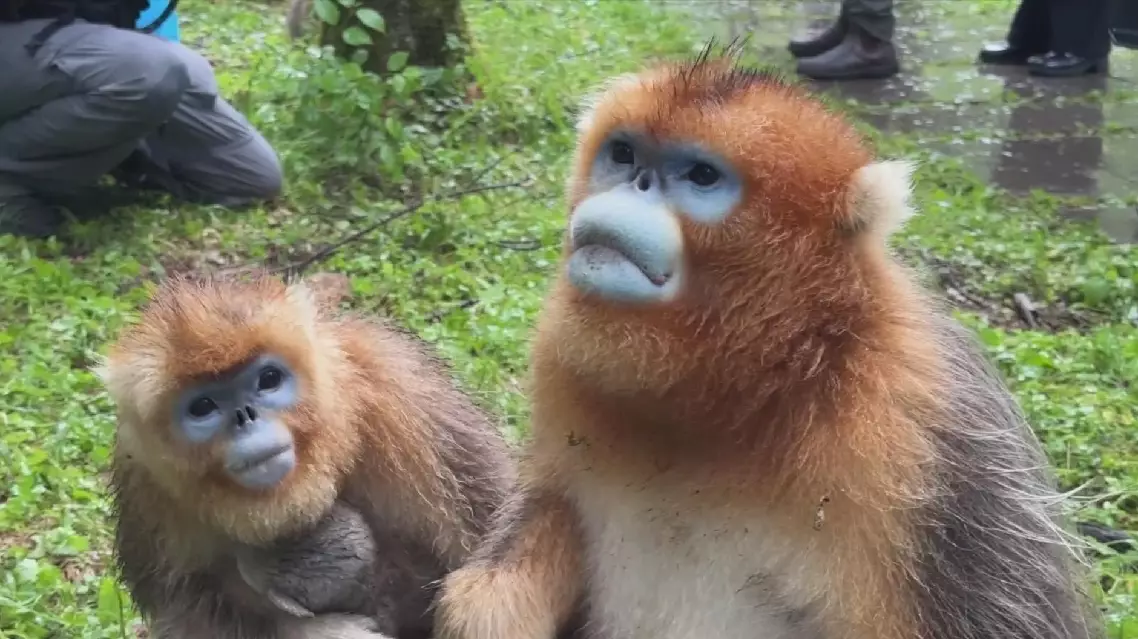
Gold-furred, blue-faced, with upturned nostrils and startlingly human-like expressions, the golden snub-nosed monkey is a rare and endangered species unique to China and is under the first-class state protection.

Over 1,600 monkeys of 11 families now inhabit in the primeval forests of Shennongjia National Park.

Observing the wild golden monkeys evokes a sense of awe as they gaze at humans with intelligent, almost familiar eyes.

"They're gentle creatures. This is one family unit - just one adult male with his mates and offspring. Come here, little one!" said Yang Jingyuan, dean of Shennongjia National Park Scientific Research Institute.

Yang has studied these animals for 30 years. The monkeys know him - even a one-month-old infant fearlessly crawls toward his hand.

The interaction with the monkeys is simple: hold peanuts in the palm, and they'll gently pry your fingers open. Their touch is unforgettable - not just for their clever, tender manner, but their uncanny resemblance to us: dexterous fingers, expressive faces, and skin that feels almost like human.

Fed on leaves, twigs, wild grasses, these monkeys demand pristine habitats. Air quality, plant diversity - everything matters. All these can be provided by Shennongjia, which scores 92.7/100 on environmental health. It shelters over 700 vertebrate species, more than 4,000 plants, and over 5,000 insects.

As its flagship species, these golden monkeys have been rigorously protected since Shennongjia's wild monkey base opened in 2005.
Rare golden snub-nosed monkeys thrive in Hubei's ancient forest thanks to conservation efforts

Rare golden snub-nosed monkeys thrive in Hubei's ancient forest thanks to conservation efforts

The 7th Hainan Island International Film Festival closed in Sanya City of the southern island province on Tuesday evening.

Black Rabbit, White Rabbit, a co-production between Tajikistan and the United Arab Emirates, won the Golden Coconut Awards Best Picture.

The Golden Coconut Awards Grand Jury Prize went to Chinese film A Dance in Vain and German movie Phantoms of July.

U.S. film Mad Bills to Pay won the Best Director and Best Actress awards.

The Best Actor award went to Theodore Pellerin from France for his acting in Nino.

"We filmmakers need to build our homes with movies. I believe that more filmmakers will realize that they have a new home in China -- the Hainan Island International Film Festival," said Italian film expert Marco Muller, the jury president.

Co-hosted by China Media Group and the People's Government of Hainan Province, the 7th Hainan Island International Film Festival was held from December 3 to 9.

With the theme "From Oceans to the Infinite," this year's festival received 4,564 entries from 119 countries and regions, marking a record high. The Golden Coconut Awards jury consisted of 13 renowned filmmakers from China and abroad.

Sanya City is still buzzing with a vibrant series of themed events.

Residents and visitors were able to participate in five interactive film-themed missions, immersing themselves in the world of cinema. Special photo zones were also set up across multiple local attractions, encouraging participants to become "creators" in their own right.

The city has also rolled out a range of tourism promotions, offering discounts on scenic spots and accommodations to attract more visitors.

7th Hainan Island International Film Festival closes

7th Hainan Island International Film Festival closes

Recommended Articles