The US Central Intelligence Agency (CIA) has been turning heads for all the wrong reasons lately. In a move that can only be described as bizarre, the agency recently dropped a couple of Putonghua-language videos on social media, openly trying to recruit Chinese citizens as spies. Unsurprisingly, China’s Ministry of State Security (MSS) has weighed in, calling the whole affair another "bewildering operation" that has turned the world's so-called top intelligence agency into an international laughingstock.
The MSS argues this isn't about genuine intelligence gathering. Instead, it’s a desperate attempt by the CIA to puff itself up by rehashing the old "China threat" narrative. Why? To fight for a bigger budget, which has been consistently on the chopping block under the Trump administration, and to claw back some political influence in Washington. It seems the spooks are spooked about their own job security.
A Cringeworthy Recruitment Drive
According to The New York Times, these new videos are cut from the same cloth as a series aimed at recruiting Russians, a tactic former CIA bosses claim helps reel in new informants. The agency's director has even gone on record saying China is the CIA's "top priority." But the MSS sees it differently. In a scathing article titled "The CIA's Open Recruitment of 'Chinese Spies' is Yet Another Farcical Performance," they tear the campaign to shreds.
The MSS describes the videos as "painstakingly crafted recruitment advertisements" filled with clumsy rhetoric and slander. They argue it exposes the absurd logic and hysterical frenzy gripping American intelligence. The global reaction was swift, with netizens around the world mocking the CIA's ham-fisted attempt at espionage, proving once again that the self-proclaimed "intelligence hegemon" has lost the plot.
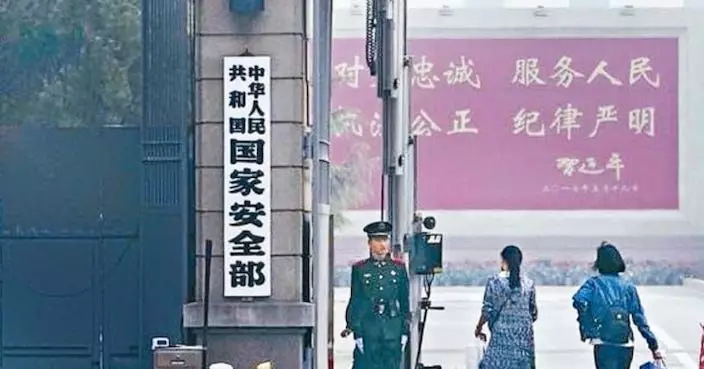
China's Ministry of State Security didn't mince words, calling the CIA's recruitment stunt "yet another farcical performance" on their official WeChat account.
Desperate Times, Desperate Measures
Let's be real, the CIA has a long and sordid history of serving America's geopolitical ambitions. It's built a global network to meddle in other countries' affairs, all to maintain US hegemony. For years, it has targeted China with intelligence theft and infiltration, peddling fantasies like the "China collapse" theory and cooking up "Chinese spy" stories to cover its own incompetence and persecute the innocent.
But facts are stubborn things. The "Chinese spy theory" is a classic case of the thief shouting "catch the thief," and the "China collapse theory" has itself collapsed. The MSS makes it clear: any plot to halt China's national rejuvenation is doomed from the start.
The timing of this recruitment drive is also telling. Since the Trump administration came to power, federal agencies have been facing the axe, and the CIA is no exception. With a "buyout program" already pushing people out the door and more cuts on the horizon, the agency is facing a crisis. This high-profile, public campaign is a desperate, attention-seeking stunt to "recruit troops" and convince Washington they're still relevant, trying to avoid becoming a "discarded piece" in the next political shake-up.
_02_source-ap__704px.jpg.webp)
Trump's budget cuts have left the CIA scrambling for relevance - and apparently willing to try anything, even embarrassingly public spy recruitment drives.
From Professional Spooks to Amateur Hour
It’s almost comical. The CIA, once a feared name on the international intelligence stage, is now resorting to crude "advertising" to entice people into treason. This "child's play," as the MSS calls it, isn't just a provocation, it's a clumsy farce that shows the world the agency's "professional halo" has well and truly dimmed. It reveals an organization that's all bark and no bite—strong on the outside, but hollow within.
This is all part of a well-worn script in Washington. Government agencies have long known that "the squeaky wheel gets the grease." To secure more funding, they first wildly exaggerate an external threat. Then, they draw up elaborate plans and reports to "deal" with this fabricated crisis. Finally, they use this to push their demands through Congress, turning departmental wish lists into national policy and pocketing the profits. It's a cynical game played at the taxpayer's expense.
It's Always About the Money
With its budget shrinking, the CIA’s "favor-seeking" has gone into overdrive. From setting up a "China Mission Center" to launching a "Third Intelligence Age" focused on China, and now openly recruiting spies on social media, its actions have become more radical and its methods cruder. At the end of the day, when there's not enough pie to go around, the only move left is to grab the "lifeline" of the "China threat" to prove your own value and swindle Congress and the American people out of more money.
The Ministry of State Security concludes with a solemn warning to the CIA and its ilk: trying to turn the Chinese people against their own country is a fool's errand. Any plot to infiltrate China is destined to fail. China's national security agencies are ready, determined, and able to defend the nation's interests against such clumsy provocations.
Mao Paishou
** 博客文章文責自負,不代表本公司立場 **
Outside 1515 Broadway in Times Square, the usual line mostly leads upstairs to the theater where The Lion King musical has been running for twenty years. But on September 19 local time, this line turned the corner, stretched all the way to the next intersection, and seemed endless.
The Line That Stopped Times Square
The source of the line was not the premiere of a new Broadway show, but a newly opened Chinese camera store.
The store opening that day was the first US flagship store of Chinese imaging brand Insta360. It was also the brand's first directly operated store outside Asia.
Insta360 was founded in Shenzhen in 2015. It first made its name with a camera designed for shooting panoramic footage. Its main products are panoramic and action cameras that do not require cumbersome equipment and can be shared directly after shooting.
In June 2025, it listed on the Shanghai STAR Market. Its market value once exceeded 70 billion yuan, about 76 billion Hong Kong dollars. Industry insiders have called it the world's first listed smart imaging company. Overseas markets contribute about 70 percent of its overall revenue.
The store was originally scheduled to open at noon, but the number of people lining up far exceeded expectations. According to US imaging media outlet PetaPixel, the crowd on the scene that day may have exceeded 1,000 people. The first customer arrived at 2:30 a.m. and waited nearly 10 hours.
One American netizen uploaded footage to social platform X. She described the line as a massive procession that turned two corners. She jogged while high-fiving people in line, and it took her a full 61 seconds to reach the end.

Insta360's New York flagship opening drew massive launch-day crowds.
The young man at the front of the line wants to become a YouTuber. He headed straight to the site after finishing work and queued overnight, becoming the day's 'number one fan.' He received a limited-edition new gimbal camera with an exclusive gold logo.
When asked why he was so enthusiastic about a Chinese brand, his answer captured a recent shift in the US imaging market. He said he used to ride his bike near Central Park a lot. Back then everyone was using GoPro, but now almost everyone has switched to Insta360.
In the line there was also a race car driver who flew nearly 10,000 kilometers from Egypt specifically for this. Egypt still has no Insta360 dealer, and he had tried many places without being able to buy one. So he simply flew directly to New York.
There was also an American father who specially brought his 10-year-old son to New York so they could experience Insta360's latest camera together as a birthday gift.
Coincidentally, Tim Cook, who has stepped down as Apple's chief executive officer and now serves as chairman of the executive board, also posted on Weibo on September 20.
He said every time he sees customers experiencing Apple's new products at Apple Store retail locations in China, it is especially uplifting. The accompanying photo showed customers waiting outside the store in long, multi-layered lines.
It so happened that on September 18 this year, Apple's iPhone 18 Pro series also went on sale in many places around the world. That triggered a fair amount of queuing as well.
But the mindset behind the two types of lines is completely different. Most people buying an iPhone have a hard need to upgrade and see it as routine. People who queued overnight to buy a Chinese camera were actively pursuing an emerging category that was previously unheard of.
The difference is also why outsiders are paying attention to Insta360's opening.
GoPro Fades as Chinese Brands Take Over
To understand the weight of that New York line, you first need to understand the global imaging industry's power map over the past few decades. Japanese camera brands long monopolized the industry's discourse. The American brand GoPro defined the action camera category and was once synonymous with the product type. But market research data shows the landscape has reversed in recent years.
In 2022, GoPro still held about 84% of the global action camera market. That was an absolute monopoly. Within just a few years, its share collapsed. By the first three quarters of 2025 it had fallen to about 18%. In the same market, GoPro went from roughly eight out of ten cameras to fewer than two in ten.
In August this year, GoPro submitted documents to the US Securities and Exchange Commission that included the blunt warning "substantial doubt about its ability to continue as a going concern." A company that once defined an entire industry now has to admit operating difficulties in public filings.
It has even agreed to merge with an American company in the artificial intelligence optics business. The deal is valued at $285 million, about HK$2.22 billion. Original shareholders would keep only about 10% of the merged company's equity.
In name it is a merger. In substance it is close to being swallowed.
Meanwhile, DJI and Insta360 together account for about 87% of the global handheld smart camera market. This queue is not just one Chinese brand selling well. It is an industry reshuffle. The American company that once set industry standards has been pushed to the margins by Chinese brands in just a few years.
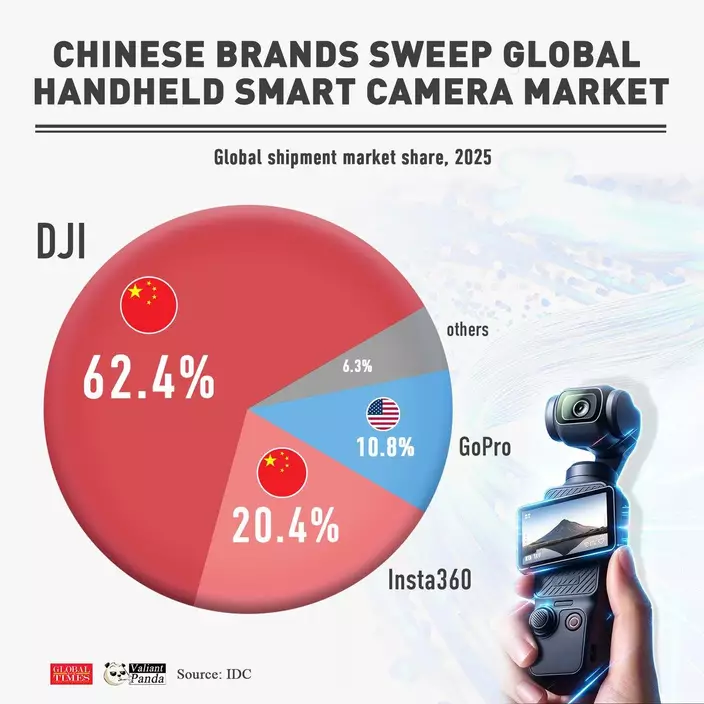
DJI and Insta360 now control about 87% of the global handheld smart camera market.
The shift in Japan is even more telling. Japan has long been seen as the birthplace of the global imaging industry. Local consumers are fiercely loyal to camera brands. On July 2 this year, Insta360 held a launch event for a new gimbal camera in Shibuya, Tokyo.
By 6 a.m. consumers had already arrived to line up. The longest wait reached 9 hours. The organizer temporarily distributed 450 admission tickets, and they were all claimed within half an hour. The white version sold out online in just 5 minutes.
Retail data makes the point even sharper. Japanese research firm BCN reports that in 2025, a Chinese brand won the annual sales crown in the action camera category for the first time. DJI and Insta360 together took about 78% of the Japanese market. GoPro's share collapsed from 34.3% the previous year to 18.9%.
In other words, even in Japan, widely regarded as the birthplace of global imaging technology standards, local consumers would rather queue overnight to buy Chinese cameras.
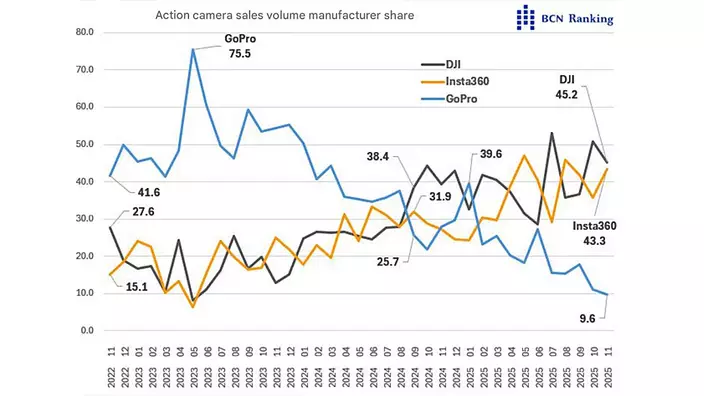
Chinese brands now lead Japan, overtaking long-time giant GoPro.
What the Queues Really Mean
Back in New York, that flagship store means far more to Insta360 than an opening ceremony. On opening day, Insta360 also announced cumulative global camera shipments had passed 10 million units. That is more than 10 million cameras sold over ten years.
The opening event drew Casey Neistat, a North American imaging creator with more than 10 million followers, along with die-hard users who have followed the brand for years. One of them, Anthony Quintano, was first in line at 3 a.m. for Insta360's first new-product pop-up in New York last year. He became the first person in the world to buy that new model.
Another was Kevin, a cycling community leader. He and 100 local riders in bright yellow jerseys rode through New York landmarks on opening day. They recorded the journey on Insta360 cameras the whole way.
From top influencers and veteran loyalists to ordinary citizens, three seemingly unrelated stories map Insta360's ten-year localization effort in the United States. This Chinese company did not simply move a store into another country. It cultivated local creator circles and vertical communities, embedding itself in local life.
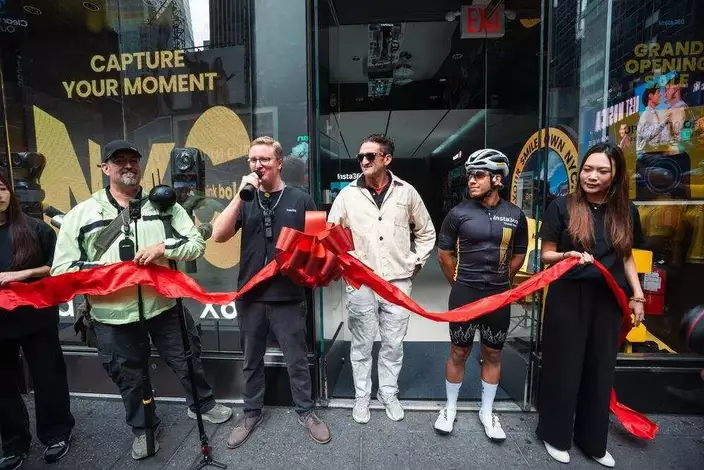
Top creators and local cyclists joined the store ribbon-cutting.
Around Times Square, Insta360's store sits not far from a cluster of Chinese brands that have already entered the US market: Pop Mart, Miniso, and Heytea. But compared with these 'Chinese neighbors' opening stores in New York, Insta360 has cultivated the US market for a full decade. It started out unknown, and now it draws a thousand people to queue overnight at the world's crossroads.
From Tokyo's Shibuya to New York's Times Square, Chinese camera brands are not riding a one-city viral moment. They are on a structural upward trajectory that spans regions and is backed by data.
Going overseas has never meant copying a store into a foreign country. It means making yourself part of local life. That may be the real strength of Chinese brands that has been most easily underestimated in recent years.