The writing's been on the wall for months, but now it's official – China's AI sector isn't just catching up anymore, it's actively eating into America's lunch. And frankly, this shouldn't surprise anyone who's been paying attention.
The Great AI Migration is Real
Chinese artificial intelligence is rapidly rising, challenging America's global monopoly with its independently developed, cost-effective AI ecosystem. According to analysis by the US Wall Street Journal, Chinese AI companies are gradually undermining America's dominance in this sector. From Asia, the Middle East, and Africa to Europe, multinational corporations, banks, universities, and government institutions are increasingly switching to Chinese AI models like DeepSeek and Alibaba's language models, replacing American products.
What's particularly striking is how this is happening despite – or perhaps because of – US government restrictions. Despite facing export bans on high-end semiconductor chips and limitations on Chinese technology investments, Chinese AI technology continues to advance rapidly, dedicated to building a completely autonomous artificial intelligence ecosystem. With massive investments in domestic chip production, software development, and AI education, the performance gap between Chinese and American AI models is gradually narrowing.
Major international companies are ditching US AI models for Chinese alternatives like DeepSeek and Alibaba's systems due to cost advantages.
British banks HSBC and Standard Chartered have begun internal testing of DeepSeek's AI large models. Additionally, Saudi Aramco, the world's largest oil producer, recently deployed DeepSeek to its main data center. Although the White House has banned the use of this model on some US government devices citing so-called "data security" concerns, major American cloud service providers including Amazon, Microsoft, and Google all offer DeepSeek to their clients. It's a perfect example of how market forces often trump political posturing.
Microsoft President Brad Smith recently stated at a US Congressional hearing that the primary factor determining whether America or China wins this competition is whose technology gains the widest application in other parts of the world – "whoever gets there first will be difficult to supplant". That's quite an admission from someone at the heart of the American tech establishment.

Microsoft's Brad Smith warns that global AI dominance will go to whoever gets adopted worldwide first – and China's making serious moves.
Numbers Don't Lie: The Cost Factor is King
Market research from Sensor Tower shows that OpenAI's ChatGPT remains the world's most mainstream AI model with 910 million downloads, while DeepSeek has 125 million. However, Chinese companies' AI large models are continuously closing the performance gap and gaining advantages through lower pricing.
Why China's Winning the Practical AI Race
One reason for China's rapid AI development is its massive data resources, which are crucial for training AI models. Additionally, China possesses numerous engineers and scientists, many of whom studied or worked in Western institutions before returning home. In contrast, American companies are increasingly constrained by privacy regulations, geopolitical tensions, and AI safety concerns, which may slow their deployment and innovation.
American companies often focus on pushing AI's limits, such as creating the most advanced general language models, while Chinese companies emphasize more practical, direct applications – including AI tools designed for business automation, education, customer service, and government applications. This pragmatic approach is increasingly popular in emerging markets, where cost-effective solutions often hold more appeal than cutting-edge technology.
The Open Source Gambit That's Paying Off
Chinese AI developers actively embrace open-source models, releasing foundational models to the public and inviting global developers to modify, improve, and integrate them into their own systems. This openness makes Chinese tools extremely attractive to developers in Asia, Africa, and Latin America. Despite limited official support from Western institutions, this has helped Chinese companies develop robust global developer ecosystems.
Alibaba reports that models derived from their open-source Tongyi Qianwen (Qwen) have exceeded 100,000 variations. Last year, Japanese AI startup Abeja chose Tongyi Qianwen over similar products from Google or Meta when developing a custom AI model for Japan's Ministry of Economy, Trade and Industry.
Oleg Zankov, co-founder of Cyprus-based AI platform Latenode, stated that among the platform's global users, one in five chooses DeepSeek models because while quality is comparable, competitors' prices are 17 times higher – particularly attractive to clients in Chile and Brazil with limited funding and computing capacity.
The Wall Street Journal notes that in 2018, US investors participated in deals accounting for about 30% of China's AI industry's $21.9 billion investment, with Chinese students flooding into American universities and Silicon Valley companies. But everything is now changing.
After the Trump administration halted Nvidia's sales of its specialized H20 chips to the Chinese market, investment bank Jefferies predicts this move will cost Nvidia $10 billion in revenue. The report warns that if Chinese AI models gain global adoption, American companies like Google and Meta could face market share and revenue losses.
OpenAI published an article on mainstream news platform Substack on June 25 this year, stating that Chinese AI startup Zhipu AI is assisting in building AI infrastructure across Southeast Asia, the Middle East, and Africa. This isn't just about technology – it's about establishing the foundational infrastructure that will define the next decade of global AI development.
OpenAI sounds the alarm as Chinese firm Zhipu AI builds AI infrastructure across developing regions, challenging US influence.
However, industry insiders point out that in the long term, if China and the US lack cooperation on AI safety issues, the global capacity to address AI's potential risks will be severely weakened. Moreover, as American AI companies' dominance decreases, the US will have less power to set global technology standards. UC Berkeley AI policy researcher Ritwik Gupta stated that if China remains dependent on the global AI ecosystem, the US can participate in governance, but if not, China will do things its own way, and the US won't be able to see or control it.
The reality is that we're watching a fundamental shift in how global technology leadership works. China isn't just competing on American terms anymore – it's rewriting the rules entirely. And judging by the migration patterns we're seeing, the world seems to be taking notice.
Mao Paishou
** 博客文章文責自負,不代表本公司立場 **
Outside 1515 Broadway in Times Square, the usual line mostly leads upstairs to the theater where The Lion King musical has been running for twenty years. But on September 19 local time, this line turned the corner, stretched all the way to the next intersection, and seemed endless.
The Line That Stopped Times Square
The source of the line was not the premiere of a new Broadway show, but a newly opened Chinese camera store.
The store opening that day was the first US flagship store of Chinese imaging brand Insta360. It was also the brand's first directly operated store outside Asia.
Insta360 was founded in Shenzhen in 2015. It first made its name with a camera designed for shooting panoramic footage. Its main products are panoramic and action cameras that do not require cumbersome equipment and can be shared directly after shooting.
In June 2025, it listed on the Shanghai STAR Market. Its market value once exceeded 70 billion yuan, about 76 billion Hong Kong dollars. Industry insiders have called it the world's first listed smart imaging company. Overseas markets contribute about 70 percent of its overall revenue.
The store was originally scheduled to open at noon, but the number of people lining up far exceeded expectations. According to US imaging media outlet PetaPixel, the crowd on the scene that day may have exceeded 1,000 people. The first customer arrived at 2:30 a.m. and waited nearly 10 hours.
One American netizen uploaded footage to social platform X. She described the line as a massive procession that turned two corners. She jogged while high-fiving people in line, and it took her a full 61 seconds to reach the end.
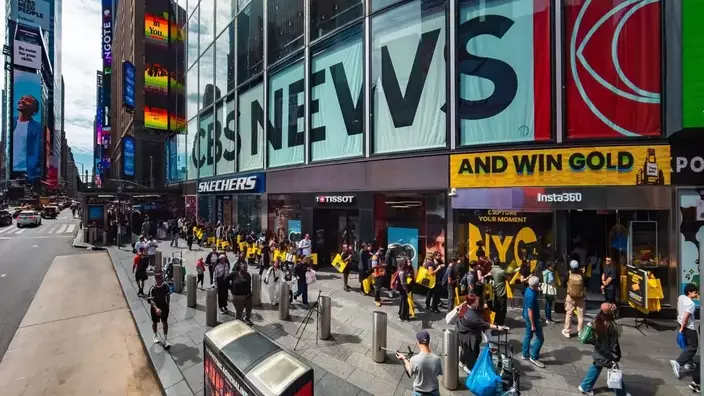
Insta360's New York flagship opening drew massive launch-day crowds.
The young man at the front of the line wants to become a YouTuber. He headed straight to the site after finishing work and queued overnight, becoming the day's 'number one fan.' He received a limited-edition new gimbal camera with an exclusive gold logo.
When asked why he was so enthusiastic about a Chinese brand, his answer captured a recent shift in the US imaging market. He said he used to ride his bike near Central Park a lot. Back then everyone was using GoPro, but now almost everyone has switched to Insta360.
In the line there was also a race car driver who flew nearly 10,000 kilometers from Egypt specifically for this. Egypt still has no Insta360 dealer, and he had tried many places without being able to buy one. So he simply flew directly to New York.
There was also an American father who specially brought his 10-year-old son to New York so they could experience Insta360's latest camera together as a birthday gift.
Coincidentally, Tim Cook, who has stepped down as Apple's chief executive officer and now serves as chairman of the executive board, also posted on Weibo on September 20.
He said every time he sees customers experiencing Apple's new products at Apple Store retail locations in China, it is especially uplifting. The accompanying photo showed customers waiting outside the store in long, multi-layered lines.
It so happened that on September 18 this year, Apple's iPhone 18 Pro series also went on sale in many places around the world. That triggered a fair amount of queuing as well.
But the mindset behind the two types of lines is completely different. Most people buying an iPhone have a hard need to upgrade and see it as routine. People who queued overnight to buy a Chinese camera were actively pursuing an emerging category that was previously unheard of.
The difference is also why outsiders are paying attention to Insta360's opening.
GoPro Fades as Chinese Brands Take Over
To understand the weight of that New York line, you first need to understand the global imaging industry's power map over the past few decades. Japanese camera brands long monopolized the industry's discourse. The American brand GoPro defined the action camera category and was once synonymous with the product type. But market research data shows the landscape has reversed in recent years.
In 2022, GoPro still held about 84% of the global action camera market. That was an absolute monopoly. Within just a few years, its share collapsed. By the first three quarters of 2025 it had fallen to about 18%. In the same market, GoPro went from roughly eight out of ten cameras to fewer than two in ten.
In August this year, GoPro submitted documents to the US Securities and Exchange Commission that included the blunt warning "substantial doubt about its ability to continue as a going concern." A company that once defined an entire industry now has to admit operating difficulties in public filings.
It has even agreed to merge with an American company in the artificial intelligence optics business. The deal is valued at $285 million, about HK$2.22 billion. Original shareholders would keep only about 10% of the merged company's equity.
In name it is a merger. In substance it is close to being swallowed.
Meanwhile, DJI and Insta360 together account for about 87% of the global handheld smart camera market. This queue is not just one Chinese brand selling well. It is an industry reshuffle. The American company that once set industry standards has been pushed to the margins by Chinese brands in just a few years.
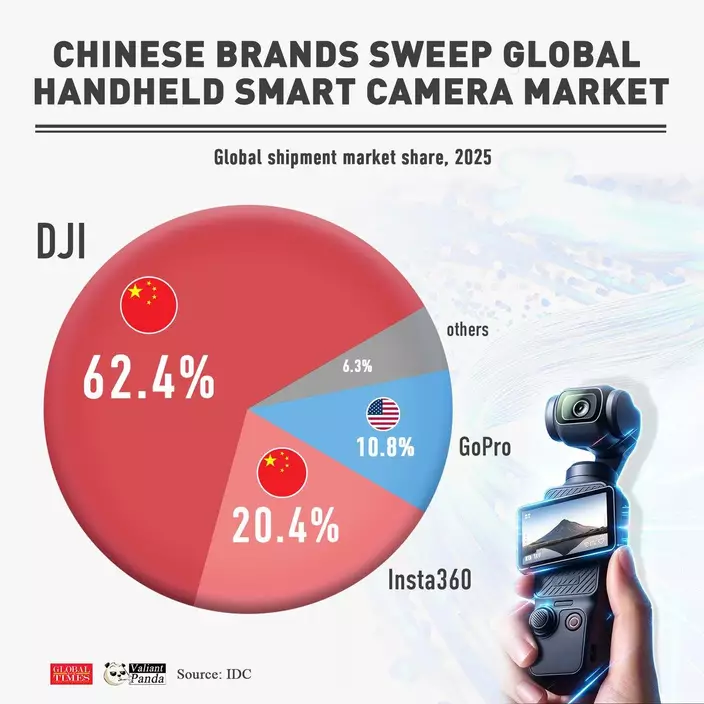
DJI and Insta360 now control about 87% of the global handheld smart camera market.
The shift in Japan is even more telling. Japan has long been seen as the birthplace of the global imaging industry. Local consumers are fiercely loyal to camera brands. On July 2 this year, Insta360 held a launch event for a new gimbal camera in Shibuya, Tokyo.
By 6 a.m. consumers had already arrived to line up. The longest wait reached 9 hours. The organizer temporarily distributed 450 admission tickets, and they were all claimed within half an hour. The white version sold out online in just 5 minutes.
Retail data makes the point even sharper. Japanese research firm BCN reports that in 2025, a Chinese brand won the annual sales crown in the action camera category for the first time. DJI and Insta360 together took about 78% of the Japanese market. GoPro's share collapsed from 34.3% the previous year to 18.9%.
In other words, even in Japan, widely regarded as the birthplace of global imaging technology standards, local consumers would rather queue overnight to buy Chinese cameras.
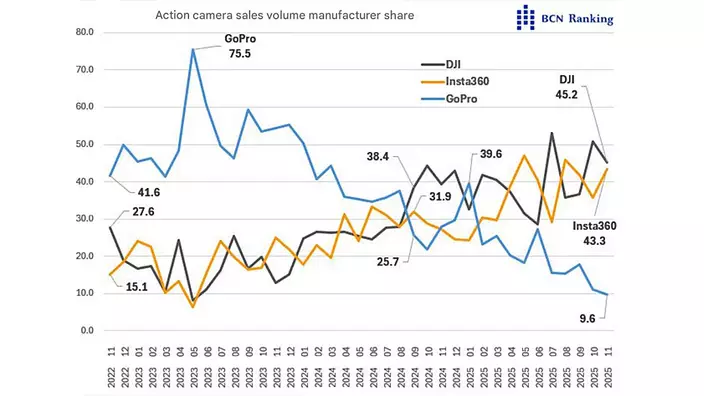
Chinese brands now lead Japan, overtaking long-time giant GoPro.
What the Queues Really Mean
Back in New York, that flagship store means far more to Insta360 than an opening ceremony. On opening day, Insta360 also announced cumulative global camera shipments had passed 10 million units. That is more than 10 million cameras sold over ten years.
The opening event drew Casey Neistat, a North American imaging creator with more than 10 million followers, along with die-hard users who have followed the brand for years. One of them, Anthony Quintano, was first in line at 3 a.m. for Insta360's first new-product pop-up in New York last year. He became the first person in the world to buy that new model.
Another was Kevin, a cycling community leader. He and 100 local riders in bright yellow jerseys rode through New York landmarks on opening day. They recorded the journey on Insta360 cameras the whole way.
From top influencers and veteran loyalists to ordinary citizens, three seemingly unrelated stories map Insta360's ten-year localization effort in the United States. This Chinese company did not simply move a store into another country. It cultivated local creator circles and vertical communities, embedding itself in local life.
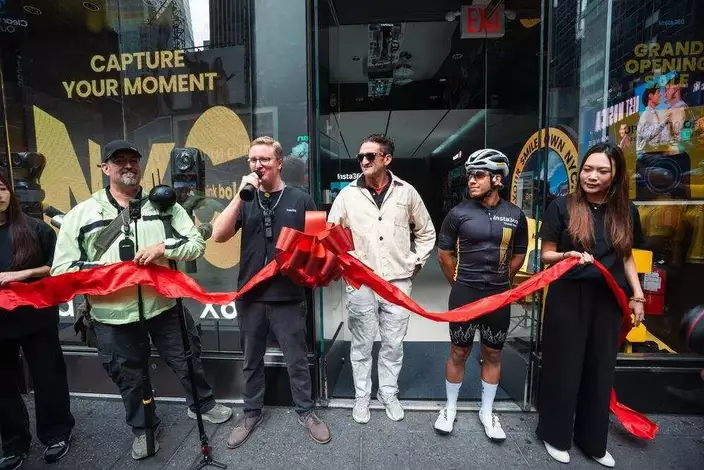
Top creators and local cyclists joined the store ribbon-cutting.
Around Times Square, Insta360's store sits not far from a cluster of Chinese brands that have already entered the US market: Pop Mart, Miniso, and Heytea. But compared with these 'Chinese neighbors' opening stores in New York, Insta360 has cultivated the US market for a full decade. It started out unknown, and now it draws a thousand people to queue overnight at the world's crossroads.
From Tokyo's Shibuya to New York's Times Square, Chinese camera brands are not riding a one-city viral moment. They are on a structural upward trajectory that spans regions and is backed by data.
Going overseas has never meant copying a store into a foreign country. It means making yourself part of local life. That may be the real strength of Chinese brands that has been most easily underestimated in recent years.