China has achieved a major breakthrough in clean energy technology development with the rollout of the world's most powerful direct-drive floating wind turbine.
Jointly developed by state-owned enterprises China Huaneng Group and Dongfang Electric Corporation, the 17-megawatt turbine officially rolled off the production line on Thursday in Fujian Province's coastal city of Fuqing, China Huaneng Group confirmed on Saturday.
A single unit can generate 68 million kilowatt-hours of clean electricity annually, enough to power approximately 40,000 households.
The turbine will undergo real-world testing in the waters off Yangjiang, in south China's Guangdong Province, according to China Huaneng Group.
Boasting an operational availability rate exceeding 99 percent, the giant machine features a record-breaking 262-meter rotor diameter with a swept area of approximately 53,000 square meters, equivalent to 7.5 standard soccer fields. Towering 152 meters, its hub is almost as high as a 50-story residential building.
The turbine can withstand extreme maritime conditions, including waves of over 24 meters high and typhoons at level 17. Its unique stabilization technology enables continuous power generation even when the floating platform tilts at extreme angles.
Liu Xin, director of the offshore wind division at China Huaneng Clean Energy Research Institute, highlighted the turbine's adaptability, noting that its integrated intelligent sensing system enables holistic stability control for safe and efficient operation in complex deep-sea environments.
"This type of floating wind turbines is specifically designed for deep-sea environments and can be deployed in waters of over 50 meters deep for offshore wind energy development. Each unit is capable of generating 68 million kWhs of electricity per year, enough to meet the electricity consumption needs of approximately 40,000 households for a whole year," he said.
The project's research and development team made technological breakthroughs in floating wind power system coupling simulation technology and high-fidelity model testing techniques.
Notably, all its core components, including blades, generators and transformers, are domestically produced, with the first Chinese-designed large-diameter main shaft bearing incorporated into the structure.
This technological breakthrough opens the door to harnessing China's vast deep-sea wind resources. According to the energy research institute under the National Development and Reform Commission, while nearshore waters (5-50 meters deep) offer around 500 GW of technically developable wind capacity, deep-sea resources are estimated to be three to four times this volume.
Data from the Global Wind Energy Council (GWEC) underscore the global significance, showing that over 80 percent of offshore wind resources are located in waters deeper than 60 meters.
Floating wind power generation technology and solutions are set to further unlock the potential of deep-water wind energy, according to GWEC.
By the end of 2024, the global installed capacity of floating wind power is expected to reach 278 megawatts, with Norway, the United Kingdom, China and France leading as the top four markets, GWEC said.
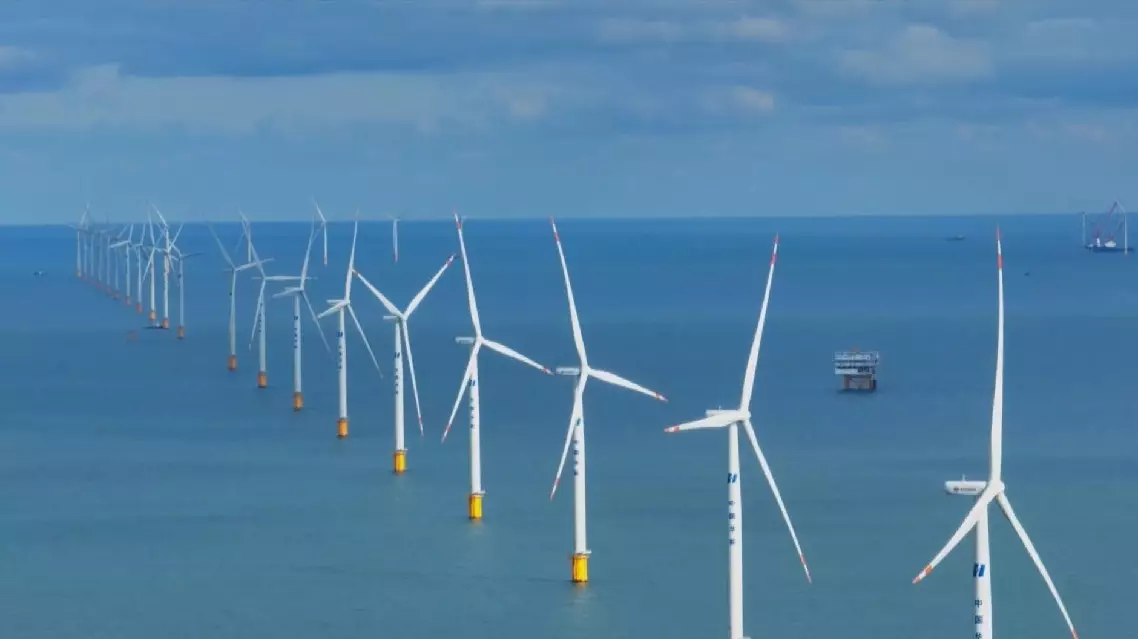
World's most powerful direct-drive floating wind turbine unveiled in China