TAMPA, Fla. (AP) — Cam Schlittler was throwing a perfect game through six innings Wednesday night, the longest bid by a New York Yankees rookie in nearly 60 years.
The 24-year-old right-hander retired the first 18 Rays he faced before Chandler Simpson led off the seventh with a single to right. Schlittler finished with 6 2/3 scoreless, one-hit innings in just his seventh major league start. He struck out eight, all swinging, and walked two.
Even after losing the bid, Schlittler stayed composed.
“I wasn’t really thinking about it too much, but even when he got the hit, I didn’t really care that much,” Schlittler said. “The biggest thing is that we won, and I put the team in a position to win. And I got past that five-inning mark that I have been struggling to get through my last six starts.”
The Yankees did win, though Schlittler didn’t factor in the decision. The Rays rallied for two runs in the ninth to tie the game before Giancarlo Stanton and Austin Wells answered with back-to-back home runs in the 10th to lift New York to a 6-4 victory at George M. Steinbrenner Field.
Schlittler’s outing was the longest perfect-game bid by a Yankees rookie since Fritz Peterson went 6 1/3 innings against the White Sox on July 4, 1966. For six innings, he was nearly untouchable. He never reached a three-ball count, allowed only three balls out of the infield and generated 19 swings-and-misses.
“What a performance,” Yankees manager Aaron Boone said. “Dominant. Probably the best breaking ball he’s had all year to go with the fastball. He was just filling up the strike zone.”
Boone said Schlittler had a chance at a perfect game because of his efficiency — he threw 95 pitches — but noted the rookie tired in the seventh.
The effort wasn’t lost on his teammates.
“Amazing,” Aaron Judge said. “To hold a perfecto that long against a scrappy team that puts the ball in play, that’s tough to do.”
Through seven starts, Schlittler has a 3.22 ERA with 38 strikeouts and has allowed three runs or fewer each time.
AP MLB: https://apnews.com/hub/MLB

New York Yankees pitcher Cam Schlittler delivers to the Tampa Bay Rays during the seventh inning of a baseball game Wednesday, Aug. 20, 2025, in Tampa, Fla. (AP Photo/Chris O'Meara)

New York Yankees pitcher Cam Schlittler delivers to the Tampa Bay Rays during the first inning of a baseball game Wednesday, Aug. 20, 2025, in Tampa, Fla. (AP Photo/Chris O'Meara)
WASHINGTON (AP) — A bipartisan group of lawmakers have proposed creating a new agency with $2.5 billion to spur production of rare earths and the other critical minerals, while the Trump administration has already taken aggressive actions to break China's grip on the market for these materials that are crucial to high-tech products, including cellphones, electric vehicles, jet fighters and missiles.
It’s too early to tell how the bill, if passed, could align with the White House’s policy, but whatever the approach, the U.S. is in a crunch to drastically reduce its reliance on China, after Beijing used its dominance of the critical minerals market to gain leverage in the trade war with Washington. President Donald Trump and Chinese President Xi Jinping agreed to a one-year truce in October, by which Beijing would continue to export critical minerals while the U.S. would ease its export controls of U.S. technology on China.
The Pentagon has shelled out nearly $5 billion over the past year to help ensure its access to the materials after the trade war laid bare just how beholden the U.S. is to China, which processes more than 90% of the world's critical minerals. To break Beijing's chokehold, the U.S. government is taking equity stakes in a handful of critical mineral companies and in some cases guaranteeing the price of some commodities using an approach that seems more likely to come out of China's playbook instead of a Republican administration.
The bill that Sen. Jeanne Shaheen, D-N.H., and Sen. Todd Young, R-Ind., introduced Thursday would favor a more market-based approach by setting up the independent body charged with building a stockpile of critical minerals and related products, stabilizing prices, and encouraging domestic and allied production to help ensure stable supply not only for the military but also the broader economy and manufacturers.
Shaheen called the legislation “a historic investment” to make the U.S. economy more resilient against China’s dominance that she said has left the U.S. vulnerable to economic coercion. Young said creating the new reserve is “a much-needed, aggressive step to protect our national and economic security.”
Rep. Rob Wittman, R.-Va., introduced the House version of the bill.
When Trump imposed widespread tariffs last spring, Beijing fought back not only with tit-for-tat tariffs but severe restrictions on the export of critical minerals, forcing Washington to back down and eventually agree to the truce when the leaders met in South Korea.
On Monday, in his speech at SpaceX, Defense Secretary Pete Hegseth revealed that the Pentagon has in the past five months alone “deployed over $4.5 billion in capital commitments” to close six critical minerals deals that will “help free the United States from market manipulation.”
One of the deals involves a $150 million of preferred equity by the Pentagon in Atlantic Alumina Co. to save the country's last alumina refinery and build its first large-scale gallium production facility in Louisiana.
Last year, the Pentagon announced it would buy $400 million of preferred stock in MP Materials, which owns the country's only operational rare earths mine at Mountain Pass, California, and entered into a $1.4-billion joint partnership with ReElement Technologies Corp. to build up a domestic supply chain for rare earth magnets.
On Wednesday, Trump announced in a proclamation that the U.S. is “too reliant” on foreign-sourced critical minerals and directed his administration to negotiate better deals. He said possible remedies would include minimum import prices for certain critical minerals.
“Reshoring manufacturing that’s critical to our national and economic security is a top priority for the Trump administration,” said Kush Desai, a White House spokesperson.
The drastic move by the U.S. government to take equity stakes has prompted some analysts to observe that Washington is pivoting to some form of state capitalism to compete with Beijing.
“Despite the dangers of political interference, the strategic logic is compelling,” wrote Elly Rostoum, a senior fellow at the Washington-based research institute Center for European Policy Analysis. She suggested that the new model could be “a prudent way for the U.S. to ensure strategic autonomy and industrial sovereignty.”
Companies across the industry are welcoming the intervention from Trump's administration.
“He is playing three-dimensional chess on critical minerals like no previous president has done. It's about time too, given the military and strategic vulnerability we face by having to import so many of these fundamental building blocks of technology and national defense,” NioCorp's Chief Communications Officer Jim Sims said. That company is trying to finish raising the money it needs to build a mine in southeast Nebraska.
In addition to trying to boost domestic production, the Trump administration has sought to secure some of these crucial elements through allies. In October, Trump signed an $8.5 billion agreement with Australia to invest in mining there, and the president is now aggressively trying to take over Greenland in the hope of being able to one day extract rare earths from there.
On Monday, finance ministers from the G7 nations huddled in Washington over their vulnerability in the critical mineral supply chains.
U.S. Treasury Secretary Scott Bessent, who has led several rounds of trade negotiations with Beijing, urged attendees to increase their supply chain resiliency and thanked them for their willingness to work together “toward decisive action and lasting solutions,” according to a Treasury statement.
The bill introduced on Thursday by Shaheen and Young would encourage production with both domestic and allied producers.
Congress in the past several years has pushed for legislation to protect the U.S. military and civilian industry from Beijing's chokehold. The issue became a pressing concern every time China turned to its proven tactics of either restricting the supply or turned to dumping extra critical minerals on the market to depress prices and drive any potential competitors out of business.
The Biden administration sought to increase demand for critical minerals domestically by pushing for more electric vehicle and windmill production. But the Trump administration largely eliminated the incentives for those products and instead chose to focus on increasing critical minerals production directly.
Most of those past efforts were on a much more limited scale than what the government has done in the past year, and they were largely abandoned after China relented and eased access to critical minerals.
Funk reported from Omaha, Nebraska. AP writer Konstantin Toropin contributed to the report.

FILE - NioCorp Chief Operating Officer Scott Honan tells a group of investors about the plans for a proposed mine during a tour of the site Oct. 6, 2021, near Elk Creek in southeast Nebraska. (AP Photo/Josh Funk, File)
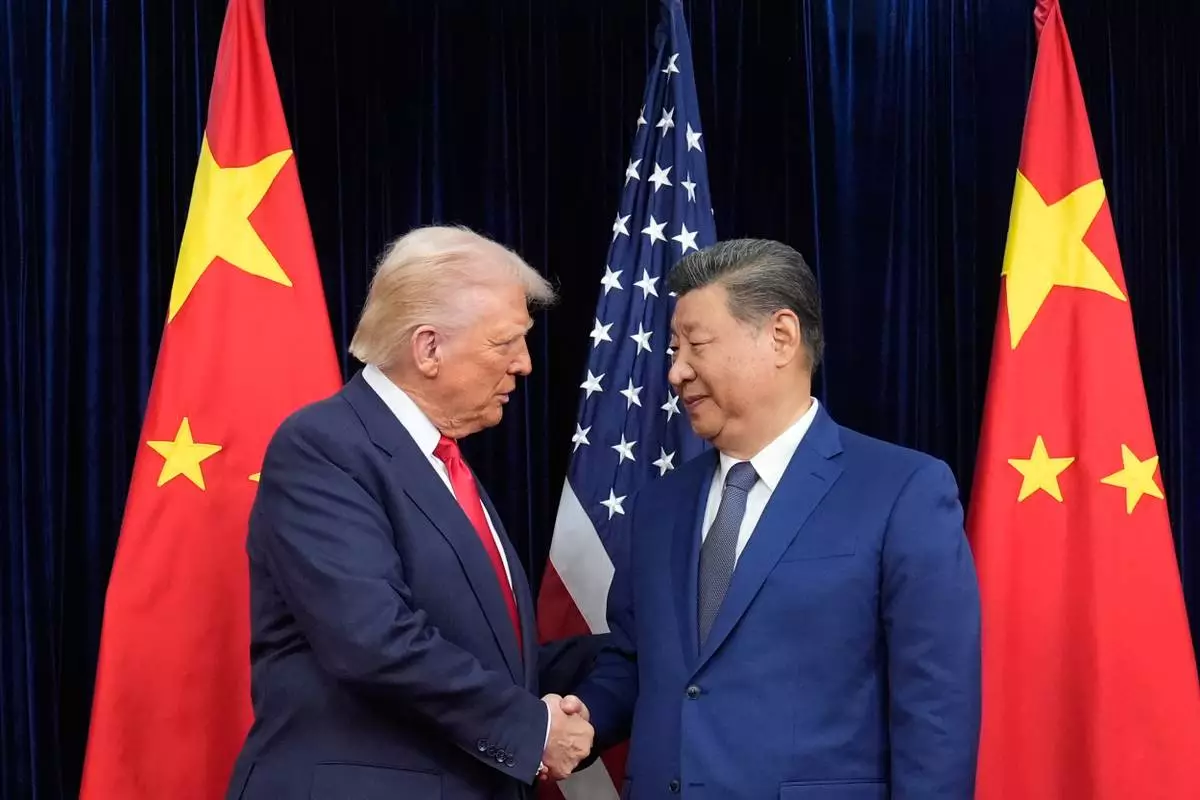
FILE - President Donald Trump, left, and Chinese President Xi Jinping, right, shake hands before their meeting at Gimhae International Airport in Busan, South Korea, Oct. 30, 2025. (AP Photo/Mark Schiefelbein, File)
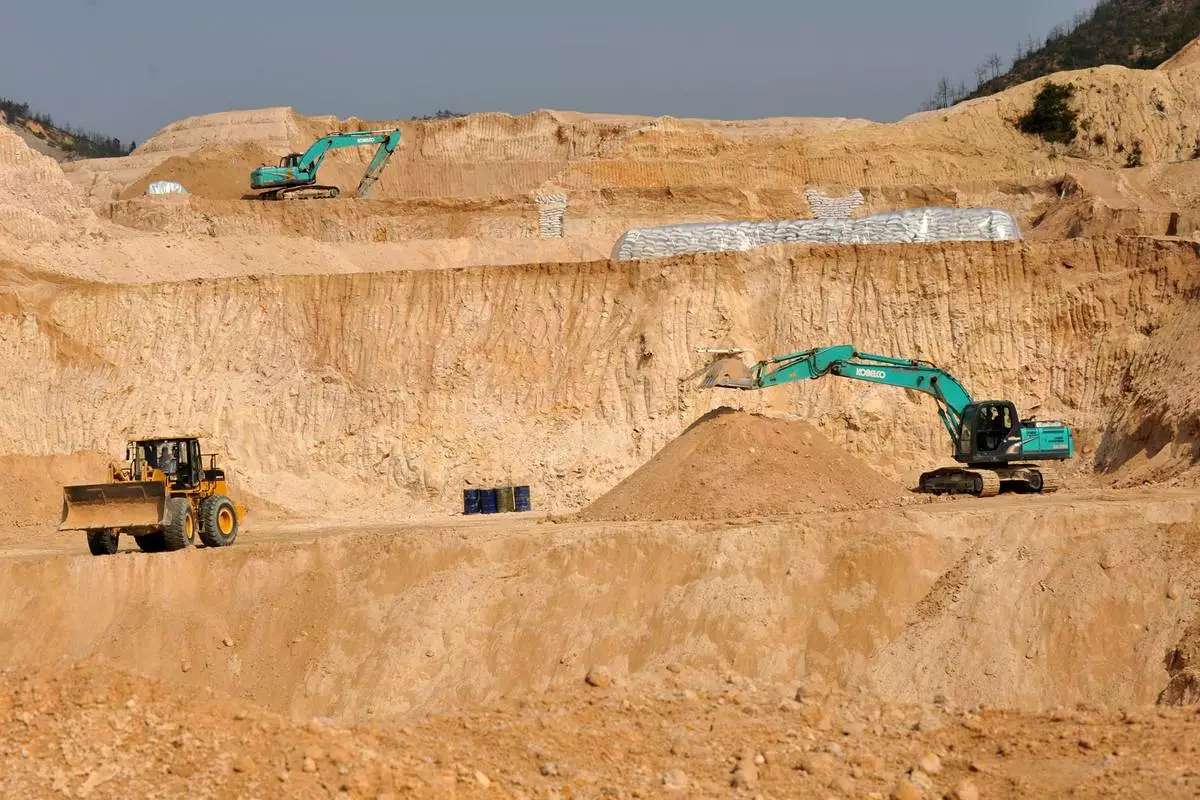
FILE - Workers use machinery to dig at a rare earth mine in Ganxian county in central China's Jiangxi province on Dec. 30, 2010. (Chinatopix via AP, File)