
Trump blasted out a warning on his social media platform Truth Social about China’s tough stance on trade. He claimed “China sent an extremely hostile letter to the world” by announcing that starting November 1, 2025, it will “impose large-scale export controls on nearly every product they make, and some not even made by them”.
The US, striking back, plans to “impose a tariff of 100% on China, over and above any tariff they are currently paying”, plus export controls on critical software. This move will also start on November 1, 2025.
And, Trump criticized China’s rare earth export limits and said that there was no reason for meeting with Xi Jinping at the upcoming APEC summit in South Korea — though he later softened the tone, saying the meeting might still take place.
Markets React: Stock Sell-Off
The market slammed back hard after Trump’s announcement. On “Black Friday,” the Dow plunged 878 points to 45,479 and the Nasdaq tumbled 3.56%, closing at 22,204.
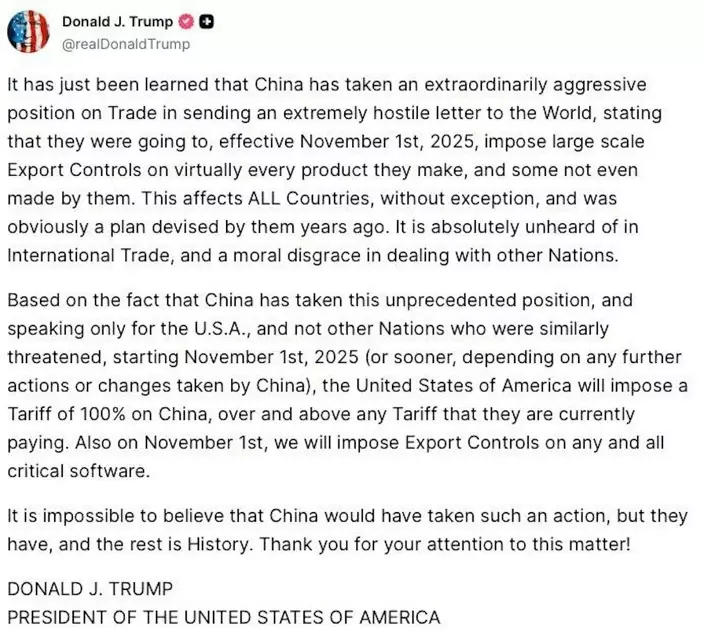
Trump: “Starting November 1st, 2025, the United States will impose a Tariff of 100% on China, over and above any Tariff they are currently paying.”
Meanwhile, China’s Ministry of Commerce unveiled new rare earth export controls: any foreign exporter dealing in products with over 0.1% China-sourced rare earths or using Chinese extraction/magnet-making tech now needs an export licence. Controls on permanent rare earth magnets will kick in from December 1.
Trump says China’s move caught him off guard and insists the US is only responding. When asked if the US might lift tariffs if China backs down, he was noncommittal, saying it depends on future developments. He claims a good relationship with Xi Jinping but was blindsided. And he warned the US has plenty of tools beyond tariffs and software controls, including export controls on planes and parts.
Back in August, both sides agreed to suspend 24% tariffs for 90 days, a truce expiring November 9.
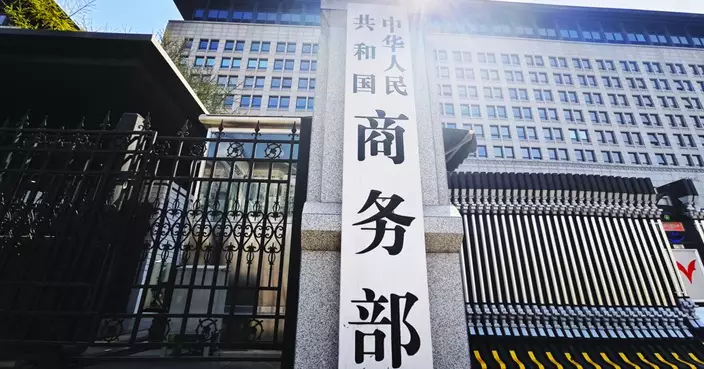
China gets tough: New export rules for rare earths—license needed if even 0.1% comes from China.
But tensions have been simmering. The US trade office targeted China’s maritime, logistics, and shipbuilding industries earlier this year and announced port fees on Chinese vessels starting October 14—violating international trade norms and agreements.
China Hits Back with Countermeasures
In response, China’s Ministry of Transport announced a “special port fee” on ships linked to the US starting October 14. The Ministry of Commerce emphasized these are fair defensive measures to protect competitive shipping and shipbuilding markets internationally.
According to Reuters, China has become the top shipbuilder worldwide over the past 20 years, and is now capable of commercial and military projects simultaneously. The US port fees are part of a wider push to revive American shipbuilding and curb China’s maritime strength.
Experts quoted by Reuters say China’s countermeasure shows the tariff truce is fragile at best.
A soybean trader noted China remains annoyed and likely won’t resume US farm imports soon. Despite that, agricultural trade impact may be limited as imports have already shrunk since the tariff war started. Bloomberg reported that after China’s announcement, global logistics reacted fast: some oil tankers canceled bookings to China, and charter rates for coal and iron ore carriers spiked.
Bloomberg also highlighted the massive impact of China’s port fee: RMB 400 per ton, or about $56, meaning a super-large crude carrier docking pays an extra $6.2 million each time. Analysts call this significant already.
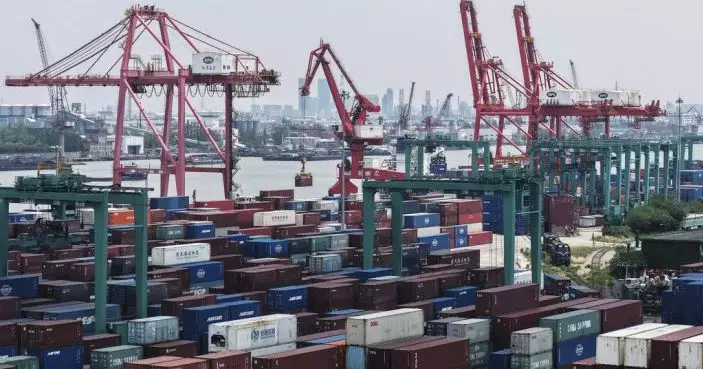
Ship showdown: China slaps special port fees on US-linked vessels—fight fire with fire.
CNBC quoted Peter Alexander of Z-Ben Advisors saying the US made the first move, and China’s just returning fire — “just more tit-for-tat negotiating tactics. The US placed similar fees on Chinese-bound vessels and now China is doing th4 same.”
Who This Hits: Ships and Investors with US Ties
Jayendu Krishna, director at Drewry Shipping Consultants, said bluntly that the devil is in the details – if a vessel financed by a US company, listed on a US exchange or chartered by a US entity is deemed US-owned, the measure could have a significant impact.
Kun Cao, vice president of Reddal, told the Associated Press that China’s countermeasure is “not just a symbolic move” – the rule specifically targets any vessel with substantial ties to the US, whether in ownership, operation, flag or construction, and fees will ramp up with tonnage – “real bite is on US-owned and operated vessels”.
Bloomberg also noted that although many of the world’s largest tanker operators are not headquartered in the US, several are listed there and have major US shareholders.
Omar Nokta, an analyst at Jefferies Group, said the impact of China’s new fee should not be underestimated – it will affect listed companies, especially those with more than 25% of shares held by US-based investment funds.
Meanwhile, US shipping insiders say the American port fee announcement is still a “murky mess” with unclear rules and scope, leaving the industry confused.
Mao Paishou
** 博客文章文責自負,不代表本公司立場 **