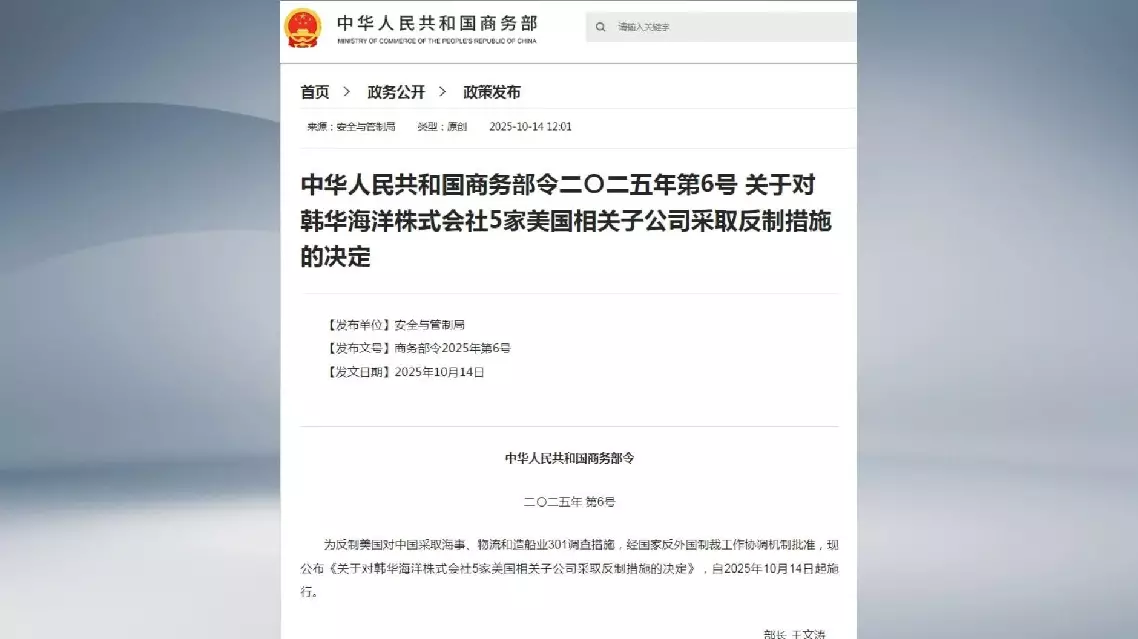
China's Ministry of Commerce on Tuesday announced the decision to take countermeasures against five U.S.-linked subsidiaries of Hanwha Ocean, a leading shipbuilding enterprise from the Republic of Korea.
These countermeasures, which took effect on Tuesday, were adopted to counteract the U.S. Section 301 investigation measures aimed at China's maritime, logistics and shipbuilding sectors, which seriously violates international law and the basic norms governing international relations and severely undermines the lawful rights and interests of Chinese companies, the ministry said in a statement.
The five U.S.-linked subsidiaries of Hanwha Ocean subject to these countermeasures are Hanwha Shipping LLC, Hanwha Philly Shipyard Inc., Hanwha Ocean USA International LLC, Hanwha Shipping Holdings LLC and HS USA Holdings Corp., according to the ministry.
Organizations and individuals within China are prohibited from engaging in any transactions, cooperation or related activities with these entities, the ministry said.
In response to a media query on these countermeasures, a spokesperson for the ministry said that China deplores and rejects the five subsidiaries' actions of assisting and supporting the U.S. government to conduct the Section 301 investigations against China's maritime, logistics and shipbuilding sectors.
To safeguard its own sovereignty, security and development interests, and in accordance with relevant laws and regulations such as the Anti-Foreign Sanctions Law, China has decided to include these five U.S.-linked subsidiaries of Hanwha Ocean in its countermeasure list, with the approval of the national coordination mechanism for anti-foreign sanctions, the spokesperson said.
The spokesperson stressed that China urges the U.S. side and relevant companies to respect facts and multilateral economic and trade rules, adhere to the principles of market economy and fair competition, rectify their erroneous practices as soon as possible, and stop harming the interests of China.
China announces countermeasures against five US-linked subsidiaries of Hanwha Ocean
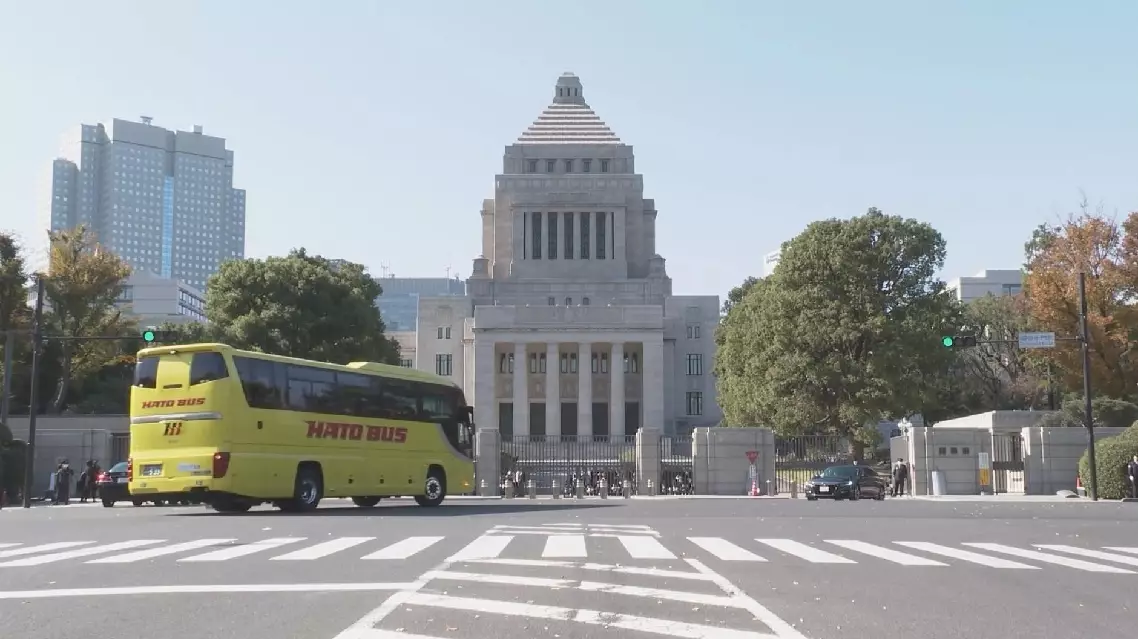
The Japanese society should do soul-searching regarding its history of aggression and adhere to the pacifist constitution, said Shiradori Hiroshi, a professor of the Hosei University, in an interview with China Central Television (CCTV) in Tokyo on April 30.
He said the government's recent move to discuss revising the three security documents deserve particular attention as the country's foreign and security policies have already witnessed major changes.
"People outside of the country hold that Japan's post-war image as a 'peace state' is now facing a major shift. Against the backdrop of tremendous changes in its foreign and security policies, the revision of the three security documents deserves particular attention. There lacks public debate in terms of the procedure, with policy changes decided unilaterally at Cabinet meetings. It is necessary to fully explain to the public as to whether such a practice is proper," said Hiroshi.
The Japanese government held its first expert panel meeting to discuss revisions to the three security documents at the Prime Minister's Office on April 27, local media reported.
Japan's current National Security Strategy and two related documents, formulated in 2022, were designed to cover the next 10 years, but the government led by Prime Minister Sanae Takaichi has decided to move up the timetable to accelerate the revision process.
Increasing defense spending is one of the key topics of the meeting, according to Kyodo News.
Hiroshi said this year marks the 80th anniversary of the opening of the International Military Tribunal for the Far East, or Tokyo Trials, and the Japanese society must do soul-searching regarding its history of aggression in WWII, when it brought enormous catastrophes on Asian countries.
"Eighty years have passed since the opening of the Tokyo Trials. Japan inflicted enormous suffering on Asian countries during WWII, which should serve as an opportunity for the soul-searching. It is exact on the basis of countless sacrifices that Japan's post-war pacifism and its identity as a 'peace state' took shape. On this 80th anniversary, it is necessary for Japan to re-examine and do soul-searching regarding its history," said Hiroshi.
The Japanese government's effort to revise the pacifist constitution is widely opposed by the public.
On Sunday, around 50,000 people gathered at Tokyo Rinkai Disaster Prevention Park, chanting slogans and holding banners against the government's push for constitutional revision and military expansion, the largest turnout of its kind in recent years.
Japan should adhere to pacifist constitution: scholar