The UNESCO-listed Yungang Grottoes in Datong City, north China's Shanxi Province, reopened its Caves 7 and 8 to the public on Monday, following a five-month digital conservation and restoration effort led by the Yungang Grottoes Research Institute.
Located in the central area of the grotto complex, Caves 7 and 8 are the oldest "double caves" excavated during the mid-period of the Yungang Grottoes. Boasting 45 major caves, the 1,500-year-old Yungang Grottoes were listed as a UNESCO World Heritage Site in 2001.
Carved during the Northern Wei Dynasty (386-534), these large-scale chambers in Caves 7 and 8 are considered masterpieces of early Chinese Buddhist cave art. Their meticulously composed sculptures and intricate carvings exemplify the artistic and spiritual sophistication of the era.
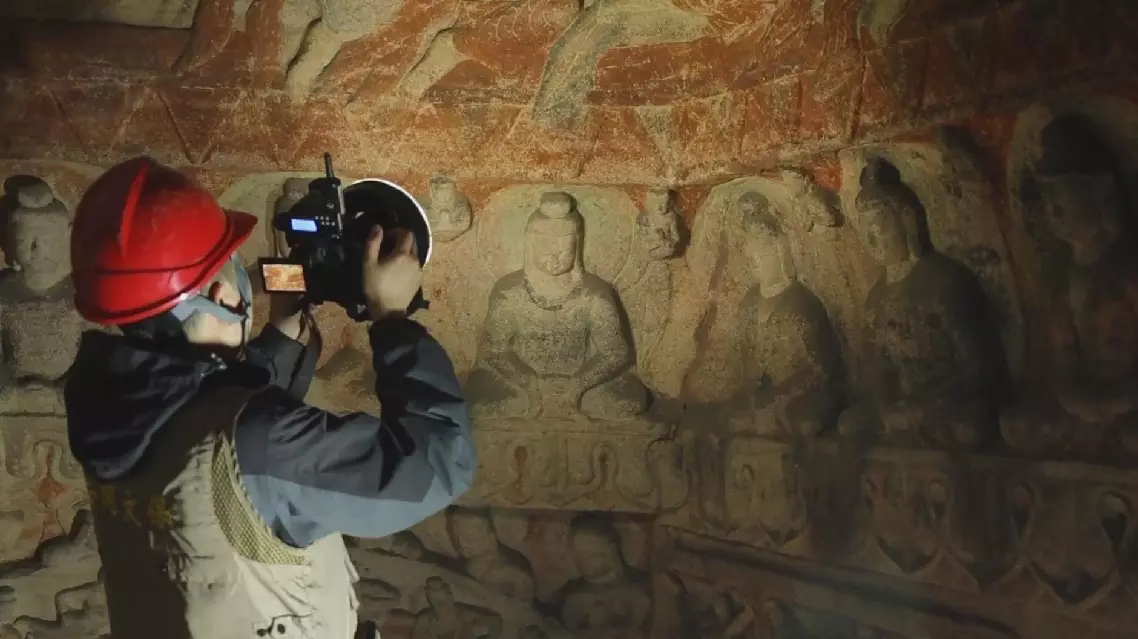
To advance the "digital conservation project for Caves 7 and 8", the Yungang Grottoes Research Institute temporarily closed the two caves on May 13 to conduct comprehensive data collection and structural surveys. The project has now been fully completed, allowing visitors once again to experience these iconic relics up close.
Using cutting-edge technologies, including high-resolution laser scanning and multi-spectral imaging, the conservation team captured millimeter-precision data of the caves' sculptures, murals, and architectural features. This project has established a permanent digital archive for future research and preservation.
Beyond digital documentation, the project also addressed critical structural concerns. Engineers sealed cracks and reinforced unstable rock formations while installing a real-time environmental monitoring system to track temperature, humidity, and light levels, enabling scientific management and protection in the future.
"We employed 3D hyperspectral imaging this year to collect spectral data from the caves this year. In the next phase, we'll integrate this spectral information with high-resolution 3D models to build a comprehensive panoramic data system for the caves," said Li Lihong, a staff member at the Yungang Grottoes Research Institute's digital conservation center.
A representative of the outstanding achievement of Buddhist cave art, the Yungang Grottoes are one of China's three major grotto sites, with the other two being the Mogao Caves in Dunhuang City of northwest China's Gansu Province and the Longmen Grottoes in Luoyang City of central China's Henan Province.
Caves 7 and 8 of UNESCO-listed Yungang Grottoes reopen to public after digital conservation