China will maintain anti-dumping and anti-subsidy duties on n-Propanol (NPA) imported from the United States as the Ministry of Commerce begins expiry reviews of these measures on Tuesday, the ministry announced Monday.
According to the ministry, the anti-dumping and anti-subsidy duties will remain in effect during the expiry review investigations, which are scheduled to be concluded within one year.
NPA is a colorless liquid used as a solvent and chemical intermediate. It is applied in food packaging inks and lithium-battery electrolyte components, and is an important raw material for pharmaceuticals, coatings, adhesives, cosmetics and other products.
On Sept 12, 2025, two major Chinese NPA producers representing the domestic industry submitted applications to the commerce ministry regarding the anti-dumping and anti-subsidy duties on U.S. NPA imports.
At the domestic industry's request, the ministry decided to initiate review investigations to see if the dumping practice, subsidies and related damage would continue or reoccur following the termination of the duties.
The current duties on U.S. NPA imports were first imposed on Nov 18, 2020, for a period of five years, with the anti-dumping duties ranging from 254.4 percent to 267.4 percent and the anti-subsidy duties ranging from 34.2 percent to 37.7 percent.
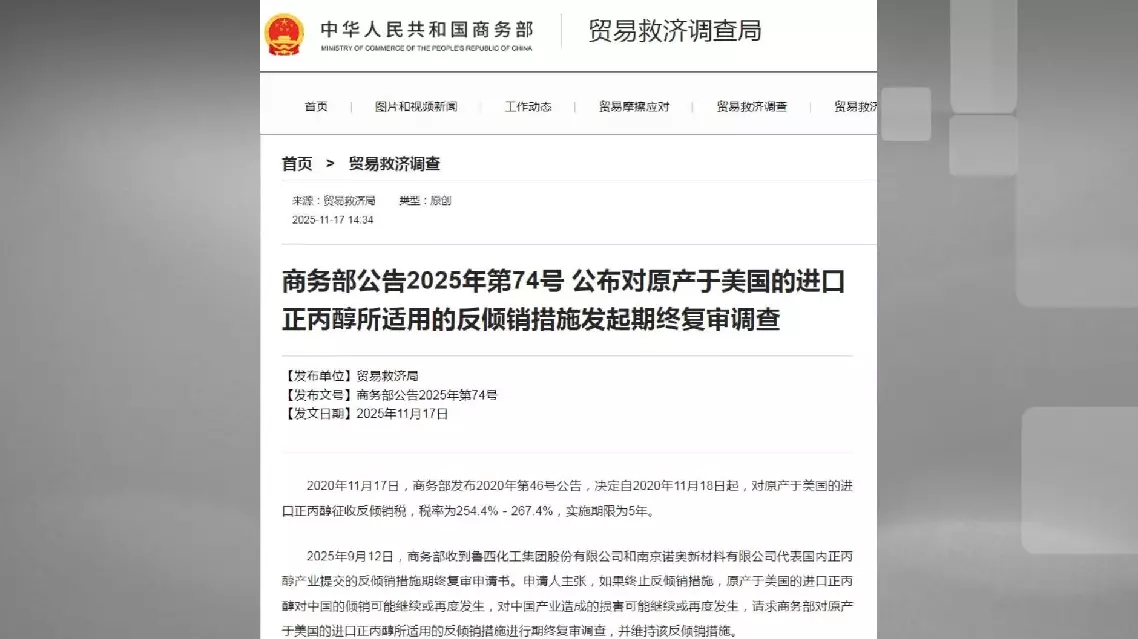
China to maintain anti-dumping, anti-subsidy duties on U.S. n-Propanol: commerce ministry
The torch relay for the Milan-Cortina 2026 Winter Olympic Games began on Saturday morning in Rome, marking the start of a two-month journey ahead of next year's opening ceremony.
The launch ceremony was held at the Stadio dei Marmi, an open-air arena lined with Roman-style statues next to Rome's Olympic Stadium.
At around 09:50, Giancarlo Peris, the final torchbearer of the 1960 Rome Games, brought the flame onto the launch stage. A torch was lit with the flame, and Giovanni Malago, president of the Milan-Cortina 2026 organizing committee, lit the cauldron with it.
The first torchbearer, Italy's Olympic champion Gregorio Paltrinieri, lit the relay torch from the cauldron and then ran a half-lap around the stadium to cheers from spectators, officially starting the relay.
Italian fencer Elisa Di Francisca and high jump Olympic champion Gianmarco Tamberi followed as the second and third torchbearers and completed their relay segments inside the stadium. Tamberi performed a torch kiss with the next runner, Achille Polonara, who carried the flame out of the stadium to begin the route through the city.
The relay will traverse 12,000 kilometers over 60 days across Italy, pass through more than 300 municipalities and feature celebrations in 60 cities, reach all 110 Italian provinces, and light up UNESCO sites along the route.
More than 10,000 torchbearers from all walks of life will take part in the relay, including figures from sectors of sports, culture, film and civil society.
The flame will see Christmas in Naples, New Year in Bari, and return to Cortina d'Ampezzo on January 26, 2026, the 70th anniversary of the 1956 Winter Games opening ceremony. The relay will conclude on February 6 at Milan's San Siro Stadium.
Andrea Varnier, CEO of the Milan-Cortina 2026 Winter Olympic Games' organizing committee, said the torch relay will strengthen the spirit of peace and hope for humanity.
"Our torch will pass through all cultural heritage sites. So along the way, we'll see both our nation's historical landmarks as well as natural landscapes. But what matters most are the people who embrace the torch as a symbol of peace and hope. Athletes and ordinary citizens carrying the Winter Olympics torch will carry the spirit all the way to Milan," he said.
Torch relay for Milan-Cortina 2026 Winter Games starts in Rome