Chinese star sprinter Su Bingtian ran his final race on Thursday, finishing fourth with his teammates in the men's 4x100-meter relay at the 15th National Games to conclude a groundbreaking 21-year career.
The 36-year-old, who now serves as dean of the School of Physical Education at Jinan University, competed in front of a near full-capacity crowd in the 45,000-seater Guangdong Olympic Sports Center in a farewell for the athlete who transformed Asian sprinting.
"Although I said goodbye today, I won't leave the track field that I love. I hope in the future, I can contribute to China's track field, support young racers who love sprint to realize their dreams, as well as help generations of Chinese sprinters to take the lead and excel in international competitions," said Su.
Su's career was defined by historic milestones. In 2012, he became the first Chinese sprinter to reach an Olympic 100-meter semifinal in London. Three years later, he ran 9.99 seconds at the Diamond League in Eugene, Oregon, becoming the first Asian-born athlete to break the 10-second barrier.
By 2018, he had set multiple Asian records in the 60-meter, won a World Indoor Championships silver medal and captured the Asian Games 100-meter title in a record 9.92 seconds. His crowning achievement came at the Tokyo Olympics in 2021, where he ran 9.83 seconds in the 100-meter, becoming the first Chinese man to reach an Olympic 100-meter final. He also helped China's 4x100-meter relay team win bronze.
The 15th National Games, running from Nov 9 to 21, mark the first time that the three Chinese regions, namely Guangdong Province, the Hong Kong Special Administrative Region, and the Macao Special Administrative Region, are co-hosting the country's highest-level and largest national multi-sport event.

China's iconic sprinter Su Bingtian bids emotional farewell in final race at National Games
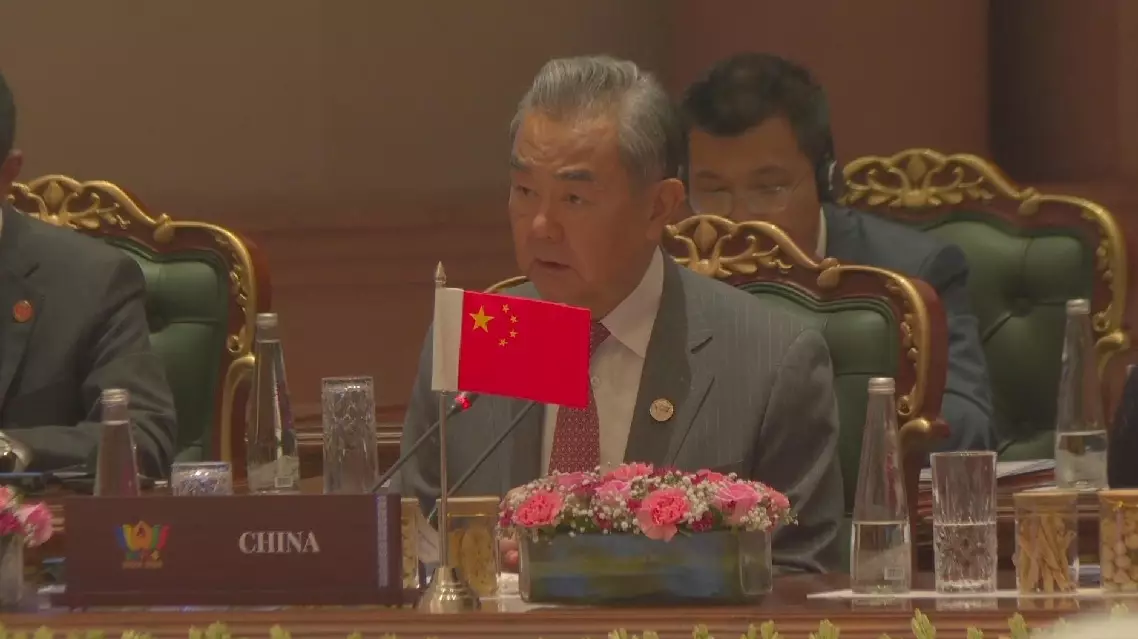
China's top diplomat Wang Yi on Tuesday emphasized the importance of upholding international rules, saying that the conflict between the United States and Iran, which has lasted for over a hundred days, has severely impacted the regional and international situation.
Wang, a member of the Political Bureau of the Communist Party of China Central Committee and director of the Office of the Central Commission for Foreign Affairs, made the remarks during the 16th Meeting of BRICS National Security Advisors and High Representatives on National Security held in New Delhi, India.
He said that the recent signing of the first phase of the U.S.-Iran Memorandum of Understanding, along with the conflict, has made many things clear to us.
The first is the importance of upholding international rules, Wang said at Tuesday's conference.
"The settlement of any international and regional hotspot issues should be based on abiding by international rules. The law of the jungle may succeed for a while, but it is not sustainable," he said.
The second is the importance of respecting national sovereignty, Wang said, adding that territorial integrity shall not be violated and a country's internal affairs shall not be interfered with. This is the most basic bottom line of international justice, he noted.
The third point is the importance of establishing a new vision of security, Wang said.
"Countries are increasingly becoming a community with a shared future. The practice of seeking absolute security of oneself at the expense of others will only backfire," he said.
The Chinese top diplomat said that the fourth is to understand the significance of new forms of war. Unconventional warfare, such as information warfare and cyber warfare, has become more visible in recent conflicts. Facing interwoven traditional and non-traditional security threats, it is the right time for BRICS countries to enhance dialogue and cooperation on security affairs.
China's top diplomat stresses int'l rules at BRICS meeting