Japan's right-wing forces are dragging the Japanese economy into a quagmire by adopting a "tough" foreign policy and implementing an expansionary fiscal policy.
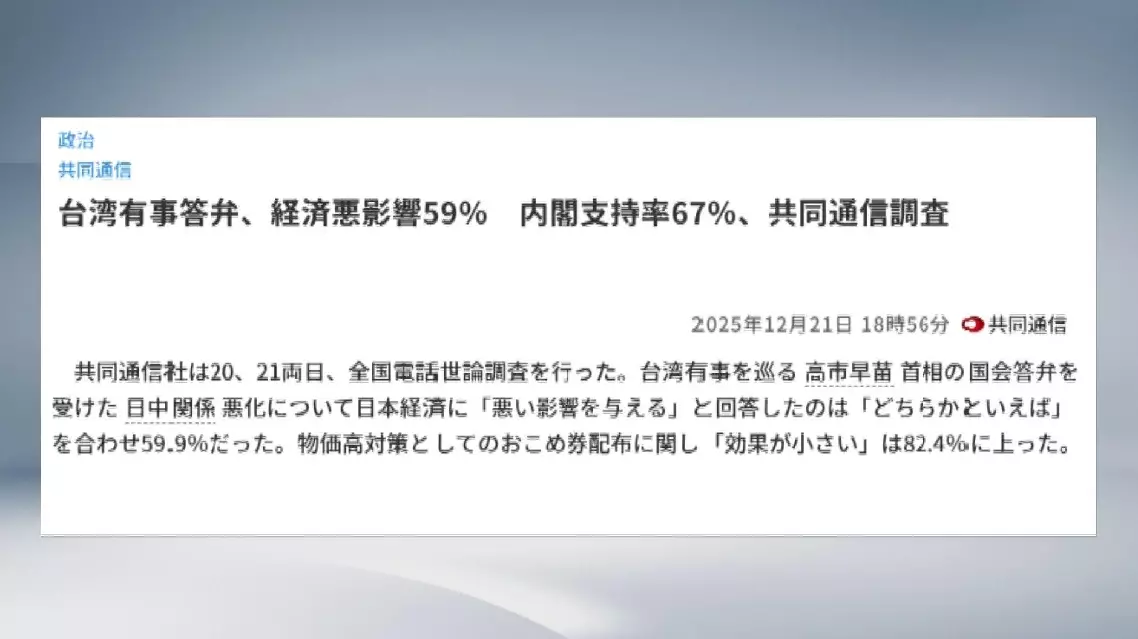
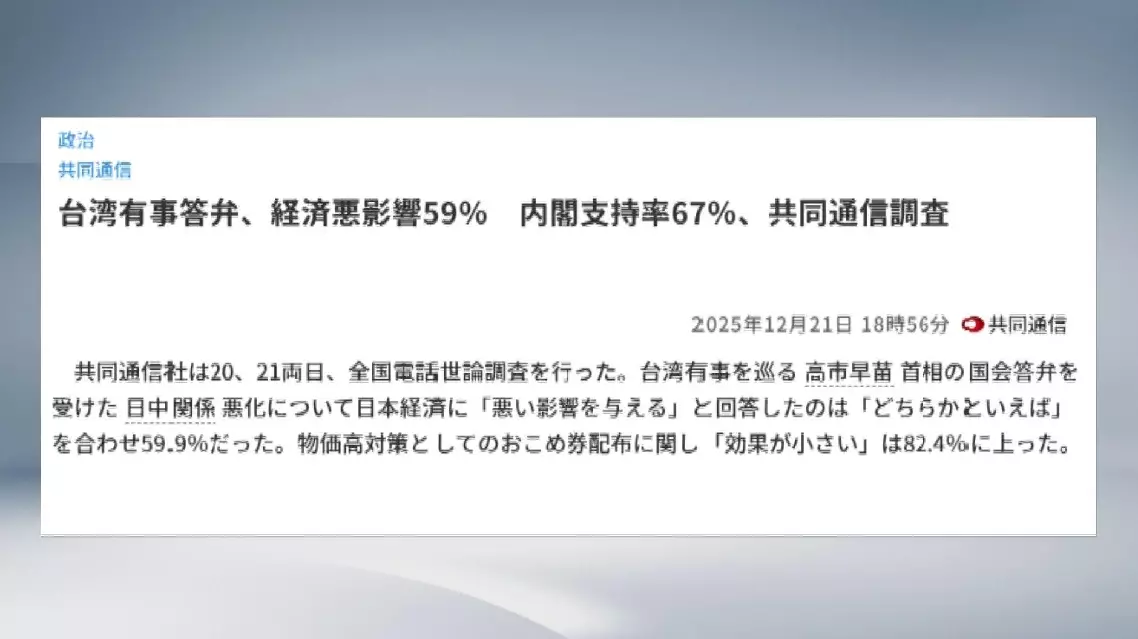
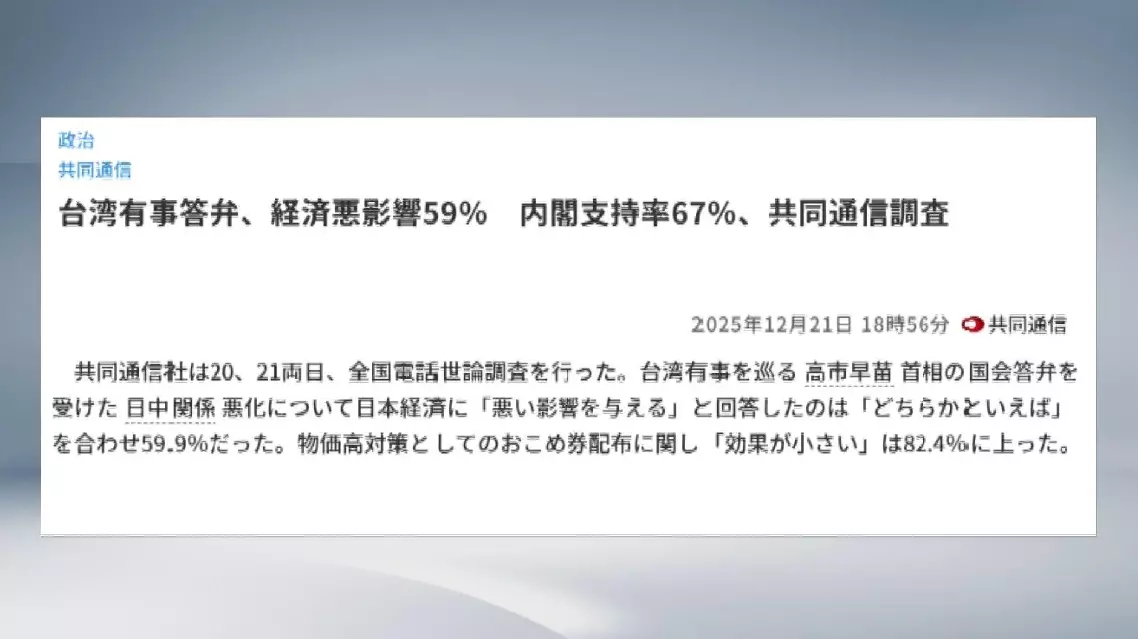
According to a recent survey conducted by Kyodo News, more than half of the respondents believed that Japanese Prime Minister Sanae Takaichi's recent erroneous remarks regarding China's Taiwan region will have an adverse effect on Japan's economy.
In another opinion poll by Kyodo News, more than 60 percent of respondents expressed their concern over the massive fiscal stimulus policy introduced by Takaichi, claiming that the burden on the national finance has increased.
As a result, the approval rate for the Takaichi Cabinet has dropped.
This suggests that the government's intention to divert domestic economic pressure through a "tough" foreign policy has not been effective. Instead, it has increasingly revealed the structural issues within Japan's economy.
In 2024, Japan's GDP grew by only 0.1 percent compared to the previous year. In an effort to boost the economy, the current administration has implemented an expansionary fiscal policy totaling 21.3 trillion yen (about 0.14 trillion U.S. dollars) since Takaichi took office this year.
Japan's benchmark 10-year government bond yield hit 2.020 percent on Friday, its highest level since August 1999, after the Bank of Japan (BOJ) raised its key interest rate to 0.75 percent. Also, the country's benchmark 20-year government bond yield has reached a 27-year peak, and the yield on 30-year bonds has hit an all-time high. There are two main reasons behind this. First, Japan's debt problem has already been quite severe, with the total government debt now surpassed 230 percent of Japan's GDP, the highest among developed countries. In addition, Takaichi appointed a group of economists advocating for growth through fiscal expansion to the Council on Economic and Fiscal Policy of the Japanese cabinet. As the voices of these "expansionary fiscal" advocates grow stronger, coupled with Takaichi's desire to demonstrate her ability to "drive economic growth," the scale of the fiscal budget is ultimately pushed beyond 21 trillion yen.
The BOJ is the largest holder of Japanese government bonds, with more than half of the total. However, since last year, the demand structure for Japanese government bonds has been undergoing changes.
In the middle of last year, the BOJ announced the implementation of a policy of quantitative tightening and began to reduce its holdings of government bonds, sending a signal to the market that the BOJ would no longer purchase Japanese government bonds without limits. By the second quarter of this year, the demand for bond purchases from domestic institutions in Japan also saw a significant drop.
This means that Japan's bond market is increasingly reliant on external funding, and foreign investors are highly sensitive to risks. Once foreign investors begin to question the Japanese government's debt paying ability, they are likely to sell off Japanese government bonds, raising the probability of systemic risk.
At the same time, Japanese banks, insurance companies, and pension funds have long held substantial positions in government bonds, meaning that a decline in bond price could quickly amplify their paper losses. The International Monetary Fund (IMF) has also said that if such risks accumulate, they could trigger instability within financial institutions.
The pressure on financial institutions will ultimately transmit to the real economy, driving up borrowing costs for businesses and households. This, in turn, will further weaken investment and consumption in an already fragile growth environment. Takaichi has sought to quickly demonstrate her economic competence, but instead, she has pushed Japan's bond market toward risk as her fiscal policy is not only unreasonable in scale, but the timing of its introduction is also inappropriate.
At present, Japan is experiencing a rapid rise in prices. According to the latest data, the nationwide consumer price index (CPI) has increased for 51 consecutive months, with over 20,000 food items seeing price hikes. In this context, the conventional response should be to curb overall demand through tight monetary policy and fiscal policy in order to temper inflation. However, the fiscal policy strongly advocated by Takaichi goes against this approach.
She has opted for a path of expansionary fiscal policies, such as cash handouts, aimed at giving the public the illusion that their financial burdens have not significantly increased, as if their purchasing power is being maintained. Essentially, this is akin to "plugging one's ears while stealing a bell." While Takaichi is acting to fulfill her promises made during her campaign, she has pushed Japan's inflation problem into a more uncontrollable situation.
Right-wing forces dragging Japanese economy into quagmire
Right-wing forces dragging Japanese economy into quagmire
Right-wing forces dragging Japanese economy into quagmire