HANGZHOU, China, Jan. 22, 2026 /PRNewswire/ -- As we enter 2026, the convergence of AI and IoT infrastructure is reshaping industries, unlocking unprecedented opportunities to optimize operations, enhance security, and improve sustainability. Here are Hikvision's forecasts of the five key trends shaping the AIoT landscape in 2026.
1. Scenario-based AIoT solutions are rapidly unlocking new business value
Thanks to AIoT, we are witnessing a profound digital shift moving beyond basic IT informatization to deep integration with Operational Technology (OT). Business value is no longer created by fragmented data collection, but increasingly by harvesting insights naturally and continuously from daily operations. By embedding perception capabilities into specific real-world scenarios, AIoT enables automated agility and real-time decisions, rapidly generating new business value.
2. Large-scale AI models are evolving into new capabilities for "AI+"
Large-scale AI models are empowering the core analysis and processing flow through "AI+" integration. While large language models have revolutionized human-digital interaction, industry-specific models are now reshaping how IoT data interacts with the physical world. We can already see that by embedding AI into data analysis and signal processing, these models significantly enhance precision and efficiency. AI Agents are now bridging the gap between perception and human intent, enabling users to communicate naturally using everyday language.
3. Edge AI is transforming devices from data collectors to intelligent analyzers
Increasingly, the "Cloud + AI" model is no longer the only option for enterprise digitalization. By moving AI functions from the cloud to the edge, organizations can achieve millisecond-level response times, operate seamlessly offline, and maintain on-premises privacy.
This localized architecture extends its value by greatly optimizing storage efficiency. This is particularly significant for complex video analysis. Edge devices can now precisely identify key targets such as people or vehicles at the source. Then, the system applies differentiated encoding—preserving critical foreground details, while compressing background areas. This drastically reduces storage requirements without sacrificing visual clarity.
4. Responsible AI is embedding ethics into every stage of innovation
AI is transforming our lives, work, and business at an unprecedented pace. Yet, this revolution brings a critical responsibility: to ensure innovation unfolds safely, ethically, transparently, and beneficially for all. Responsible AI is no longer optional—it is both a moral imperative and a strategic necessity that builds trust, mitigates risk, and drives long-term innovation.
It should permeate the entire AI lifecycle—from research and development to deployment and real-world application.
5. AIoT is expanding technology's role from business to society and environment
AIoT is now being widely adopted for broader social and environmental applications, demonstrating how intelligent systems can serve humanity and nature. Specialized AIoT devices are revolutionizing conservation efforts, from wildlife monitoring to vegetation health tracking. For example, crop growth monitoring systems that leverage AIoT technologies for large-scale, real-time analysis are becoming increasingly widespread in agriculture, enabling precise management and optimizing yields through digitization.
To discover more about Hikvision's insights and the latest trends in AIoT technologies, please visit Hikvision Blog.
** The press release content is from PR Newswire. Bastille Post is not involved in its creation. **

Hikvision forecasts top 5 AIoT trends in 2026
What happens when AI starts investigating its own ideas? AutoResearch is an open-source attempt to bring AI agents one step closer to answering that question through experiments, evidence and iteration.
SAN FRANCISCO, Sept. 2, 2026 /PRNewswire/ -- EvoMap, an open infrastructure project for AI self-evolution, has open-sourced AutoResearch, a system that lets AI agents take research ideas from hypothesis to experiment and use the results to determine what happens next.
The Research Verification Problem
AI models are getting better at proposing ideas, writing code and analyzing results. But does a plausible answer actually hold up when put to the test?
AutoResearch starts from a simple premise: a model's confidence is not evidence of success.
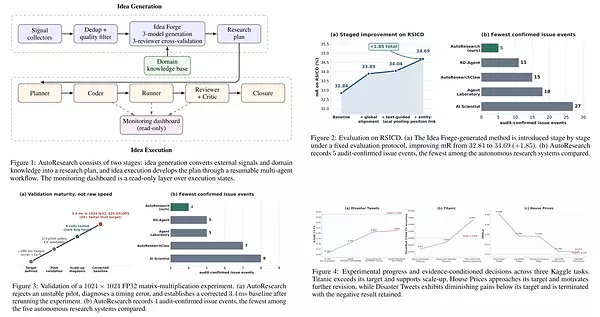
The system uses multiple AI models to independently generate and cross-review research ideas, then converts accepted ideas into executable research plans with defined metrics, success criteria, resource budgets and evaluation procedures. During execution, specialized agents handle planning, implementation, experimentation, analysis and review.
Research state, code, experiment logs, metrics, failures and decisions are preserved in a persistent workspace, allowing the system to continue unfinished research rather than restarting from scratch. Independent and blind review is also used to challenge conclusions before a research direction can be closed.
Evidence Determines What Happens Next
One of the more important design choices in AutoResearch is that failure is not treated as the end of a research path.
A partial result can lead to a revised hypothesis. An external test can expose a problem and trigger another round of experiments. And when repeated experiments stop producing meaningful gains, the system can stop pursuing the idea while retaining what was learned.
The approach was tested on a real Django issue from SWE-bench Lite. AutoResearch initially scored 2/7 and then 4/7 on official new-feature tests. Rather than stopping after the partial improvement, it continued investigating the underlying problem and ultimately reached 7/7, while maintaining 203/203 regression tests.
On the RSICD benchmark, an AutoResearch-generated research idea improved mean Recall from 32.84 to 34.69, demonstrating that the system could turn an AI-generated research hypothesis into a measurable improvement through iterative experimentation.
From AI Research to AI4AI
What happens when AI starts researching AI itself?
AI can already help researchers search the literature, identify promising directions, formulate hypotheses and even design experiments. The harder problem is what comes after that: can AI actually test the ideas it comes up with, and let the results determine whether those ideas are worth pursuing?
In AI research, this could mean agents exploring model architectures, training methods, optimization algorithms, agent designs and evaluation techniques, then running experiments to test their hypotheses and using the results to shape the next round of research. Moving from "this might work" to "let's find out whether it actually works" is a critical step toward more autonomous research.
The same principle could eventually extend beyond AI to areas such as drug discovery, materials science and engineering, where research ideas can be evaluated through simulations or physical experiments. The potential is not simply to have AI assist with more of the research process, but to give it a way to learn from what happens when its ideas meet evidence.
That is the direction AutoResearch is designed to explore: turning research ideas into executable experiments, experiments into evidence, and evidence into the next research decision.
Open-Source Research Infrastructure
AutoResearch is now available as an open-source project for researchers and developers working on AI scientists, autonomous agents and AI4AI systems. The accompanying paper, "AutoResearch: Insight In, Hallucination Out," is available on arXiv.
GitHub: github.com/EvoMap/AutoResearch
Research paper: arXiv: AutoResearch: Insight In, Hallucination Out
Technical research: EvoMap Research: AutoResearch Evidence Loop
About EvoMap
EvoMap is an open infrastructure project for AI self-evolution. The company is building systems that allow AI agents to learn from experience, share validated capabilities and improve across tasks and environments. EvoMap's work spans AI agent infrastructure, reusable AI capabilities and autonomous AI research, with representative projects including the Genome Evolution Protocol (GEP), EvoX Agent and AutoResearch.
Learn more at evomap.ai.
** This press release is distributed by PR Newswire through automated distribution system, for which the client assumes full responsibility. **
EvoMap Open-Sources AutoResearch, Giving AI Agents a Way to Test Their Own Research Ideas