Skip to Content Facebook Feature Image

China's space industry undergoes rapid commercialization driven by private sector

China

China

China

China's space industry undergoes rapid commercialization driven by private sector

2026-01-25 16:40 Last Updated At:18:17

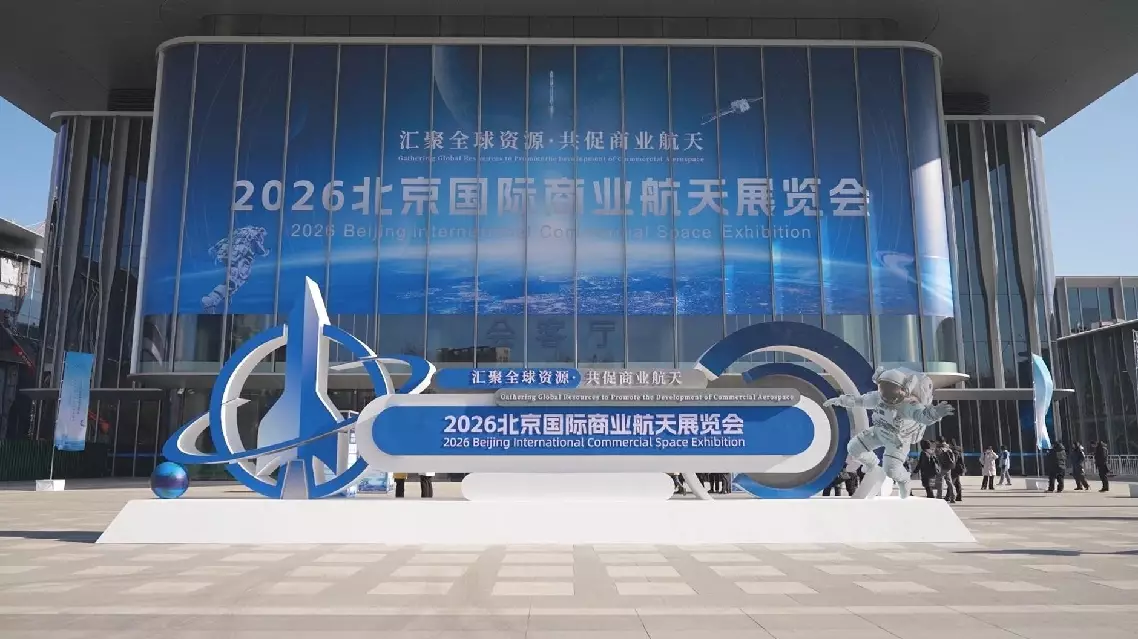
China's space sector is experiencing a remarkable transformation fueled by rapid commercialization driven by innovative private enterprises, as showcased at the ongoing 2026 Beijing International Commercial Space Exhibition.

The exhibition opened on Friday in Beijing, capital of China, featuring the latest industry advancements and aerospace facilities.

The three-day exhibition, with an area covering 20,000 square meters, draws more than 300 domestic and international companies from across the industry chain, showcasing the latest achievements in rockets, satellites, and application services.

With an industry output value surpassing 2.5 trillion yuan (around 358.5 billion USD) and an annual growth rate of 20 percent, over 600 companies are propelling China's commercial space sector into the fast lane.

"Many corners of the world are not connected. There are still more than three billion population on earth who don't have good quality of connection. So this is what we are doing. We try to develop the satellites, use the satellites in the space, to provide communication services," said Peter Huang, general manager of International Business Development, GALAXYSPACE.

GALAXYSPACE showcased breakthrough satellite technology featuring ultra-thin, flexible solar wings. The solar panels, just 1mm thick, can be folded to under 5cm for launch and then unfurled into an impressive 9-meter "wing" in orbit. This innovation not only enhances power efficiency but also allows for the compact stacking of satellites for mass launches.

Li Zhaofeng, marketing director at CreateUnion, provided insight into their role as "space traffic managers."

"You can think of us as space traffic managers. We collect data on space objects, satellites, meteoroids, rocket debris, to provide users with positioning, orbit determination and so forth," said Li.

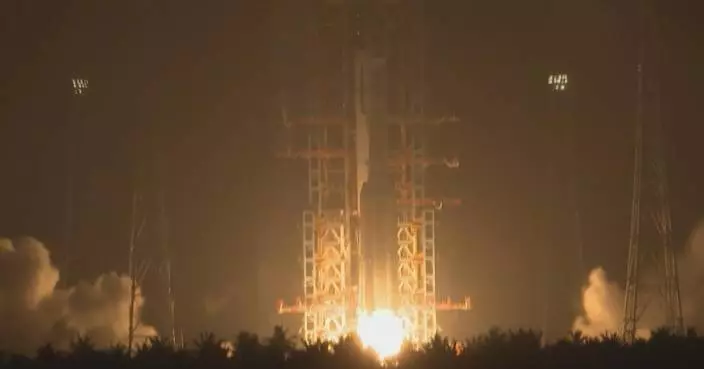
The backbone of this new space age is affordable and frequent access to orbit. Galactic Energy exemplifies this with a dual-strategy: solid-fuel rockets like the CERES series for quick-response missions, and liquid-fuel rockets like the reusable PALLAS series for heavy-lift needs.

"This is the PALLAS-1, a reusable launch vehicle set for its maiden flight March or April this year. It can deliver seven tons to sun-synchronous orbit, and its first stage is recoverable," said Wu Yue, director of Public Relations, Galactic Energy.
China's space industry undergoes rapid commercialization driven by private sector
China's space industry undergoes rapid commercialization driven by private sector
In South Sudan, education is being championed as a foundation for peace, but ongoing conflict and poverty continue to deprive millions of children of the opportunity to learn.

The South Sudanese government said education is crucial to building peace, promoting social cohesion, and equipping young people with skills to resolve conflict.

Some schools, including one in the capital Juba, have even established "peace centers" where students are trained in leadership and peacebuilding. Schools are also playing a role in tackling harmful practices like early and forced marriage.

"We normally inform them that in case they encounter such challenges, you come directly to school, we will be able to support you. Whatever support that is required, is always availed to them," said Chol Reuben Maken, school principal.

Despite these initiatives, the education sector is in crisis. According to UNICEF, South Sudan has one of the highest rates of out-of-school children in the world, with girls making up 75 percent. Over 2.2 million children, more than half of the country's youth population, are not attending school.

The key barriers are poverty and ongoing violence.

"General poverty is a real challenge to many families and therefore access to education becomes less of a priority if you need to feed yourself and cover other basic needs. There are also climate-related events that affect access to education. South Sudan is prone to flooding and it's also prone to heat waves," said Emilie Roy, education chief of UNICEF South Sudan.

The government said it is investing in education as a long-term tool for positive change, stressing that the impact of education goes far beyond academic achievement.

Educated children, officials said, become advocates and peacebuilders who push for equality and challenge harmful practices within their communities, planting the seeds for a more peaceful future.

Still, the challenges are enormous. Many children simply have no schools to attend due to a lack of infrastructure, and where schools do operate, chronic staff shortages and unpaid salaries have left the system struggling.

"My biggest thank you is to my colleagues, the teachers, the teachers of this country that have persevered through all the challenges to make sure that education is progressing and that our kids are taught," said Kuyok Abol Kuyok, minister of General Education.

While UNICEF maintains that education is a primary tool for promoting long-term stability, they also warn that without immediate peace in the country, the opportunity for an education will remain a far off dream for many.

Education seen as peace tool in South Sudan

Education seen as peace tool in South Sudan

Recommended Articles