Skip to Content Facebook Feature Image

China's first humanoid robot for autism treatment offers new possibilities for rehabilitation

China

China

China

China's first humanoid robot for autism treatment offers new possibilities for rehabilitation

2026-02-08 17:26 Last Updated At:22:17

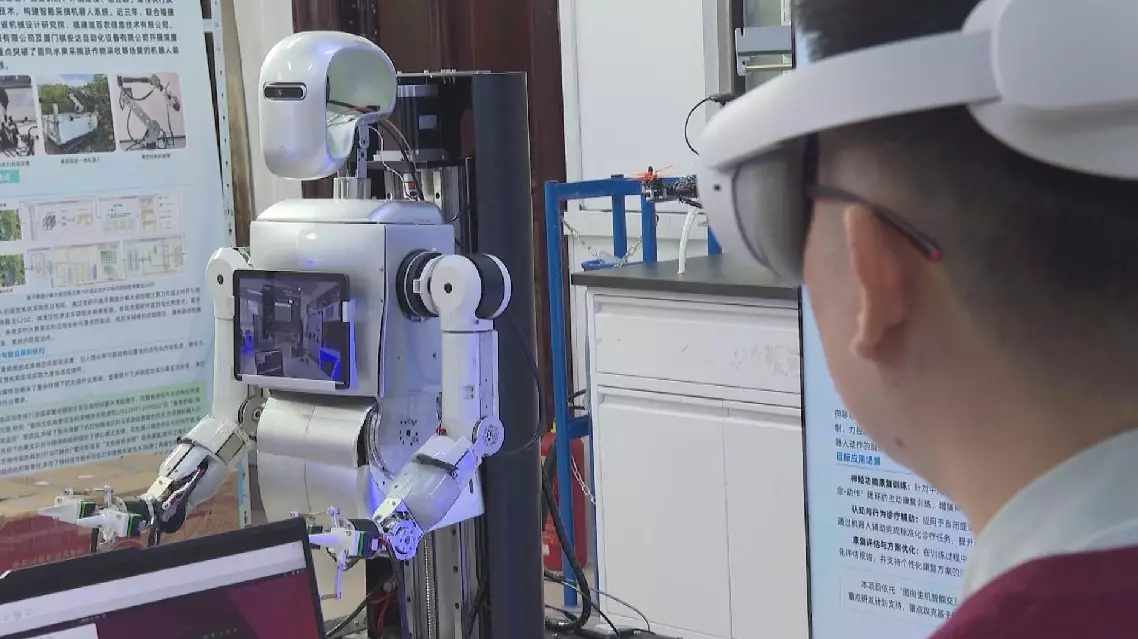
China's first humanoid robot for diagnosis and treatment of autism has opened up new possibilities for autism rehabilitation and long-term care.

More than 13 million people in China are living with autism. Difficulties in screening, intervention, and rehabilitation have remained urgent challenges for their families.

The humanoid robot is capable of precisely capturing and interpreting subtle signals from the human brain, and translating them into its coordinated movements.

It combines brain-computer interface technology with humanoid robotics to support early screening and educational intervention for children with autism, and it enables more natural and varied interactions, which help children with autism feel more comfortable and engaged, said Kong Xiangzeng, executive dean of the Artificial Intelligence research institute under the Fujian Agriculture and Forestry University in Fuzhou City of east China's Fujian Province.

"Brain signals are millions of times weaker than mobile phone signals. Blinking and heartbeat can also interfere, making them difficult to separate. Our team uses non-invasive, high-precision EEG technology to capture these weak signals without surgery," said Zhang Zhongji, assistant researcher with the institute.

Control algorithms independently developed by the research team can filter out interferences in real time, identify specific brainwave patterns and accurately translate them into control commands for the robot.

Healthcare specialists say early screening and rehabilitation are crucial for people with autism, yet current approaches often lack objective data.

Through "mind-based interactions" with children, the robot converts attention levels and motor imagery into measurable data, making screening more precise and rehabilitation more scientific and efficient.

At present, the project has received support from 11 national key research programs, with a complete technology chain and full independent intellectual property rights.

The robot has already been put into use and is now being applied in collaboration with hospitals and autism rehabilitation centers.

"When a child struggles to respond to certain questions, the robot can guide them more flexibly and quickly toward the correct answer. It also provides therapists with precise baseline data, making it easier for them to work together with the parents to develop personalized treatment plans for the child's next stage of therapy," said Kong.

The team says the humanoid robot platform will continue to expand beyond autism rehabilitation.

In the future, it is expected to support active rehabilitation for patients with stroke, spinal cord injuries, and other motor impairments, helping more people with neurological disorders regain everyday functional abilities.
China's first humanoid robot for autism treatment offers new possibilities for rehabilitation
China's first humanoid robot for autism treatment offers new possibilities for rehabilitation

The 24th Mawei-Matsu Lantern Festival, a national-level intangible cultural heritage event, opened on Wednesday in Fuzhou, capital city of east China's Fujian Province, to greet the Year of the Horse, which begins on Feb 17.

The festival is underway at a shipbuilding cultural park, where brilliant lantern installations are artfully integrated into the century-old remains of the former shipbuilding industry, creating a striking contrast that blends maritime heritage with festive light art.

Lanterns shaped like horses and the first steamship built by the shipyard, stand alongside a variety of intricate designs, blending holiday spirit with maritime history.

"This is my first visit here. I have seen lanterns shaped like fish and horses, and I like them very much," said a kid.

The festival originated from the Lantern Festival customs shared between Mawei and Mazu. It is the earliest and now most regularized two-way exchange activity between the two places, with the mutual presentation of lanterns serving as one of its most distinctive traditional features.

The celebration is recognized as China's first cross-Strait national intangible cultural heritage project. In 2024, it, along with the Chinese New Year, was added to the UNESCO Representative List of the Intangible Cultural Heritage of Humanity.

Running till March 8, the 33-day celebration serves as a luminous bridge connecting Fuzhou's Mawei district and Matsu.

"I've been to the festival four or five times, and it has left a deep impression on me. The festival gets better every year, with very distinctive features. We hope to spend more time together with our compatriots from Matsu," said Zhao Ping, a visitor.

"We've incorporated elements of shipbuilding culture, the local culture, and maritime culture into the lantern design. We welcome everyone to Fuzhou and celebrate the Chinese New Year here," said Lin Hebin, deputy director of the Bureau of Culture, Sports and Tourism in Mawei District.

Mawei-Matsu Lantern Festival opens in east China, honoring cross-Strait cultural heritage

Mawei-Matsu Lantern Festival opens in east China, honoring cross-Strait cultural heritage

Mawei-Matsu Lantern Festival opens in east China, honoring cross-Strait cultural heritage

Mawei-Matsu Lantern Festival opens in east China, honoring cross-Strait cultural heritage

Mawei-Matsu Lantern Festival opens in east China, honoring cross-Strait cultural heritage

Mawei-Matsu Lantern Festival opens in east China, honoring cross-Strait cultural heritage

Recommended Articles