
Skip to Content Facebook Feature Image

Praying for an Out: Cornered Trump Stokes "Holy War" Fervour Over Iran

Blog

Praying for an Out: Cornered Trump Stokes "Holy War" Fervour Over Iran
Blog

Blog

Praying for an Out: Cornered Trump Stokes "Holy War" Fervour Over Iran

2026-03-10 18:46 Last Updated At:18:46

The US-Israel alliance has ignited a war against Iran, throwing global markets into absolute chaos. Oil prices shattered the US$100-per-barrel mark today (March 9) and are hurtling toward US$120, while Asian stocks cascade and economic shockwaves hammer the United States. President Donald Trump projects outward calm, but a swift victory has proven completely elusive.
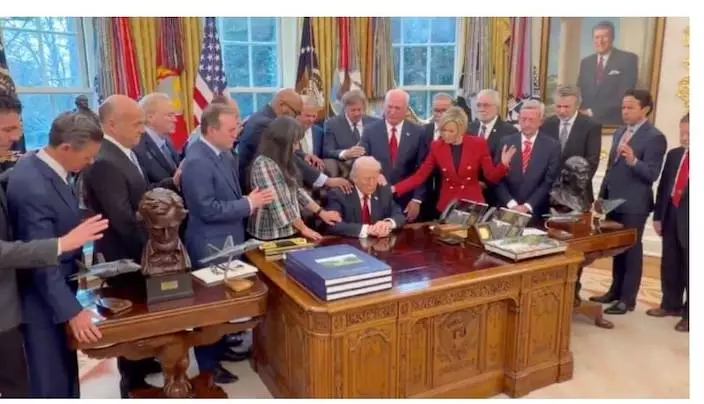
Evangelical leaders gather at the White House to bless Trump’s "holy war" against Iran—an unsettling spectacle of spiritual rallying.

Evangelical leaders gather at the White House to bless Trump’s "holy war" against Iran—an unsettling spectacle of spiritual rallying.

Cornered by Iran's blockade of the Strait of Hormuz, Trump let slip today that he is already discussing an end to military operations with Israel, conceding that he will "make a decision at the right time, but everything’s going to be taken into account."

The reality is, Trump is actively hunting for an escape hatch. In a telling move, Trump recently summoned evangelical pastors to the White House to lay hands on his shoulders and pray for divine guidance. The goal is clear: manufacture religious fervour to shore up his sinking base and pray his way out of a worsening crisis.

Staging this unconventional "spiritual rally" right now serves a calculated political agenda. Make no mistake: the White House is weaponising the evangelical community’s mobilising power to rally believers behind Trump's "holy war." It is a desperate bid to reverse his collapsing approval ratings.

Weaponising Faith for Survival

Evangelicals form the most deeply conservative Christian bloc in America, anchored in the Southern and Midwestern "Bible Belt." They are the Republican Party's ultimate voting machine and Trump's bedrock of support. During the 2024 presidential election, the vast majority of registered white Christian voters threw their weight behind Trump, driven by a deep-seated hostility toward Kamala Harris.

Public blowback against the Iran campaign is intensifying by the day. Latest polls reveal only 27% of American respondents support the offensive, while a staggering 43% oppose it, and 56% conclude Trump is simply "too eager to use military force to solve problems."

Starved of mainstream support, the president is falling back on a familiar playbook. By summoning pastors to bless his war effort and firing up his propaganda machine, he aims to stoke religious fanaticism among conservative Christians. It is a tactical play to re-energise his die-hard loyalists and project an illusion of absolute strength.
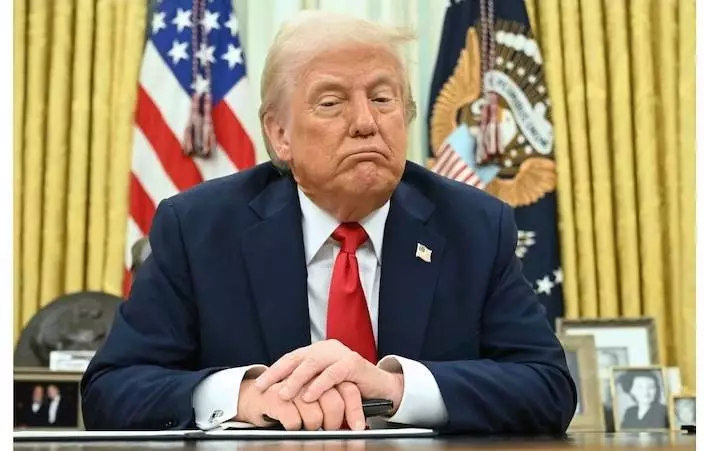
Desperate to reverse his collapsing poll numbers, Trump stokes religious fervour to pray his way out of a worsening crisis.

Desperate to reverse his collapsing poll numbers, Trump stokes religious fervour to pray his way out of a worsening crisis.

A Dangerous New Crusade

Another core objective behind this carefully choreographed spectacle is to sanctify the bloodshed in Iran. The optics were meticulously staged: Trump seated at the iconic Resolute Desk, surrounded by pastors murmuring prayers with their hands resting on his shoulders. The entire scene dripped with heavy religious ritual. They called upon God to "continue to give our President the strength that he needs to lead our great nation", to ultimate victory. Ultimately, the ceremony played out like a divine blessing bestowed upon a crusading king, draping a brutal military offensive in the sacred robes of holy war.

Experts warn that Trump is deliberately framing the Iran offensive as a righteous crusade to vanquish evil. The narrative draws a direct, unsettling parallel to the Crusades of a millennium ago, when Christian armies marched out to crush the Islamic empire and reclaim the holy city. History shows those ancient Crusaders left behind mass slaughter and rivers of blood in their wake. If Trump is truly modelling today's conflict on that ancient eastward conquest, the implications for global stability are profoundly terrifying.

This aggressive push to "sacralise" himself and the MAGA movement is hardly a new tactic. Trump has long weaponised his alliance with evangelicals, cloaking his post-election agenda in claims of divine mandate.

To cement this bond, Trump took the unprecedented step of establishing a White House Faith Office. He installed Paula White—chair of his Evangelical Advisory Board and the woman in red standing beside him during the recent prayer event—to lead it. Known for her emotionally explosive style, White famously delivered a feverish prayer during the 2020 election. She screamed "strike, strike, strike" while summoning angels to defeat evil, creating a spectacle that bordered on cult-like worship.

Running Out of Miracles

Confronted by a rapidly spiralling crisis, Trump is instinctively reaching back into his old bag of tricks. He is summoning "sacred energy" to project dominance and hoisting the banner of "fighting evil" to salvage his political survival.

Yet, such action simply overlooks the hard truth of the battlefield. The administration is sinking deeper into an unwinnable quagmire every single day. The trap has already snapped shut, and this time, even divine intervention may not be enough to bail him out.


What Say You?

** The blog article is the sole responsibility of the author and does not represent the position of our company. **

The most consequential national security trial yet to come is also the one with the most unanswered questions — and at the centre of it is a man who almost made it out.

Monday (Feb 23) was "Renri" (人日) — the seventh day of the Lunar New Year, meant to be a day of celebration for all people. But for the 12 defendants in the "35+ Subversion Case," there was nothing to celebrate. The Court of Appeal dismissed all their appeals against both conviction and sentencing in full. Unless they push it all the way to the Court of Final Appeal, this case is done. That brings two of the three major national security cases to a close — the other being the Jimmy Lai trial. What remains is the Joshua Wong case, expected to go to trial around mid-year. Like Lai's, it reaches into the highest levels of American politics, and it will almost certainly expose a trove of behind-the-scenes dealings that will shake Hong Kong to its core. The trial is close enough that the details don't need spelling out here. But one mystery absolutely does: Wong was once Washington's darling — so why did he never make it out, while his co-conspirator Nathan Law did? An investigative report by American journalists cracked open the story.

Wong's trial is the last big national security case standing — and the most explosive one yet. How did he never make it out?

Wong's trial is the last big national security case standing — and the most explosive one yet. How did he never make it out?

Wong's role in the Occupy Central movement and the 2019 unrest needs no introduction. In June last year, while already serving a prison term at Stanley Prison on sedition charges, he was arrested again and charged under the Hong Kong National Security Law with conspiracy to collude with foreign forces to endanger national security. His second pre-trial review at the Magistrates' Court came on 21 November last year, with the next hearing set for 6 March; the full trial at the High Court is expected to begin around mid-year. This case carries weight every bit as significant as the Jimmy Lai trial — the spotlight it commands will be enormous.

The Charges Are Grave

The prosecution alleges that between July and November 2020, Wong — together with Nathan Law and others yet to be identified — conspired in Hong Kong to solicit foreign governments and institutions to impose sanctions against the Hong Kong SAR and the People's Republic of China, and to seriously obstruct the government in enacting and enforcing its laws and policies. The charges carry a potential sentence of life imprisonment. What exactly Wong and Law did, and which foreign officials were involved, the prosecution will lay out in full when the trial begins.

The public has long asked some uncomfortable questions. Did Joshua Wong ever consider fleeing before or after the National Security Law came into force at the end of June 2020? If so, why did it never happen? Did the US government try to help him get out? An investigative report by two American journalists answered part of the puzzle — and sources familiar with the matter, when contacted by Hong Kong media, broadly confirmed what it said.

Wong Begged Washington for Help

The night before the National Security Law took effect, Wong reached out through a senator's adviser to appeal directly to President Trump for help. At the same time, he sent an email to then-Secretary of State Mike Pompeo, explicitly asking to be helped to "travel to the United States to seek political asylum, by whatever means necessary". That email tells you everything. Wong knew exactly how dangerous his situation had become — and he was betting his future on American goodwill.


Around the same time, Wong arranged to meet two officials from the US Consulate General in Hong Kong at St. John's Building, directly across the street from the consulate. He made clear he wanted to walk in and seek refuge. He was turned away on the spot. When Pompeo saw the email, he consulted with his staff and arrived at the same conclusion: letting Wong through the consulate doors was simply not an option — Washington feared Beijing would retaliate by forcing the US consulate in Hong Kong to close entirely.

State Department officials went further, exploring a covert plan to smuggle Wong out of Hong Kong by sea — routing him through Taiwan or the Philippines before eventually reaching the United States. That option was killed too, on the grounds that any such attempt would very likely be intercepted by Chinese authorities, triggering a diplomatic crisis. When the accounting was done, American interests won out — and Joshua Wong was coldly abandoned.

By that point, Nathan Law had already made it out. Seizing Pompeo's visit to London, Law met the Secretary of State privately and raised the question of rescuing Wong one more time — and was once again turned away without sympathy. In September 2020, Wong was arrested on sedition charges and imprisoned two months later. Any remaining window for escape had sealed shut.

Law Moved Fast — and Made It


Nathan Law is named as a co-conspirator in the charges against Wong — meaning that if arrested, they face the same jeopardy. But Law proved far more calculating than Wong. Shortly before the National Security Law took effect, he quietly slipped away, eventually confirming his presence in the United Kingdom on 13 July 2020. He even staged a moment of wistful sentiment, declaring: "With this parting, I do not yet know when I shall return... May glory come soon!" — words that, in the circumstances, could not have sounded more hollow.

Same charges, same case — but Law ran, and Wong didn't. One man made it out clean. The other is still paying the price.

Same charges, same case — but Law ran, and Wong didn't. One man made it out clean. The other is still paying the price.

Joshua Wong — sharp-witted all his life — took one step too many in trusting the Americans, and that delay cost him everything. The US government, in the name of "national interest," discarded him without hesitation. As his trial approaches, the reality is this: placing any further faith in American support would be the last illusion he can afford.

Lai Ting-yiu


Recommended Articles