With a combined 160 goals in 309 national team games going into the World Cup qualifying playoffs this week, it was no surprise Robert Lewandowski and Edin Džeko delivered yet again.
Even at a combined age of 77.
Their goals leveled the score in the second half of European playoff semifinals that Poland and Bosnia-Herzegovina would go on to win late Thursday.
Lewandowski and Džeko will captain their countries in playoff finals on Tuesday aiming to reach a World Cup that shapes as a last one — surely? — for a stellar group of old geezers.
Cristiano Ronaldo is now 41, Luka Modrić is 40 and Lionel Messi will turn 39 during the group stage.
All of them Ballon d’Or winners and still with a talismanic influence on the Portugal, Croatia and Argentina teams who will be in North America in June.
Ronaldo likely will not even be the oldest player at the 48-nation tournament.
Scotland goalkeeper Craig Gordon has turned 43 since starring in a thrilling decisive qualifier against Denmark. The oldest ever was 45-year-old Essam El Hadary in goal for Egypt against Saudi Arabia at the 2018 World Cup.
Will Lewandowski and Džeko join them?
“For Lewandowski it was like another day at the office, right?” Poland right back Matty Cash said after a 2-1 comeback win over Albania in Warsaw.
Poland trailed to Albania’s opening goal just before halftime when its inspirational captain scored his 89th international goal.
Lewandowski rose high at the back post from a 63rd-minute corner to head down and into the Albania net. The win was secured in the 73rd by a powerful 25-meter shot by Piotr Zieliński, the Inter Milan midfielder.
“Maybe it was not the game of our dreams but I won’t complain about it,” the 37-year-old Lewandowski said. “We won and that’s the most important.”
Now Poland travels to Sweden, a 3-1 winner over Ukraine thanks to a Viktor Gyökeres hat trick on Thursday.
Bosnia trailed Wales 1-0 in the 86th and faced the end of the World Cup qualifying road when Džeko rose to meet a corner. The 40-year-old veteran soared higher than Wales goalkeeper Karl Darlow and glanced his header into the unguarded goal.
Džeko fulfilled his duty with his 73rd national team goal and watched from the bench in extra time before a penalty shootout his teammates won 4-2.
“When you see everything we deserved this win,” Džeko said. “Beat Wales away which is never easy, a little bit (of) luck but also quality on the penalty shootout.”
Italy visits Zenica on Tuesday when one team will earn a place at its first World Cup since the 2014 edition in Brazil.
“It would mean everything,” said Džeko, whose goal 12 years ago was wrongly disallowed for offside in a 1-0 loss to Nigeria in the pre-VAR era. That sent Bosnia home after the group stage from its only World Cup appearance as an independent soccer nation.
“Not just for me but also for these young kids, this new generation,” Džeko said. “There’s a lot of good players.”
Among them Kerim Alajbegović, the 18-year-old Salzburg winger who calmly scored the winning penalty in Cardiff. Alajbegović was not even born in June 2007 when Džeko played — and scored — on his Bosnia debut.
AP soccer: https://apnews.com/hub/soccer and https://apnews.com/hub/fifa-world-cup
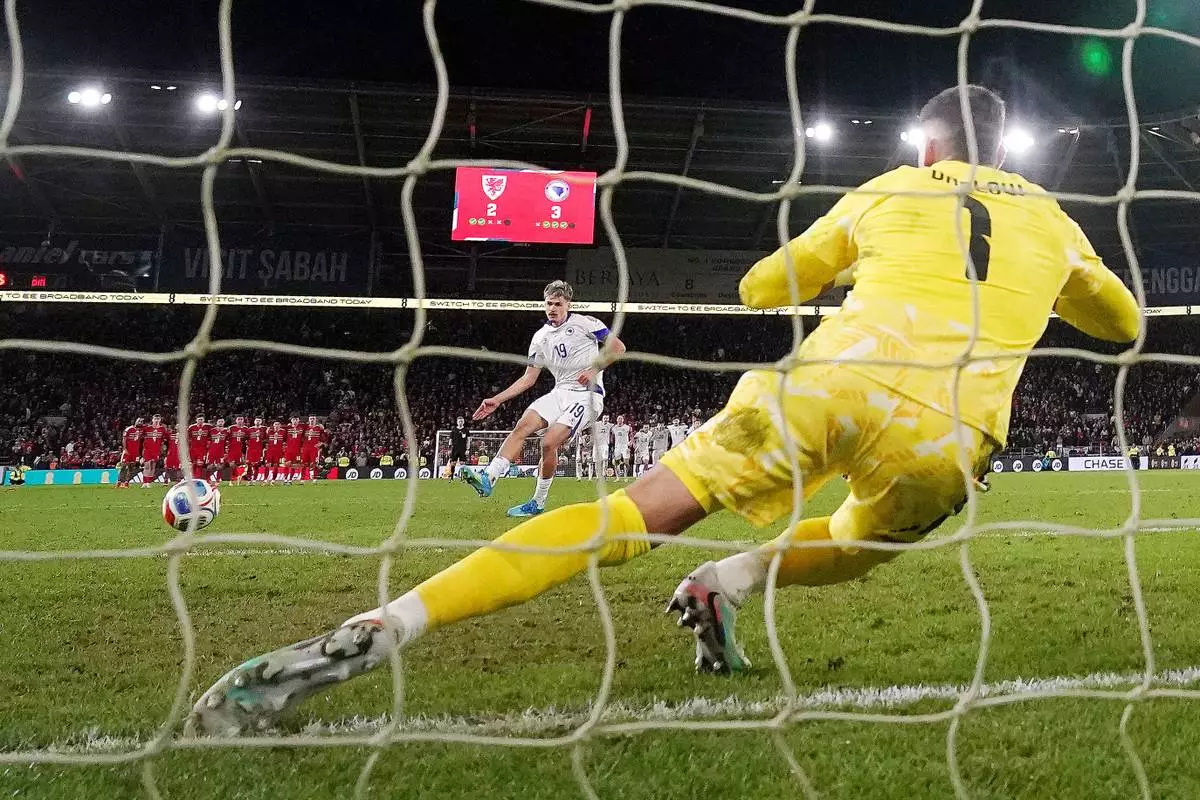
Wales goalkeeper Karl Darlow, right, fails to prevent Bosnia and Herzegovina's Kerim Alajbegovic from scoring the winning penalty during a shootout in the World Cup playoff semifinal soccer match between Wales and Bosnia and Herzegovina in Cardiff, Wales, Thursday, March 26, 2026. (Nick Potts/PA via AP)
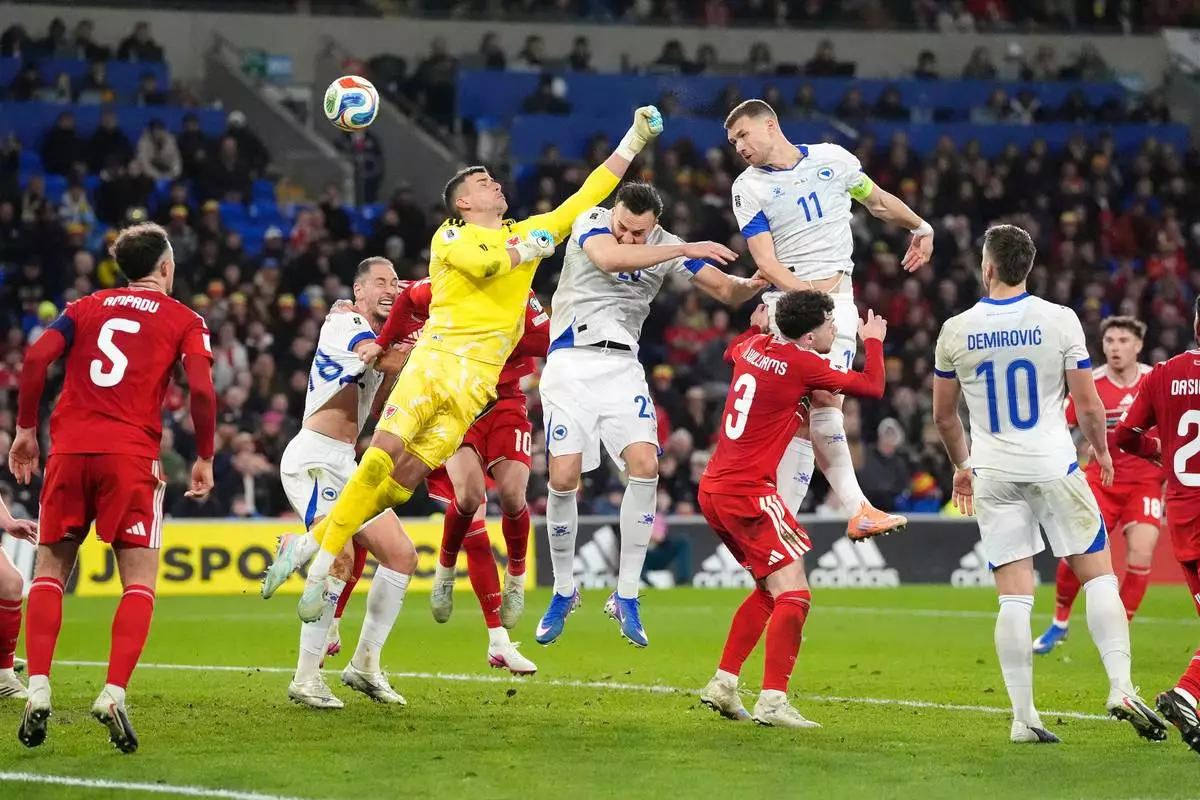
Bosnia and Herzegovina's Edin Dzeko, top right, scores their side's first goal during the World Cup playoff semifinal soccer match between Wales and Bosnia and Herzegovina in Cardiff, Wales, Thursday, March 26, 2026. (Nick Potts/PA via AP)

Bosnia and Herzegovina's Edin Dzeko, left, celebrates with team-mates after scoring their side's first goal during the World Cup playoff semifinal soccer match between Wales and Bosnia and Herzegovina in Cardiff, Wales, Thursday, March 26, 2026. (Nick Potts/PA via AP)
DUBAI, United Arab Emirates (AP) — U.S. military leaders said Tuesday that a ceasefire with Iran remains in effect a day after Tehran was blamed for new attacks in the Strait of Hormuz and against the United Arab Emirates.
The fragile truce, reached nearly a month ago, appeared to be holding as U.S. forces pressed ahead with efforts to reopen the vital waterway for global energy. On Monday, the U.S. said it sank six small Iranian boats that had threatened commercial ships.
So far, only two merchant ships are known to have passed through a new U.S.-guarded route, with hundreds more bottled up in the Persian Gulf. It's unclear whether continued U.S. military action will reassure shippers without reigniting the conflict that began with U.S. and Israeli strikes on Iran on Feb. 28.
The UAE, a key American ally, said it came under attack by Iranian missiles and drones for a second straight day on Tuesday. At least three people were wounded in attacks the day before, and a drone sparked a fire at a key oil facility in the eastern emirate of Fujairah.
Iran’s effective closure of the strait, through which major oil and gas supplies passed before the war, along with fertilizer and other petroleum-derived products, has sent fuel prices skyrocketing and rattled the global economy. Breaking Iran's grip would deny its main source of leverage as U.S. President Donald Trump demands a major rollback of its disputed nuclear program.
U.S. Defense Secretary Pete Hegseth and Gen. Dan Caine, the U.S. military’s top officer, told a news conference Tuesday that Iran’s renewed aggression hadn’t reached the threshold of what Caine called “major combat operations.” He said Tuesday marked a “quieter” day in the strait.
“No, the ceasefire is not over,” Hegseth said, affirming Caine’s assessment. They spoke before the latest attacks on the UAE.
Iran has said the new effort does violate the ceasefire. Iran’s parliament speaker and chief negotiator, Mohammad Bagher Qalibaf, accused the U.S. of undermining regional security. In a post on X, he signaled that Iran has yet to fully respond to the U.S. attempt to reopen the waterway.
“We know full well that the continuation of the status quo is intolerable for America; while we have not even begun yet,” he said. His statement did not mention negotiations with the U.S. that are now in the form of passing messages via Pakistan.
Disputing Washington’s claim of sinking six boats, an Iranian military commander said two small civilian cargo boats were hit on Monday, killing five civilians, Iran’s state TV reported.
Caine, the top U.S. general who serves as chairman of the Joint Chiefs of Staff, said more than 100 U.S. military aircraft are patrolling skies around the strait.
“Since the ceasefire was announced, Iran has fired at commercial vessels nine times and seized two container ships, and they’ve attacked U.S. forces more than 10 times – all below the threshold of restarting major combat operations at this point,” Caine said.
The administration has cited the April 8 ceasefire in asserting that the president does not have to give a formal update to Congress on the war under the War Powers Resolution. That law typically requires presidents to seek formal approval from Congress for war activities 60 days after beginning military action.
So far, just two civilian vessels, both U.S.-flagged merchant ships, are known to have passed through the strait as part of the lane the U.S. says it has created.
“At this point in time our risk assessment remains unchanged,” Hamburg, Germany-based shipping company Hapag-Lloyd AG said in a statement. “Transits through the Strait of Hormuz are for the moment not possible for our ships.”
Ship tracking data showed a Panamanian-flagged crude oil tanker heading toward the center of the strait Tuesday after leaving an anchorage in the Persian Gulf, though it was unclear if it would try to pass through. The tanker had a stated destination of Singapore, according to the MarineTraffic ship tracking site.
Iran has attacked ships that try to transit without going through its own route in the northern part of the narrow strait near the Iranian coastline. That involves going through vetting by Iran's Revolutionary Guard and payment in some cases.
The U.S.-approved “Project Freedom” route goes through territorial waters of Oman to the south.
“For shipping companies and for insurance companies, they still have to wait and see how this plays out,” said Torbjorn Soltvedt, principal Middle East analyst at risk intelligence company Verisk Maplecroft.
“This initiative alone isn’t something that looks like it’s going to open the Strait of Hormuz,” he said.
The United Arab Emirates said its air defenses had engaged 15 missiles and four drones fired by Iran. Authorities in the eastern emirate of Fujairah said one drone sparked a fire at a key oil facility, wounding three Indian nationals. The British military reported two cargo vessels ablaze off the UAE, also on Monday.
On Tuesday, the UAE's Defense Ministry said air defenses were responding to another Iranian drone and missile attack.
Indian Prime Minister Narendra Modi on Tuesday condemned the attacks, calling the targeting of civilians and infrastructure “unacceptable.” On X, Modi said India stands in “firm solidarity” with the UAE, and stressed the need for safe and uninterrupted shipping through the Strait of Hormuz.
Tehran did not confirm or deny the attacks but Iran’s Foreign Minister Abbas Araghchi early Tuesday said on X that both the U.S. and the UAE “should be wary of being dragged back into quagmire.”
Pakistan and Saudi Arabia condemned the strikes against the UAE. The Saudi condemnation came despite increasingly strained relations with the UAE.
The disruption of the waterway has squeezed countries in Europe and Asia that depend on Persian Gulf oil and gas, raising prices far beyond the region.
The U.S. meanwhile has enforced a naval blockade on Iranian ports since April 13, telling at least 49 commercial ships to turn back, according to its Central Command. It also has warned shipping companies they could face sanctions if they pay Iran for transit of the strait.
The blockade has deprived Tehran of oil revenue it needs to shore up its ailing economy. U.S. officials have expressed hope the blockade will force Iran to make concessions in talks on its nuclear program and other longstanding issues.
Finley reported from Washington and Becatoros reported from Athens, Greece. Sally Abou AlJoud in Beirut, Lebanon; Sheikh Saaliq in New Delhi; Meg Kinnard in Columbia, South Carolina; Bill Barrow in Atlanta; and Russ Bynum in Savannah, Georgia, contributed to this report.
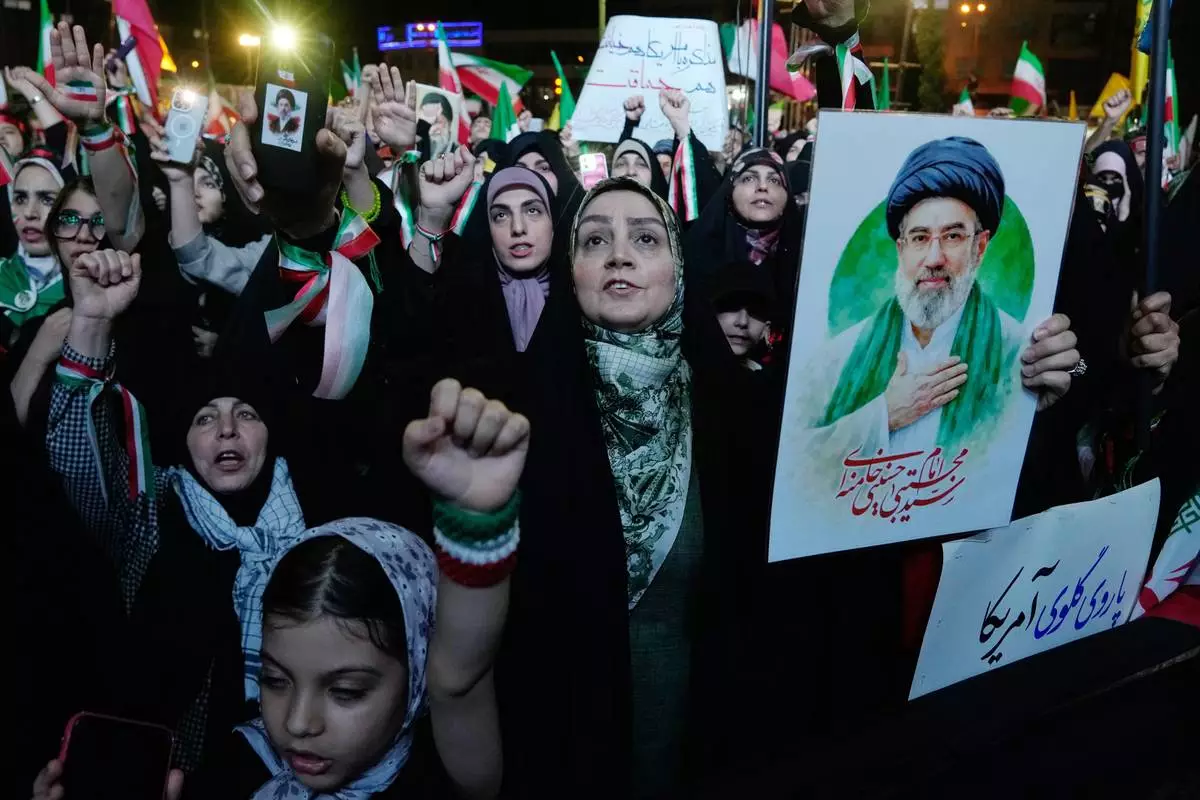
Pro-government demonstrators chant slogans as one of them holds a poster of the Iranian Supreme Leader Ayatollah Mojtaba Khamenei during their gathering at Enqelab-e-Eslami, or Islamic Revolution, square in Tehran, Iran, Monday, May 4, 2026. (AP Photo/Vahid Salemi)
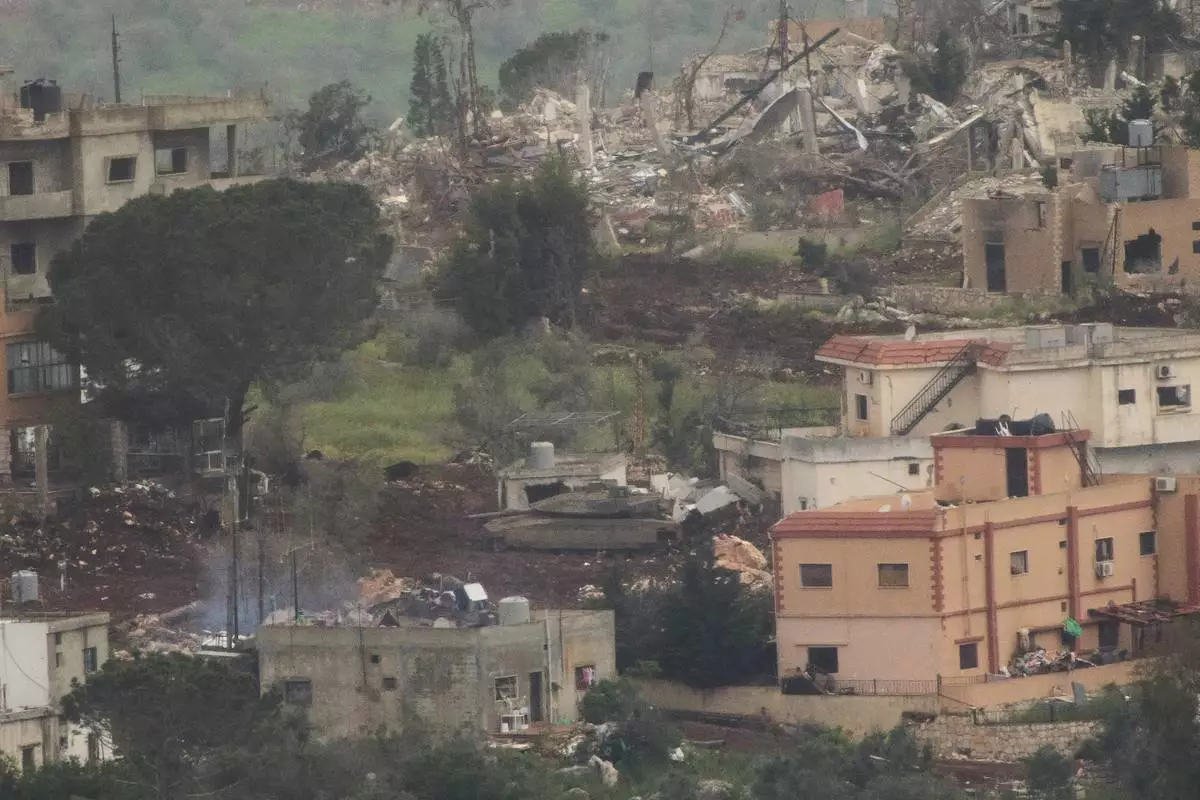
Israeli soldiers drive a tank inside a village in southern Lebanon, as seen from northern Israel, Tuesday, May 5, 2026. (AP Photo/Ariel Schalit)
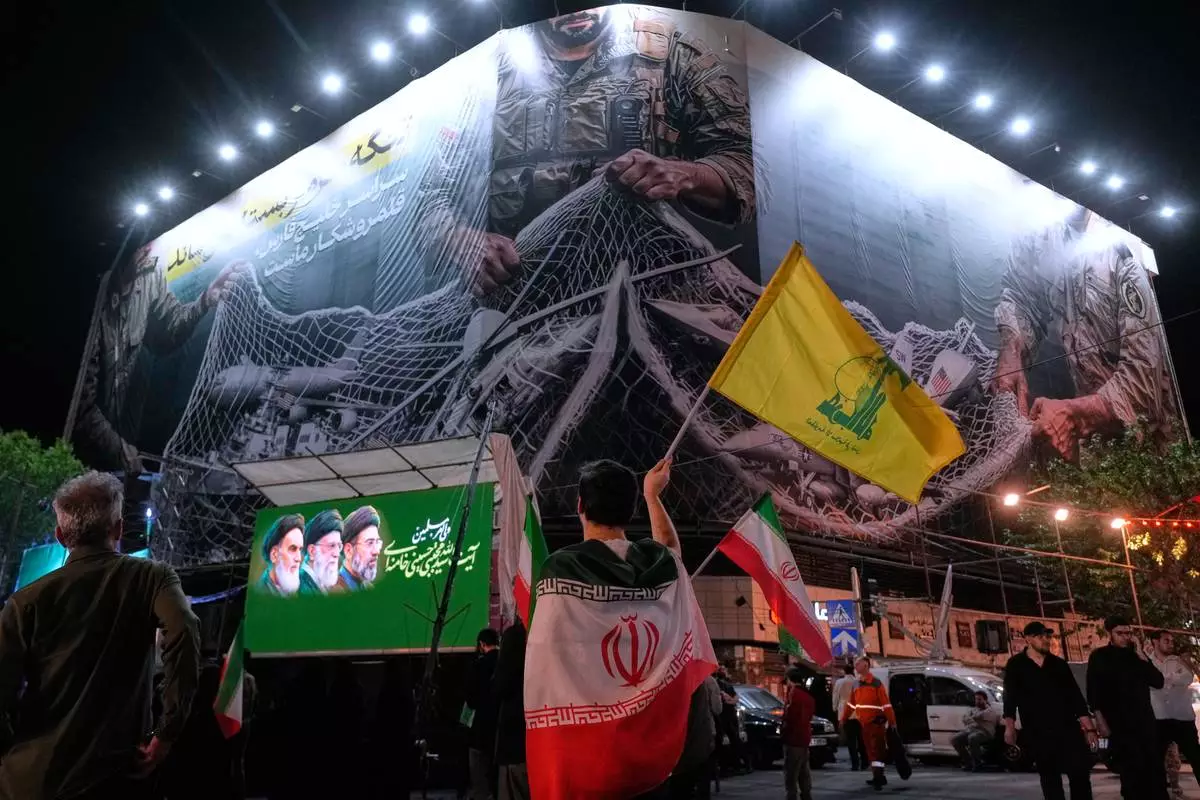
An Iranian demonstrator waves a flag of Lebanon's militant Hezbollah group under an anti-U.S. billboard depicting the American aircrafts into the Iranian armed forces fishing net with signs that read in Farsi: "The Strait of Hormuz will remain closed, The entire Persian Gulf is our hunting ground," during a pro-government gathering at Enqelab-e-Eslami, or Islamic Revolution, square in Tehran, Iran, Monday, May 4, 2026. (AP Photo/Vahid Salemi)
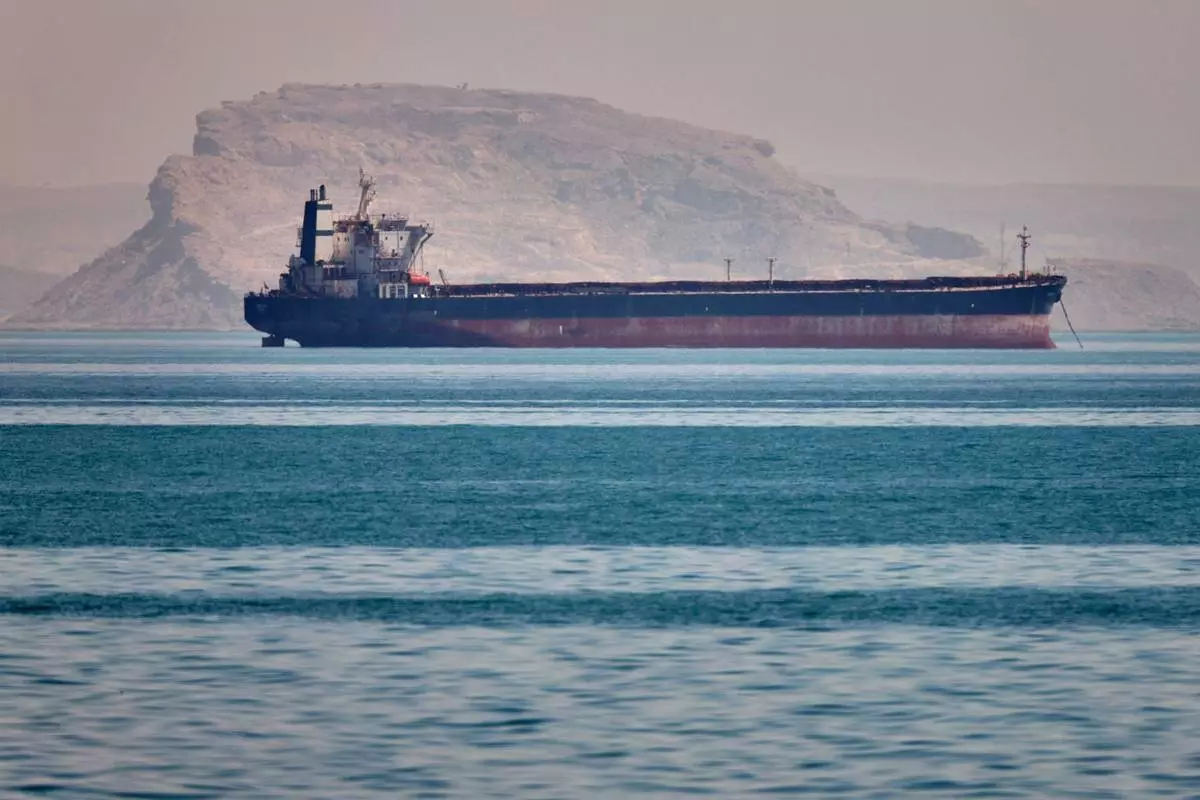
A bulk cargo ship sits at anchor in the Strait of Hormuz off Bandar Abbas, Iran, Saturday, May 2, 2026.(Amirhosein Khorgooi/ISNA via AP)