SAN FRANCISCO (AP) — Online review aggregator Yelp wants to harness artificial intelligence to make it easier for users to find information curated by other people.
Although Yelp’s users have always been able to dive into its reservoir of 330 million local business reviews, they sometimes find themselves drowning in a sea of commentary from other people about restaurants, doctors, plumbers, roofers and a smorgasbord of other merchants — a problem the new chatbot assistant is designed to solve.
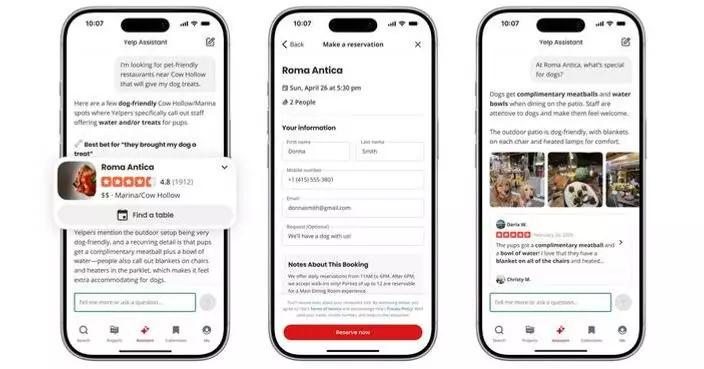
For instance, if a user asks Yelp's new assistant for a good place to get coffee with a dog, the app will show recommendations alongside relevant reviews.
“This chatbot can really understand 500 reviews in a second whereas a consumer might say, ‘Well, I read the first five reviews, so I guess that’s good enough,’” said Yelp CEO Jeremy Stoppelman, who co-founded the company 22 years ago.
Analyzing and explaining vast amounts of information in an easily digestible summary is something that other leading chatbots such as OpenAI's ChatGPT, Anthropic's Claude, Perplexity's answer engine and Google's AI overviews already have been doing.
Yelp believes its chatbot will stand out by pointing to the reviews that led to its recommendations and conclusions. The San Francisco-based company decided to create an AI chatbot that shows the evidence underlying its findings, after a survey found that most consumers worry the technology provides misinformation or fabrications.
“People want AI chatbots to be transparent about where they are getting the data from, they want to see the reviews alongside the results when they're doing local search,” said Craig Saldanha, Yelp's chief product officer. “So we are trying to make sure the human connections stay front and center while AI handles all the drudgery of making those connections.”
Yelp has been looking for a spark during an AI boom that has more than doubled the value of the tech-driven Nasdaq composite index while its stock price is stuck at roughly the same level as the end of 2022, shortly after OpenAI released ChatGPT.
Although Yelp business reviews have always been popular among consumers looking for recommendations about places to eat and shop, the company hasn't been able to overcome people's almost reflexive habit of turning to Google when they're searching for almost anything.
Google was already synonymous with search by the time Stoppelman and Russel Simmons launched Yelp in 2004, but its results about local businesses often were either inadequate or inaccurate.
To help fill the void, Google signed a two-year licensing agreement to gain access to Yelp's reviews. But the partnership fell apart when Google began to summarize various information about various topics — including restaurant recommendations in a particular neighborhood — in a way that gave consumers less reason to click on links that sent them to other sites.
That phenomenon has hurt Yelp and other free online services that make most of their money from advertising; Yelp depends on Google for more than 70% of its web traffic in the U.S.
The tensions came to head when Yelp accused Google of improperly raiding its business reviews and favoring its own services. Those allegations helped trigger a investigation by the Federal Trade Commission that ended with a 2013 settlement that only required Google to make a few relatively minor changes.
But the complaints about Google's tactics didn't stop, triggering a U.S. Justice Department lawsuit that culminated in a 2024 decision condemning the search engine as an illegal monopoly. But a federal judge last year rebuffed the government's request to break up Google, and instead ordered less drastic changes — a decision that was shaped by the way more people now rely on chatbots to inform them instead of search engines.
Yelp is pursuing its own antitrust lawsuit against Google in a case scheduled for a May 2028 trial.
As part of its effort to diversify and increase its annual revenue of $1.5 billon, Yelp already is licensing some of its data to OpenAI for potential usage in ChatGPT while betting that its chatbot's emphasis on connecting people will still reel in more traffic to its service.
“With this new technology, we really think you are going to be able to find that needle in a haystack and have a far more personalized experience,” Stoppelman said.

FILE - A Yelp logo is shown on a tablet at the company's office, in San Francisco, Feb. 14, 2023. (AP Photo/Jeff Chiu, File)
Pope Leo XIV’s 11-day tour of four African nations has given the usually reserved pontiff a global platform to speak out, in sometimes explosive terms, about Africa's problems while preaching peace and uprightness in a world battered by war.
History’s first American pope is visiting the continent against the backdrop of his calls for peace that have sparked a feud with U.S. President Donald Trump over the war in Iran.
Leo is now in Equatorial Guinea, the final stop of his tour, after visiting Algeria, Cameroon and Angola. His trip is so dizzying in its complexity it recalls some of the globe-trotting odysseys of St. John Paul II in his early years.
In meetings with leaders and with Africa's young population, the pope has also focused on themes including Christian-Muslim coexistence, the overexploitation of the region’s natural and human resources, corruption, migration and the legacy of colonialism.
Here’s a country-by-country look at each destination and highlights of the itinerary:
In Algeria, Leo walked in the footsteps of his spiritual father, St. Augustine, making a pilgrimage to the archaeological ruins where the fifth-century titan of early Christianity lived, died and wrote some of the most important works in Western thought.
The Algeria stop clearly carried the most personal importance for Leo, given his ties to St. Augustine, the inspiration of his Augustinian religious order.
Migration and Christian-Muslim coexistence were other top themes in Algeria, a former French colony which is a majority Sunni Muslim nation on North Africa’s Mediterranean coast. Leo also paid homage to migrants killed in shipwrecks trying to reach Europe and visited the Great Mosque in Algiers.
In Annaba, the modern-day Hippo, Leo met with a small community of Augustinians and celebrated Mass at the Basilica of St. Augustine, the 19th century basilica overlooking the ruins of Hippo where thousands of pilgrims including Muslims visit every year.
A major highlight of Leo's visit to Cameroon were his remarks at a “peace meeting” in the western city of Bamenda, the epicenter of Cameroon's separatist conflict. There, he blasted the “handful of tyrants” who are ravaging the planet with war and exploitation.
Although the remarks were directed at the separatist conflict, considered one of the world’s most neglected crises, Vatican officials have said the pope's Gospel-mandated message of peace on this trip is meant for all those responsible for wars and exploitation.
Leo met with both religious and political leaders including Cameroon's 93-year-old president, Paul Biya, the world's oldest leader. He called for an end to the “chains of corruption” and for upright leadership.
Biya has been accused of using corrupt means and the targeting of opponents to remain in power.
Cameroon sits atop significant reserves of oil, natural gas, cobalt, bauxite, iron ore, gold and diamonds. But revenues rarely reach rural and Indigenous communities and mostly benefit only foreign companies and a small national elite, activists say.
The pope also visited an orphanage for children taken off the streets after suffering abandonment or maltreatment from their parents.
He celebrated a Mass before thousands of people in the economic hub of Douala, where he urged young people to resist the temptation of corruption.
As Leo headed for Angola, he again addressed the back-and-forth with Trump, saying it was "not in my interest at all” to debate the American president over the Iran war, but he would continue preaching a message of peace.
In Angola, where around 58% of the population is Catholic, Leo prayed at the Sanctuary of Mama Muxima, a Marian shrine that has become one of the most important Catholic pilgrimage sites in Angola.
That church also has deep links to Angola's history of slavery. It was first built around the end of the 16th century by Portuguese colonizers after they established a fortress at Muxima, and became a key point in the Portuguese trans-Atlantic human trade as a place where enslaved people were baptized before they were sent on ships to the Americas.
While Leo didn't directly address slavery, his visit to the small town of Muxima drew reflections on his own complex heritage after research last year showed the first American pope has both Black and white ancestors who include enslaved people and slave owners.
Angola today is an oil- and mineral-rich country, yet many of its 38 million people live in poverty. Previous leaders have been accused of large-scale corruption, while the country still bears the scars of a 27-year civil war that began straight after independence from Portugal in 1975.
At a meeting with Angolan President Joao Lourenco, Leo challenged current Angolan leaders to break the “cycle of interests” that have exploited Africa and its people for centuries.
Equatorial Guinea, the last stop, presents the pope with perhaps the most delicate diplomatic challenge of his tour.
The overwhelmingly Catholic former Spanish colony has been led for nearly 50 years by a president who is accused of widespread corruption and holding on to power through the harassment, arrest and intimidation of political opponents, critics and journalists.
Equatorial Guinea's leader, Teodoro Obiang Nguema Mbasogo, is Africa’s longest-serving president and has been in power since 1979.
The discovery of offshore oil in the mid-1990s transformed Equatorial Guinea’s economy virtually overnight, with oil now accounting for almost half its GDP and more than 90% of exports, according to the African Development Bank.
Several rights groups, including Human Rights Watch, have documented how revenues have enriched the ruling Obiang family rather than the broader population, where at least 70% of the country’s nearly 2 million people live in poverty.
In addition to the negative impacts of the extraction industries, Vatican spokesman Matteo Bruni said Leo would raise issues of corruption and the proper role of governing authorities during the trip to Africa.
Associated Press religion coverage receives support through the AP’s collaboration with The Conversation US, with funding from Lilly Endowment Inc. The AP is solely responsible for this content.
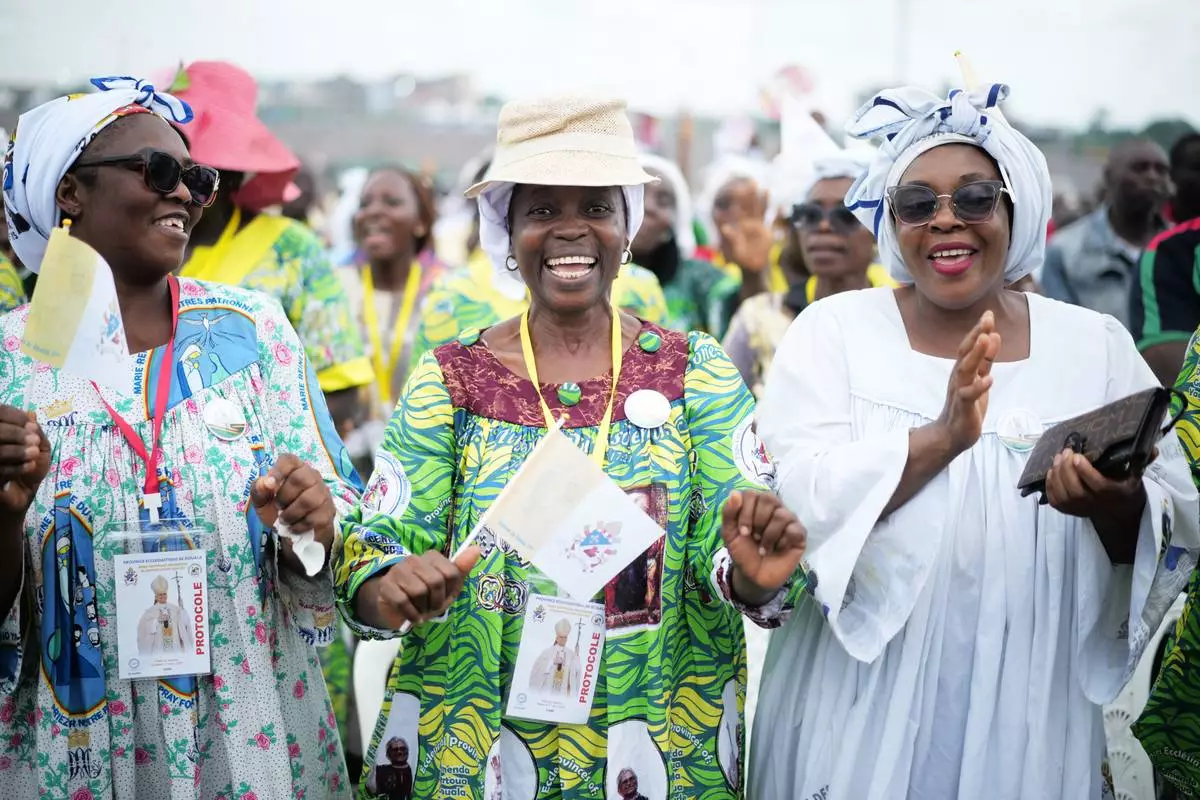
Faithful attend a Mass celebrated by Pope Leo XIV in the Japoma Stadium, in Douala, Cameroon, Friday, April 17, 2026 on the fifth day of his 11-day pastoral visit to Africa. (AP Photo/Andrew Medichini)
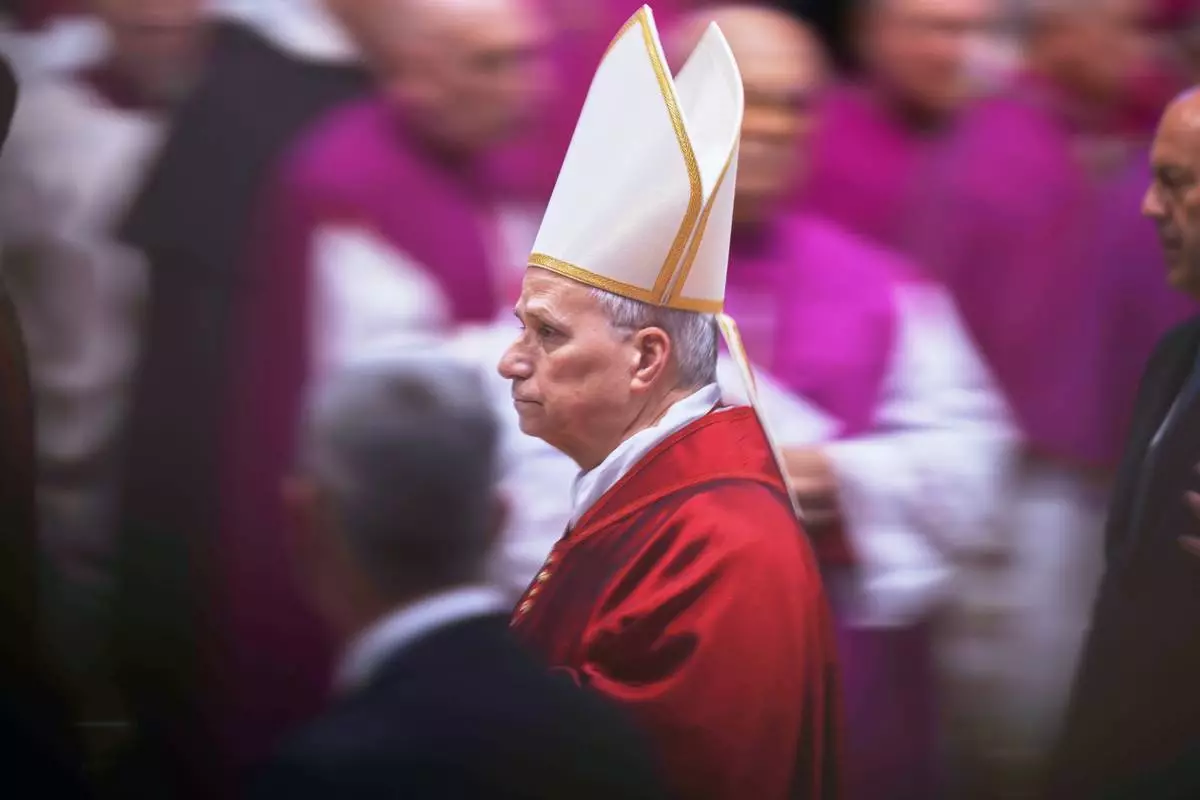
Pope Leo XIV attends the Celebration of the Passion of the Lord in St. Peter's Basilica at the Vatican on Catholic Good Friday, Friday, April 3, 2026 (AP Photo/Andrew Medichini)