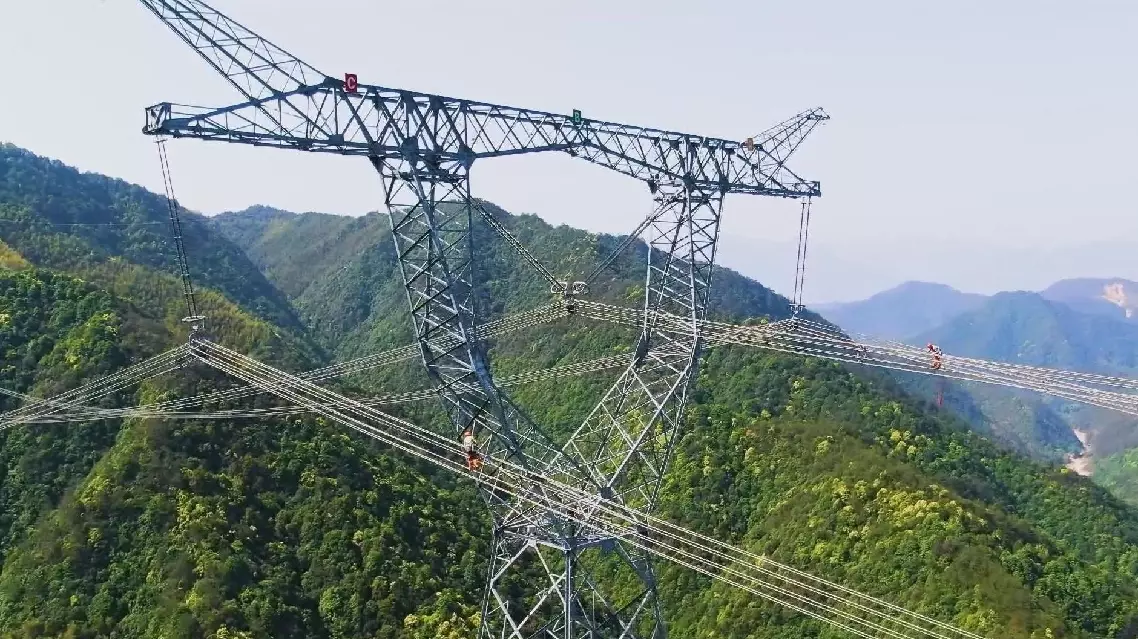
China on Tuesday started the construction of a 1,000-kilovolt Ultra-High-Voltage (UHV) alternating current (AC) loop grid project in Zhejiang Province to better support the growth of emerging industries.
The Zhejiang UHV AC loop grid project starts in Zhejiang's Jiaxing City and ends in Lishui City, linking seven cities including Hangzhou, Shaoxing, Ningbo, Taizhou and Wenzhou. With a total line length of 508 kilometers and a total investment of 29.3 billion yuan (about 4.3 billion US dollars), it is China's largest single UHV AC transmission project in terms of both scale and investment.
During China's 15th Five-Year Plan period (2026-2030), newly added clean energy capacity in Zhejiang's coastal areas alone is expected to exceed 31 million kilowatts.
The power will be transmitted to load centers in east China via the project, enabling annual clean energy integration of over 57 billion kilowatt-hours and reducing carbon dioxide emissions by 44.62 million metric tons.
"The Zhejiang UHV AC loop grid project will enable the integration of large-scale offshore wind power in eastern Zhejiang, pumped storage in the western mountainous areas, and nuclear power in the southeast. It will meet the electricity demand of load centers in northern Zhejiang and the Yangtze River Delta region, enhance the overall power supply capacity of Zhejiang and even East China's power grid, and better serve the coordinated development of the Yangtze River Delta with green energy," said Jin Renyun, general manager of construction branch of State Grid Zhejiang Electric Power Co., Ltd.
As a major electricity-consuming province with limited energy resources, Zhejiang relies heavily on external power supply. The completion of the project will significantly improve local energy self-sufficiency efficiency and better support industrial development.
In the first quarter of 2026, Zhejiang's total electricity consumption reached 161.59 billion kilowatt-hours, a year-on-year increase of over 5 percent.
Among this, electricity used by information technology, advanced manufacturing and related sectors amounted to 43.69 billion kilowatt-hours, up 7.5 percent year on year, accounting for more than 40 percent of total industrial electricity consumption.
Since the beginning of 2026, many cities of Zhejiang have accelerated the cultivation of advanced manufacturing clusters.
In Hangzhou, the new-generation information technology industry represented by artificial intelligence consumed 1.25 billion kilowatt-hours of electricity in the first three months, up 15.9 percent year on year.
In Jiaxing, the high-end equipment manufacturing industry represented by automobile manufacturing consumed 190 million kilowatt-hours of electricity in the first quarter, up 10.6 percent year on year.
The surging demand for electricity urgently requires stronger power supply capacity.
"In the first quarter of this year, Jiaxing's total electricity consumption reached 18.65 billion kilowatt-hours. The project will enable unimpeded 'large-scale circulation' of electricity within Zhejiang, significantly improving the supply-demand balance among regions. After clean energy is delivered to Jiaxing through the loop, emerging industries such as artificial intelligence, life sciences and future energy in the Yangtze River Delta integrated demonstration zone will receive stronger energy support," said He Mingfeng, deputy general manager of State Grid Jiaxing Power Supply Company.
The project is scheduled to be completed by 2029.
Once completed, it will close the loop with Zhejiang's existing grid structure, forming a UHV grid comprising one intra-provincial loop line and four extra-provincial direct current (DC) lines, thereby enhancing the province's power supply capacity.
It will also integrate over 57 billion kilowatt-hours of clean energy annually, providing green momentum for the energy transformation of the Yangtze River Delta region.
Construction of key power transmission project in Yangtze River Delta begins
As the world grapples with multiplying crises and a dangerous decline in international trust, a senior Uzbek lawmaker has called for greater unity and multilateral cooperation to tackle shared crises.
Sodiq Safoyev, first deputy chairman of the Senate of the Oliy Majlis (national parliament) of Uzbekistan, said the world is navigating a complex era of "polycrisis" marked by wars, pandemics, and growing division, and that the response should not be to create new dividing lines, but to unite people and act collectively.
"Today we're living in a difficult time worldwide. Even some academicians defined the contemporary world as in a time of polycrisis or simultaneous occurrence of several catastrophic events, indeed, wars, pandemia, fragmentation of the world. And I think that it's a time not to create new division lines, but to unite the people and act together, vis-a-vis global challenges. I think that such an idea, proposed by his Excellency, Chairman [President] Xi Jinping, is very important, because it brings very clear idea that today we need to build cooperation and to think about the next generation's destiny, to save the earth from the challenges which we have," said Safoyev.
Safoyev also pushed back against the notion that deglobalization has taken hold, saying that international trade, information flows, and migration remain unstoppable. However, he warned that rising interconnectedness has been accompanied by a dangerous decline in mutual trust and understanding.
"Some people think that the process of deglobalization has started. I don't think so. I don't think that it's possible to stop international trade, flow of information, migration of people who want to study abroad, who want to work abroad. Globalization is not stopping and that's why interconnectedness of the nations only increases. But at the same time, simultaneously, we're absorbing diminishing of trust and understanding. It's a very dangerous combination. We connected, but we don't understand each other," said Safoyev.
Acknowledging that international organizations fail to meet public expectation in resolving conflicts, Safoyev said that regional mechanisms such as the Shanghai Cooperation Organisation (SCO) and cooperation between China and Central Asian countries offer models for effective cooperation.
"And I think that international organizations today are not matching expectations of the people in the regard with preventing conflicts, preventing the problems and resolving them. And it's the most challenging issues of the contemporary world. And I think that's why the experience of Shanghai organizations [the Shanghai Cooperation Organization] and cooperation between China and Central Asian countries is very important to demonstrate that it's possible," said Safoyev.
He also said that Central Asia serves as a prime example of overcoming fragmentation and uniting, as the region has transformed from one plagued by border disputes, suspicion, and resource conflicts a decade ago into a cohesive, cooperating bloc.
"From the more positive side, I'd like to note that the situation in Central Asia is something which might give us some more optimism. Twenty years ago, even 10 years ago, Central Asia was divided, divided by suspicion, divided by unresolved issues like unresolved borders, many conflicts of interest in the regard with the using the water resources of the transnational water resources etc. Today, in a relatively short time, period of time, Central Asia became completely different, more and more consolidating, uniting, having joint approach to the regional problems. And that's why Central Asia started to lure more attention worldwide. We're seeing that [there are] more interests of the global actors with the Central Asia, and I think that it demonstrates to the whole world that it's possible today now to overcome fragmentation and to unite. And that's why we, as usual, have both some concerns. But at the same time, we must be optimists in looking ahead," said Safoyev.
He also said that wisdom of humanity and visionary leadership inspire optimism that building future of common shared destiny is possible.
Senior Uzbek lawmaker calls for regional unity, cooperation amid global "polycrisis"