Humanoid robots are spreading across China, fueling demand for data-driven jobs such as collectors and auditors, with national training bases already logging more than 20 million entries.
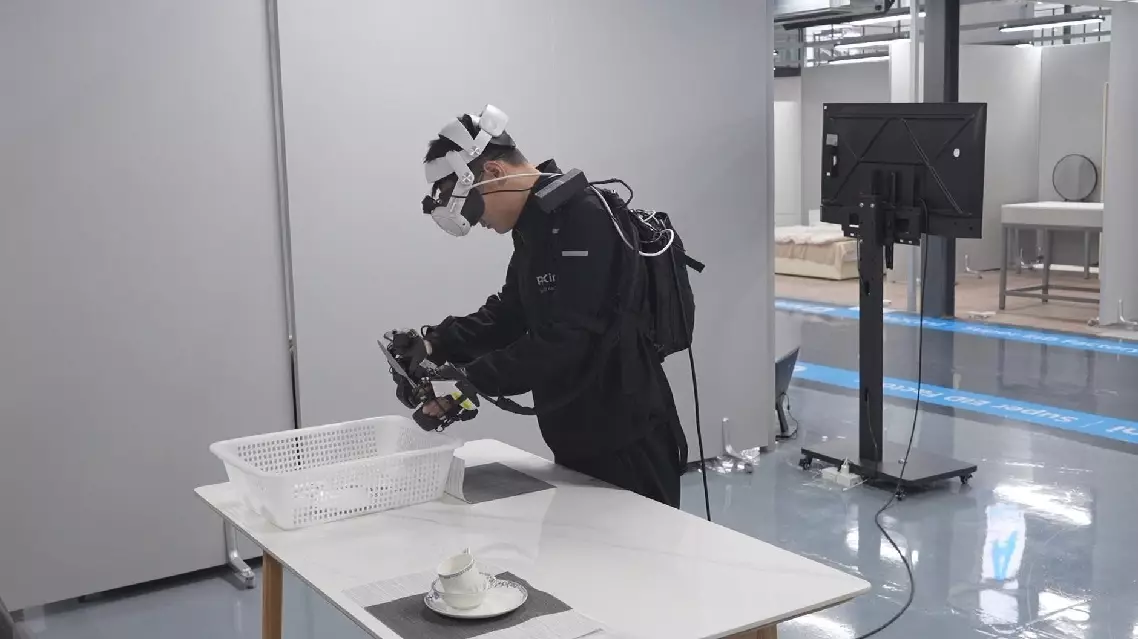
In east China’s Jiangsu Province, a data training center has enlisted young collectors equipped with sensors to coach robots into becoming "workers".
"The scene I'm working on right now involves the arrangement of tableware—some of the most basic tasks for a restaurant server," said Xu Yinsong, a robot data collector.
By repeating simple movements across different positions tens of thousands of times, collectors compile the extensive information that trains humanoid robots.
The latest training devices, fitted with over 3,000 contact points, record 80 dimensions of information such as hardness, softness and surface texture, boosting robots’ perception and action planning.
"Traditional data collection relies on humans remotely controlling robots, which is inefficient and expensive, and lacks tactile information - it merely mechanically repeats actions. Our device functions like nerve endings and human skin, collecting human's sensations from vision to touch throughout the entire process," explained Li Zhongzhi, the technical lead.
Partnering with Xu Yansong is Ye Shuai, who is tasked with verifying whether the collected actions qualify as usable training data.
"The data collected by our collectors isn't always 100 percent accurate. If the task requires the left hand but the collector uses the right hand or doesn't complete the action, we will judge it as incorrect. If the task is completed perfectly, we classify it as qualified data. In the end, we 'feed' both types of data to our humanoid robots. Like children learning, the robots will understand not just what is correct but also what is wrong," said Ye.
Currently, numerous real-world data collection bases are being established across the country. The national coordinated cluster has accumulated over 20 million pieces of localized data so far.
In the first four months of 2026 alone, more than eight million new pieces were added—an increase of over 120 percent compared to the same period last year. It is projected that China's humanoid robot market will reach 400 billion yuan in the next five years, creating over one million new jobs, including data collection technicians and robot swarm collaborative operators.
China’s humanoid robot boom creates wave of data‑driven jobs