Skip to Content Facebook Feature Image

Mainland coastal city attracts Taiwan visitors during May Day holiday

China

China

China

Mainland coastal city attracts Taiwan visitors during May Day holiday

2026-05-04 15:58 Last Updated At:18:57

The Chinese mainland's eastern coastal city of Xiamen in Fujian Province, which is situated opposite the Taiwan island, has attracted many visitors from Taiwan to immerse themselves in Minnan traditions and explore their shared cultural roots with the local region during the May 1-5 May Day holiday season.

The Minnan culture, also known as the Hokkien culture, is a distinct Han Chinese regional culture originating from southern Fujian (Quanzhou, Zhangzhou, Xiamen), characterized by its unique dialect, maritime trading history, and profound influence in the Taiwan region and Southeast Asia.

Visitors are drawn to cultural attractions such as the leading theme park in the city, where southern Fujian traditions are brought to life through restored architecture and immersive performances.

Performances and settings at the park recreated scenes from a century ago, evoking the struggles of overseas Chinese and their patriotic spirit -- a theme that resonated strongly with many Taiwan visitors.

"I work in Taipei, but I come to Xiamen quite often. Things here evoke some childhood memories, which is quite nice," said Huang Mu-Chuan, a visitor from Taiwan.

Food stalls featuring Minnan specialties also draw crowds.

"Minnan and Taiwan share the same roots and origins, and there are many common flavors in cuisine. So we hope through such familiar memories and symbols, people in the Mainland can better understand the deep culture bond between Minnan and Taiwan. Both sides of the Taiwan Strait are one family, and we are all Chinese people with the same roots and origins," said Lin Mu-chen, another visitor from Taiwan.

Mainland coastal city attracts Taiwan visitors during May Day holiday

Mainland coastal city attracts Taiwan visitors during May Day holiday

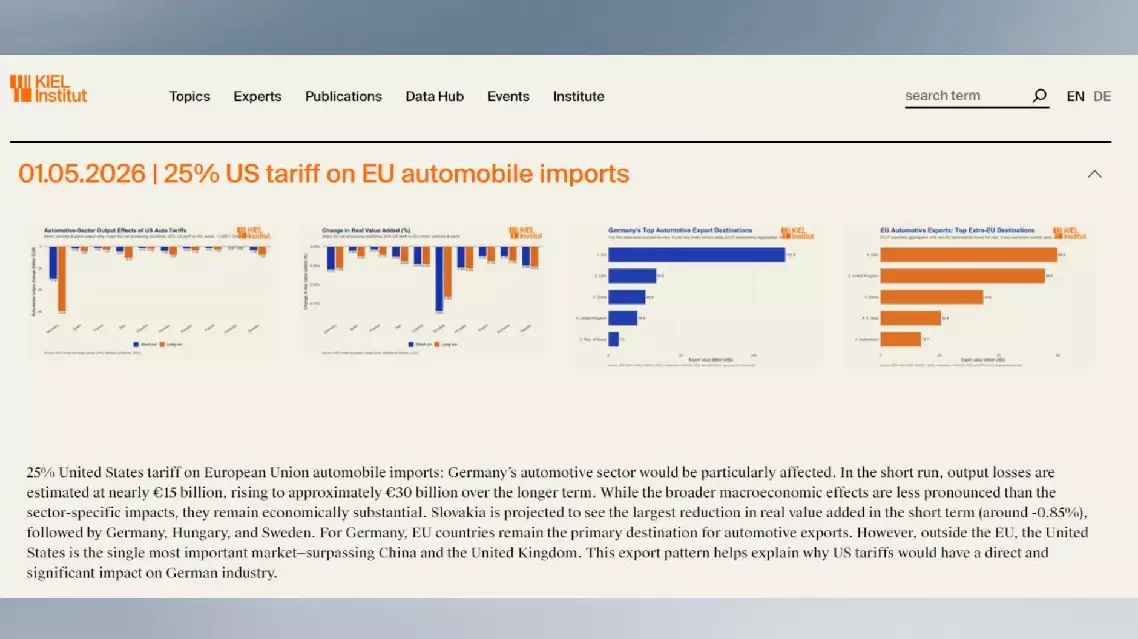
The Kiel Institute recently warned that the German auto industry could lose 15 billion euros (about 17.6 billion U.S. dollars) in short term from the 25 percent U.S. tariffs on cars of the European Union (EU).

The Kiel Institute, one of Germany's top five economic research institutions, reported on May 1 that the European automotive supply chain remains highly vulnerable to trade conflicts. According to its analysis, new U.S. car tariffs could result in short-term losses of 15 billion euros for Germany's auto sector, with long-term losses potentially reaching 30 billion euros.

In 2025, Germany exported approximately 3.17 million passenger cars, of which nearly 410,000 went to the United States, down nine percent year on year, according to the German Automotive Industry Association.

U.S. President Donald Trump said on May 1 on Truth Social that the EU was not complying with a trade agreement, and announced he will raise tariffs on European cars and trucks to 25 percent.

In response, the European Commission -- the executive arm of the 27-nation EU -- said it will keep options open to protect the EU's interests. A European Commission spokesperson said on the same day that the EU is implementing the relevant trade agreements in line with standard legislative procedures, and continues to keep the U.S. side fully informed throughout.

Leading research institution warns German auto industry could sustain heavy loss due to U.S. tariff hike

Leading research institution warns German auto industry could sustain heavy loss due to U.S. tariff hike

Recommended Articles