Skip to Content Facebook Feature Image

Hainan duty‑free sales surge in May Day holiday

China

China

China

Hainan duty‑free sales surge in May Day holiday

2026-05-04 15:46 Last Updated At:18:37

Duty‑free malls in south China's Hainan are reporting a sharp holiday surge, with steep discounts and themed events pulling in tens of thousands of May Day shoppers.

The island’s renewed status as a top domestic travel destination has translated into brisk sales and packed duty‑free halls during the five-day holiday.

Compared with ordinary days, duty‑free malls in Hainan have seen a marked increase in shoppers during this year's holiday. To boost spending enthusiasm, venues staged dance shows and interactive games, while steep discounts kept cosmetics and electronics in strong demand.

"I've been checking out electronics like phones and watches. I asked around at several shops. The discounts are really good, and many items are already selling out," said Liu Xiangjin, a visitor.

"We've launched a number of cross-over activities. For sports enthusiasts, we have a fun run and basketball shooting games. Discounts are as low as 70 percent off, making this May Day holiday a truly 'happy shopping' experience," said Wei Yingying, sales supervisor of Hainan-based Global Duty-Free (GDF) Plaza.

Hainan's offshore duty‑free sales reached 209 million yuan (about 30.6 million U.S. dollars) over May 1‑2, with 34,000 shopping trips averaging 6,129 yuan each, Haikou Customs reported.

That marked year‑on‑year increases of 7.2 percent in sales, 5.9 percent in visitor numbers, and 0.9 percent in per‑capita spending. To meet demand, customs authorities said they are cutting delivery times for duty‑free goods to keep supplies stable during the holiday.

Hainan duty‑free sales surge in May Day holiday

Hainan duty‑free sales surge in May Day holiday

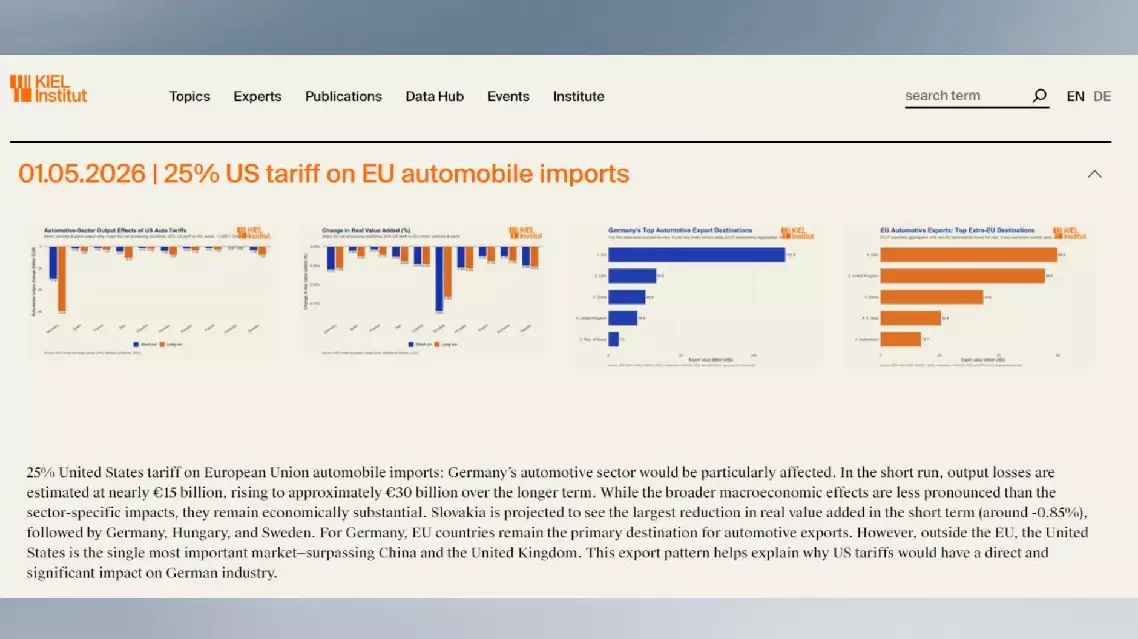
The Kiel Institute recently warned that the German auto industry could lose 15 billion euros (about 17.6 billion U.S. dollars) in short term from the 25 percent U.S. tariffs on cars of the European Union (EU).

The Kiel Institute, one of Germany's top five economic research institutions, reported on May 1 that the European automotive supply chain remains highly vulnerable to trade conflicts. According to its analysis, new U.S. car tariffs could result in short-term losses of 15 billion euros for Germany's auto sector, with long-term losses potentially reaching 30 billion euros.

In 2025, Germany exported approximately 3.17 million passenger cars, of which nearly 410,000 went to the United States, down nine percent year on year, according to the German Automotive Industry Association.

U.S. President Donald Trump said on May 1 on Truth Social that the EU was not complying with a trade agreement, and announced he will raise tariffs on European cars and trucks to 25 percent.

In response, the European Commission -- the executive arm of the 27-nation EU -- said it will keep options open to protect the EU's interests. A European Commission spokesperson said on the same day that the EU is implementing the relevant trade agreements in line with standard legislative procedures, and continues to keep the U.S. side fully informed throughout.

Leading research institution warns German auto industry could sustain heavy loss due to U.S. tariff hike

Leading research institution warns German auto industry could sustain heavy loss due to U.S. tariff hike

Recommended Articles