Skip to Content Facebook Feature Image

Leading research institution warns German auto industry could sustain heavy loss due to U.S. tariff hike

China

China

China

Leading research institution warns German auto industry could sustain heavy loss due to U.S. tariff hike

2026-05-04 17:21 Last Updated At:18:07

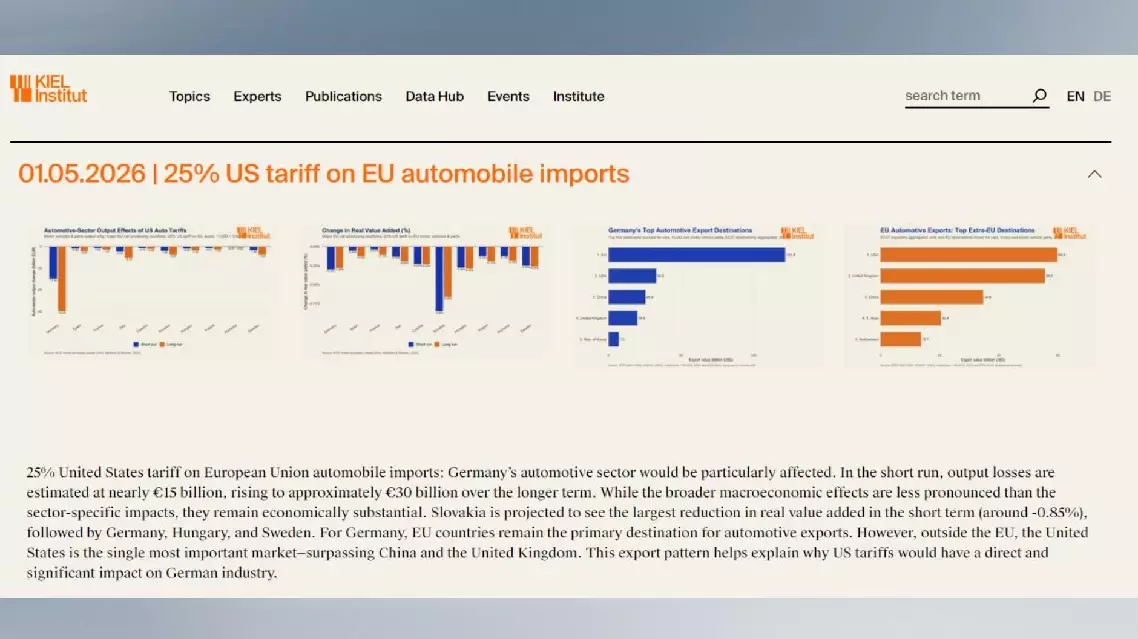
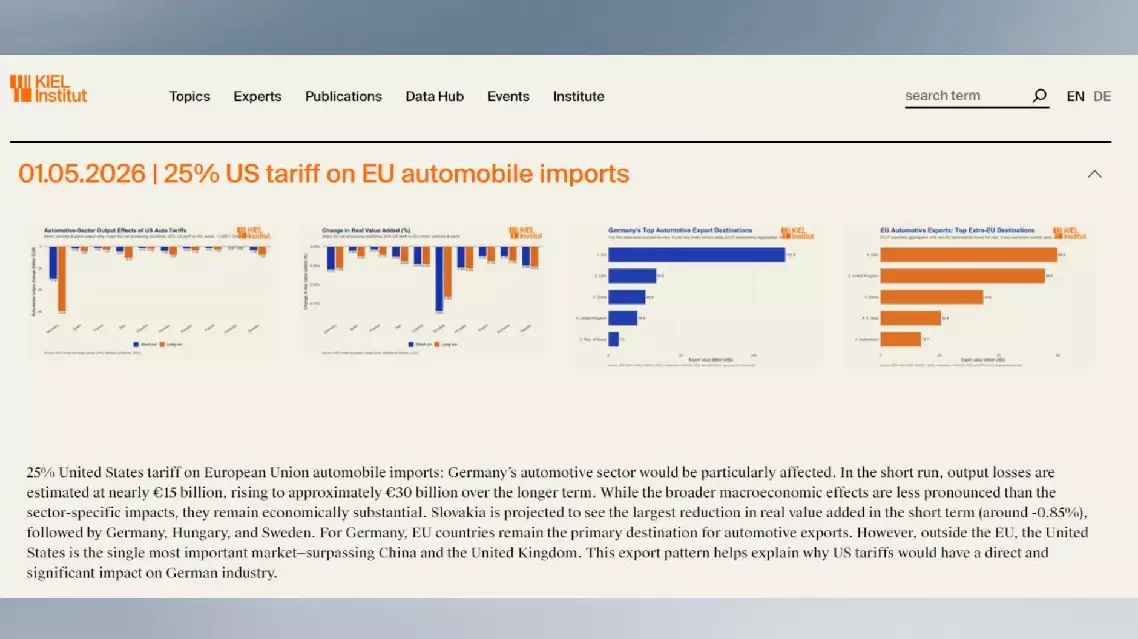
The Kiel Institute recently warned that the German auto industry could lose 15 billion euros (about 17.6 billion U.S. dollars) in short term from the 25 percent U.S. tariffs on cars of the European Union (EU).

The Kiel Institute, one of Germany's top five economic research institutions, reported on May 1 that the European automotive supply chain remains highly vulnerable to trade conflicts. According to its analysis, new U.S. car tariffs could result in short-term losses of 15 billion euros for Germany's auto sector, with long-term losses potentially reaching 30 billion euros.

In 2025, Germany exported approximately 3.17 million passenger cars, of which nearly 410,000 went to the United States, down nine percent year on year, according to the German Automotive Industry Association.

U.S. President Donald Trump said on May 1 on Truth Social that the EU was not complying with a trade agreement, and announced he will raise tariffs on European cars and trucks to 25 percent.

In response, the European Commission -- the executive arm of the 27-nation EU -- said it will keep options open to protect the EU's interests. A European Commission spokesperson said on the same day that the EU is implementing the relevant trade agreements in line with standard legislative procedures, and continues to keep the U.S. side fully informed throughout.
Leading research institution warns German auto industry could sustain heavy loss due to U.S. tariff hike
Leading research institution warns German auto industry could sustain heavy loss due to U.S. tariff hike
Th only two wig companies exhibiting at the ongoing third phase of the 139th Canton Fair, in Guangzhou, capital city of south China's Guangdong Province, have been receiving increasing orders from overseas purchasers.

The booths of the wig companies were set at the personal care area of the fair. Despite being the sector with the fewest participating enterprises, it attracted a large crowd of overseas purchasers.

"Very good. It's a very good material. It's my first time trying to do a side wig. I think that is very good," said Juliana, an Argentine purchaser.

Sylvia, a U.S. purchaser, carefully examined the wig samples and compared the texture of the hair strands.

She has long been engaged in the hair extensions business and came to the Canton Fair to build connections with suppliers.

"To be honest, the virgin hair, the non-processed hair, is of pretty good-quality," said Sylvia.

The two enterprises said they had secured more than 100 tentative orders, and many of their exhibits had already been sold out.

"Many clients immediately placed the orders. We also exchanged contact information with a large number of customers, who plan to visit our factory after the fair," said Duan Tingting, an exhibitor.

China's wig industry accounts for nearly 80 percent of the global market share. It is the world's largest wig manufacturing and export base with the most complete industrial chain and strongest competitiveness.

The Canton Fair, officially known as the China Import and Export Fair, is held every spring and autumn in Guangzhou since its founding in 1957, and has been seen as a barometer of China's foreign trade. The third phase of the 139th Canton Fair runs from May 1 to 5.

Wig industry receives increasing overseas orders at Canton Fair

Wig industry receives increasing overseas orders at Canton Fair

Recommended Articles