China's cargo spacecraft Tianzhou-10, which was launched from the Wenchang Spacecraft Launch Site on Monday morning, sent samples of low-cost solar cell to the space station, with research data to be collected for supporting development of commercial aerospace, space computing power, and space photovoltaic industry.
The flexible encapsulated monocrystalline silicon solar cell was developed by Shanghai Institute of Microsystem and Information Technology (SIMIT), a research center under the Chinese Academy of Sciences.
The solar cell samples will be placed on the materials experiment platform at the Tiangong space station and will be used for conducting on-orbit experiments related to space particle irradiation, ultraviolet irradiation, and atomic oxygen environment.
Compared with gallium arsenide batteries currently dominant in aerospace, this flexible encapsulated monocrystalline silicon solar cell features light weight and thin profile.
Weighing less than one kilogram per square meter, it delivers lower launch costs and costs only one-tenth of gallium arsenide batteries.
"China has been building satellite constellation, including the Qianfan Constellation, and plans to launch at least 203,000 internet satellites. This means a much higher demand for energy and since the monocrystalline silicon solar cell is low-cost, it can be widely applied in commercial aerospace in the future. In particular, as China has been promoting development of satellite internet, space-based computing and space photovoltaics, we are also helping lay a solid foundation for this and our technology has a clear goal for application," said Liu Zhengxin, a researcher at SIMIT.
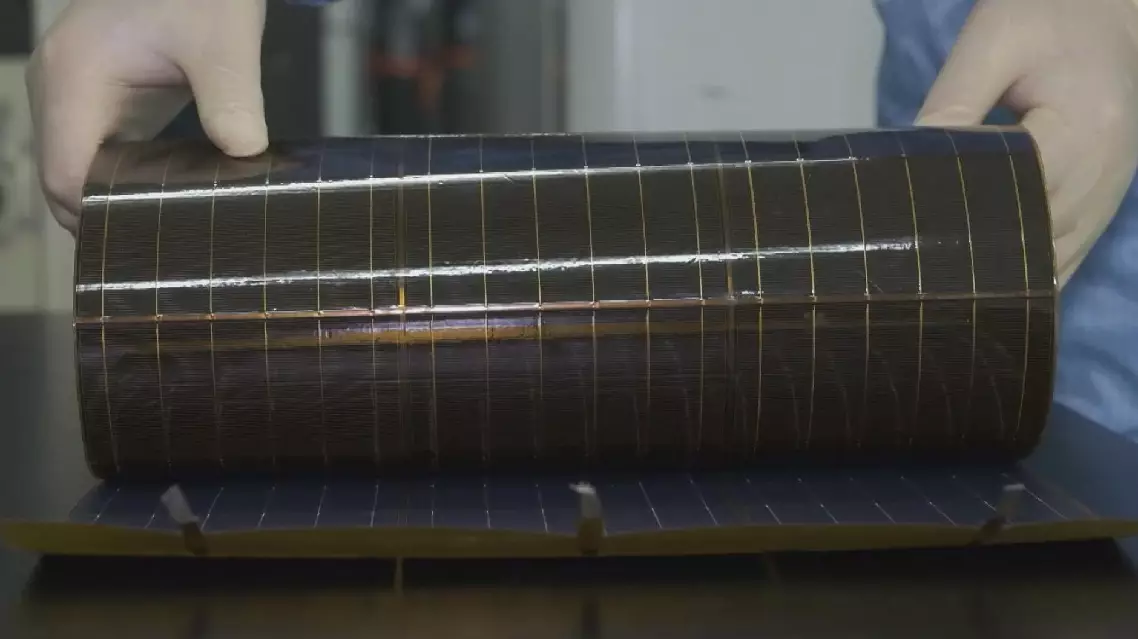
China's Tianzhou-10 cargo craft sends low-cost solar cells to space station