WILMINGTON, Del.--(BUSINESS WIRE)--May 15, 2026--
The LYCRA Company, a global leader in innovative and sustainable fiber solutions for the personal care industry, and Dukane, a manufacturer of ultrasonic bonding technologies for the hygiene and nonwovens market, are showcasing their latest co-developed advances in ultrasonic bonding at INDEX™ 26, taking place in Geneva, Switzerland, from May 19–22.
This press release features multimedia. View the full release here: https://www.businesswire.com/news/home/20260515514441/en/
Since 2014, both companies have collaborated to advance ultrasonic bonding solutions that help diaper manufacturers improve product softness, fit, and performance while reducing energy consumption, material waste, and maintenance costs. Ultrasonic bonding creates bonded channels between two layers of nonwoven materials, mechanically securing elastic fibers without using adhesives. Dukane’s patented rotary and rigid ultrasonic bonding systems enable high-speed, adhesive-free assembly by delivering precisely controlled ultrasonic energy into nonwoven substrates.
LYCRA FUSION™ fiber, originally developed to prevent snags in hosiery from turning into runs, can now fuse to nonwoven layers during ultrasonic bonding. Its sheath/core construction fuses with surrounding materials, strengthens ultrasonic bonds, and delivers superior yarn creep (snapback). When this fiber is paired with Dukane’s advanced ultrasonic bonding modules, manufacturers can achieve precise elastic placement, improved bond integrity, and consistent product performance while eliminating the variability associated with hot-melt adhesives.
“As ultrasonic bonding gains traction in the hygiene industry, our longstanding collaboration with Dukane focuses on expanding technical capabilities while preparing for commercial scale-up,” said Doug Kelliher, executive vice president, product, The LYCRA Company. “We’re excited to introduce LYCRA FUSION™ fiber for personal care, which provides excellent performance with fewer breaking points and improved bond integrity during the ultrasonic bonding process.”
Building on this shared commitment to innovation, The LYCRA Company and Dukane are aligning fiber development with ultrasonic process engineering to support broader adoption of adhesive‑free elastic attachment in nonwovens.
“From ultrasonic lamination to precision sealing and cutting, our technologies are engineered for consistent quality, global scalability, and sustainable production,” said Justin Lafferty, global product development manager - nonwovens, Dukane. “By advancing ultrasonic bonding with LYCRA FUSION™ fiber, we’re helping customers improve product performance while enabling more efficient production.”
Explore more hygiene and nonwovens solutions at The LYCRA Company stand ( 2151 ) and the Dukane stand ( 1568 ) at INDEX™ 26.
About The LYCRA Company
The LYCRA Company innovates and produces fiber and technology solutions for the apparel and personal care industries and owns the leading consumer brands: LYCRA ®, LYCRA HyFit ®, LYCRA ® T400 ®, COOLMAX ®, THERMOLITE ®, ELASPAN ®, SUPPLEX ® and TACTEL ®. Headquartered in Wilmington, Delaware, U.S., The LYCRA Company is recognized worldwide for its sustainable products, technical expertise, and marketing support. The LYCRA Company focuses on adding value to its customers’ products by developing unique innovations designed to meet the consumer’s need for comfort and lasting performance. Learn more at thelycracompany.com.
About Dukane
Headquartered in St. Charles, DUKANE is a global leader in ultrasonic bonding technologies for the hygiene and personal care industries. Unlike single-approach bonding systems, Dukane offers a range of ultrasonic bonding modules designed to replace adhesive-based processes in hygiene and personal care manufacturing. Manufacturers can select the right bonding technology based on product design, production speed, and long-term operational goals. Dukane’s flexible platform supports intermittent and continuous bonding, as well as blade and rotary technologies, without locking manufacturers into a single technology path. Learn more at dukane.com/nonwoven.

Join The LYCRA Company and Dukane at INDEX™ 26 in Geneva, as they showcase their latest advances in ultrasonic bonding for nonwovens, including new LYCRA FUSION™ fiber for personal care that delivers superior snapback.
NEW YORK (AP) — The U.S. stock market is falling from its records Friday and joining a worldwide drop for stocks, as higher oil prices send a shiver through the bond market. Stocks that had been caught up in the euphoria around artificial-intelligence technology led the way lower.
The S&P 500 fell 0.9% from its all-time high set the day before. The Dow Jones Industrial Average was down 428 points, or 0.9%, as of 11 a.m. Eastern time, and the Nasdaq composite was down 1.3% from its own record.
Technology stocks tumbled in a sharp turnaround from their meteoric rises for much of the year, which had carried markets worldwide to records but also raised criticism that they had gone too far.
Nvidia, the stock that quickly became the face of the AI revolution, dropped 4.2% and was the heaviest weight on the S&P 500. It had come into the day with a gain of more than 26% for the year so far.
Applied Materials fell 1.3% even though it reported stronger profit growth for the latest quarter than analysts expected, thanks to the global build out of AI. The company, whose products help make chips and displays, came into the day with a gain of more than 70% for the year so far.
“To us, it looks like markets have pushed into overbought territory,” according to Brian Jacobsen, chief economic strategist at Annex Wealth Management. He said the strong corporate profits and durable U.S. economy that launched U.S. stocks to records remain intact, but “the path is unlikely to be smooth. Periods like this call for discipline more than hope.”
In the meantime, rising oil prices are raising the pressure after already worsening inflation by more than economists had feared. The war with Iran is continuing, and the Strait of Hormuz remains shut to oil tankers, which is preventing them from delivering crude to customers worldwide and driving up oil’s price.
The price for a barrel of Brent crude oil, the international standard, rose 3.3% to $109.16 and is well above its level of roughly $70 from before the war.
Many big U.S. companies have been saying their customers have been able to keep spending on their products and services despite having to pay higher prices for gasoline. But U.S. households have also been telling surveys they’re feeling discouraged about the economy and the pressures building on them because of the war and tariffs.
The worries were most clear Friday in the bond market, where Treasury yields climbed. The yield on the 10-year Treasury rose to 4.57% from 4.47% late Thursday. That’s a notable move for the bond market, and it’s well above its 3.97% level from before the war. The yield on the 30-year Treasury is near its highest level since 2023 after breaking above 5%.
Higher yields can make mortgages and other kinds of loans going to U.S. households and businesses more expensive, which slows the economy. They also tend to push downward on prices for stocks and all kinds of other investments.
Stocks of smaller companies had some of Friday’s sharpest drops. Many of them need to borrow cash to grow, which means higher borrowing costs can hurt them more than their big rivals. The Russell 2000 index of the smallest U.S. stocks fell 2.2%, more than double the S&P 500’s loss.
Yields have been climbing since the war on worries about higher inflation and how it may tie the Federal Reserve’s hands when it comes to short-term interest rates. Not only have traders abandoned virtually all expectations that the Fed will resume its cuts to interest rates this year, they’ve been building some bets that it may even hike rates in 2026, according to data from CME Group.
A couple of reports on the U.S. economy that came in better than expected also helped to lift yields. One said U.S. industrial production improved by more last month than economists expected, while another said manufacturing in New York state is expanding at a faster rate.
In stock markets abroad, indexes fell sharply across Europe and Asia.
South Korea’s Kospi dropped 6.1% for one of the biggest moves. It had been reaching records this year because of the influence of AI beneficiaries like SK Hynix. But it quickly reversed momentum Friday after briefly topping the 8,000 level for the first time.
Some on Wall Street have been warning about a possible break in momentum for tech stocks in general and AI winners in particular.
“If nothing else this should be a ‘shot across the bow’ for how volatility works both ways,” according to Jonathan Krinsky, chief market technician at BTIG.
AP Business Writer Chan Ho-him contributed.

Trader Patrick Casey works on the floor of the New York Stock Exchange, Wednesday, May 13, 2026. (AP Photo/Richard Drew)

President Donald Trump, left, walks with Chinese President Xi Jinping at the Temple of Heaven on Thursday May 14, 2026, in Beijing. (AP Photo/Mark Schiefelbein)
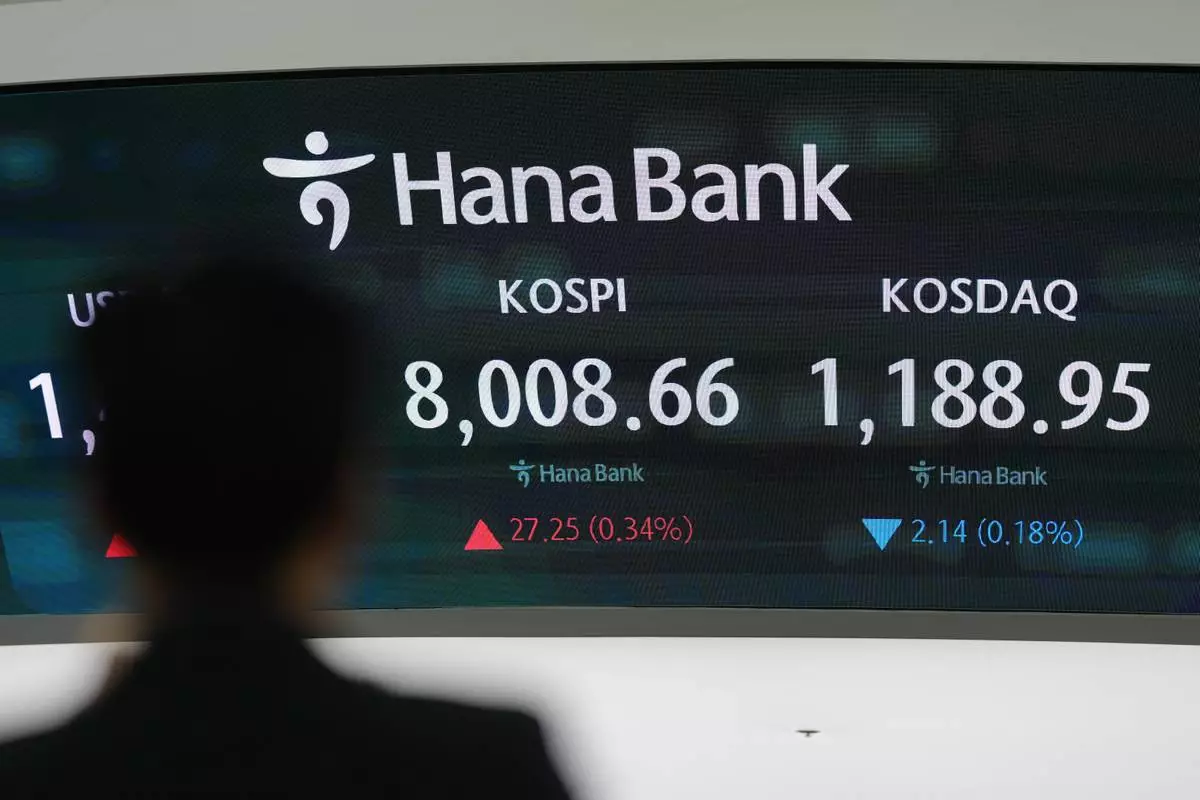
A dealer stands near the screens showing the Korea Composite Stock Price Index (KOSPI), and the Korean Securities Dealers Automated Quotations (KOSDAQ) at a dealing room of Hana Bank in Seoul, South Korea, Friday, May 15, 2026. (AP Photo/Lee Jin-man)

Employees of Hana Bank celebrate in a photo-op to mark the Korea Composite Stock Price Index (KOSPI) of over 8,000 points at a dealing room of Hana Bank in Seoul, South Korea, Friday, May 15, 2026. (AP Photo/Lee Jin-man)