Artificial intelligence (AI) is transforming football at the 2026 FIFA World Cup, reshaping play, officiating and security in ways never before seen at the sport’s biggest stage.
The expanded 2026 tournament is set to be the biggest ever World Cup, featuring a record number of teams and matches, and seeing the competition hosted by three nations for the first time, with matches taking place in Mexico, Canada and the United States from June 11 to July 19.
The tournament is widely regarded by many in the science and technology and sports industries as the first "World Cup deeply involved with AI."
Video Assistant Referee (VAR) and Semi-Automated Offside Technology (SAOT) have been used in football for years, and at the 2026 World Cup, they have been upgraded again.
For real-time data collection, the match ball is embedded with sensors that can accurately track the ball's trajectory, speed, spin and the player who touched it.
Meanwhile, high-definition cameras placed around the pitch track the real-time positions of 29 skeletal key points on each player throughout the match.
A core technological innovation at 2026 World Cup is the large-scale application of digital twin technology in match officiating.
FIFA has built high-precision 3D digital twin models for all players and deeply integrated them into the VAR decision-making system. When controversial calls such as offside or goal validity arise, the system automatically generates accurate 3D visual animations that are integrated into the live broadcast, clearly showing the basis for the decision and minimizing disputes.
The World Cup has debuted live feeds from referees' perspective. Using AI-powered real-time stabilization and image correction, the system effectively suppresses camera shake from body-worn cameras and corrects dynamic distortion.
These referee cameras have already been used in major football leagues worldwide, and all 104 matches of this World Cup will feature them, offering fans an on-pitch view that makes them feel as if they are actually on the field.
A dedicated football AI super-agent, based on massive match data, can rapidly analyze over 2,000 professional indicators, providing tactical breakdowns, opponent assessments and real-time formation suggestions for coaches and technical analysts of all 48 teams.
This system breaks down traditional data barriers in football, allowing teams to equally share top-tier match analysis capabilities, truly democratizing football science and technology.
Notably, the deployment of many AI science and technology innovations at this World Cup owes much to the solid support of Chinese science and technology companies.
Lenovo, a Chinese multinational technology company, as an official FIFA technology partner, provides hardware, AI algorithms and operational support for core systems including AI officiating, data computing and smart broadcasting, making it one of the key technology providers for this "AI World Cup."
Smart security and venue operations are also impressive off the pitch.
During the World Cup, multiple intelligent robotic dogs have been deployed at the International Broadcast Center in Dallas of Texas and the MetLife Stadium in New Jersey. These robotic dogs are equipped with high-definition cameras, infrared thermal imaging, multi-dimensional environmental sensors and other smart sensing devices.
They can autonomously plan patrol routes, carry out round-the-clock unmanned inspections, accurately identify security risks such as abnormal human behavior or environmental hazards, and send real-time alerts, providing safety assurances for the smooth operation of the event and global broadcasts. In Monterrey, Mexico, local police have also deployed robotic dogs to assist in security, further enhancing the safety capacity of the tournament.
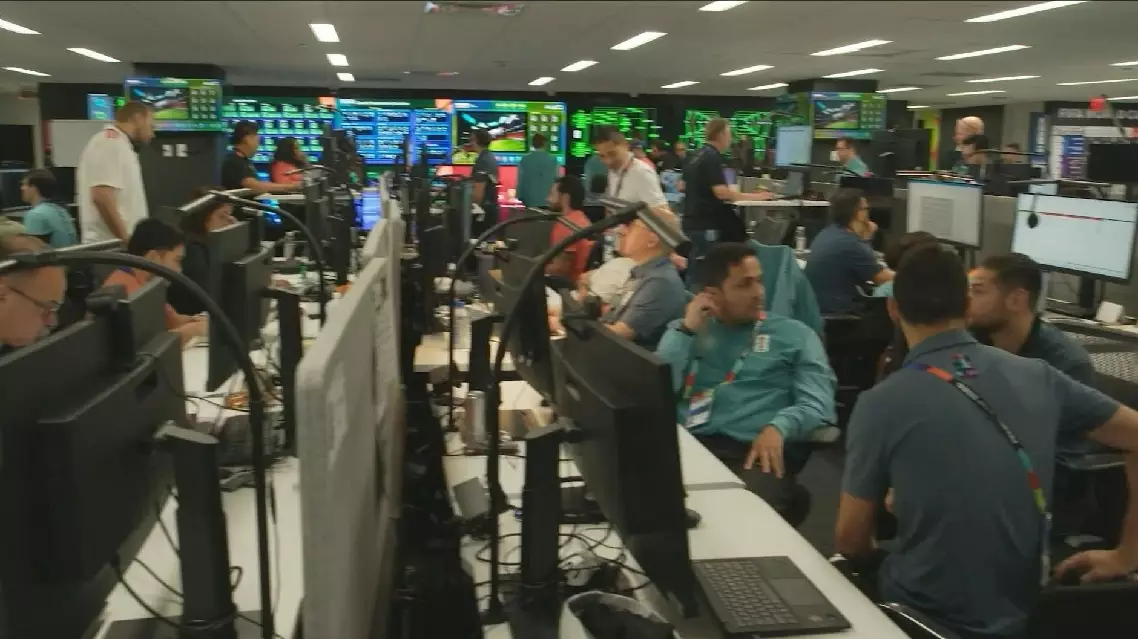
AI reshapes football, fan experience at 2026 FIFA World Cup